

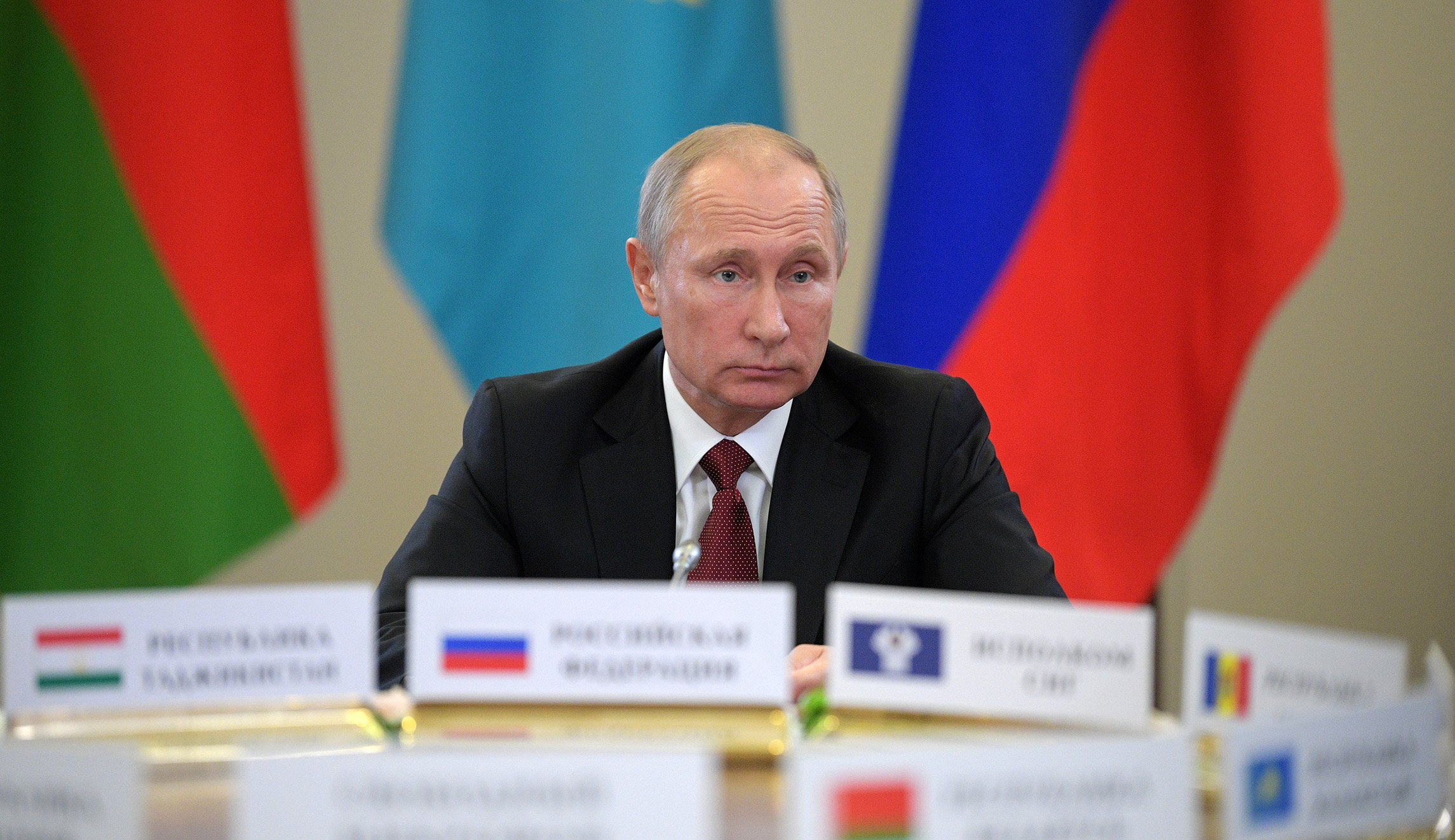
President Trump’s attitudes toward Iran and Israel are putting Russian President Vladimir Putin in the unusual position of echoing European argument against American foreign policy.
Trump’s effort to adopt a posture more aggressive toward Iran and favorable toward Israel puts him out of step with Russia and leading European powers. His expected decision to declare the Iran nuclear deal inconsistent with U.S. national security interests is the most notable example of that shift, which Russia opposes. And that places Putin, who is reviled in Western foreign policy circles for his invasion of Ukraine and desire for “a post-West world order,” in the role of the world’s leading non-European internationalist, for this week at least.
Recommended Stories


Russian Foreign Minister Sergey Lavrov told the Trump administration to “adhere to the plan” in a Thursday evening call with Secretary of State Rex Tillerson, just as British Foreign Minister Boris Johnson did Tuesday.
“Given the status of this agreement, including the decision to approve it by the supreme body responsible for security measures in the modern world, it is difficult for me to imagine how it is possible to legally withdraw from an agreement that is a product of collective work recognized by everyone as a binding international legal act,” Lavrov told reporters Thursday.
That’s not the only disagreement of the week. Lavrov’s team joined the United Nations in faulting the United States for deciding to withdraw from UNESCO, a cultural agency that the Trump administration believes is marred by persistent bias against Israel.
“This decision by the United States evokes regret,” Foreign Ministry spokeswoman Maria Zakharova said Thursday. “A country that was one of the founders of UNESCO is quitting it at a time that is difficult for this organization and is thereby aggravating its position … and wrecking the implementation of many major projects.”
That rebuke echoed the UNESCO director-general’s response to the move, as well as the German government’s belief that the withdrawal sends the “completely wrong signal at this point,” per Culture Minister Monika Grütters.
But the Iran deal is the chief issue of the week. Russian and European officials have favored sticking with the Iran deal, which they negotiated jointly with Iran and President Barack Obama’s team. Russia’s reasons for supporting the deal have raised suspicions at times, even from Democratic lawmakers who also believe that Trump should not walk away.
“Russia and Iran have collaborated, it’s my belief that they collaborated all during the negotiations on the JCPOA [Joint Comprehensive Plan of Action] and I think that that’s — the old line of the axis of evil, I think this is the axis of evil today,” Rep. Eliot Engel, D-N.Y., said in February. “And we have to confront it.”
Trump does not intend to withdraw from the agreement. Instead, he is expected to notify the Senate that the deal is not vital to U.S. interests in a process required by federal law. That move will set the stage for imposing the sanctions that the Obama administration waived under the agreement. But instead of applying the sanctions immediately, U.S. officials hope to use the imminent threat of the sanctions to force revisions to the agreement.
“He can’t be sure they’re complying because they won’t give access to certain critical military sites,” Sen. Tom Cotton, R-Ark., a leading proponent of Trump’s new Iran policy, told the Washington Examiner in a recent interview. “Even if they were complying with every single letter, word, and spirit of the JCPOA, it’s still not in our national security interests. We’ve seen them run wild over the last two years.”
The prospect of Trump arrayed against Putin and Europe on the merits of an international agreement might have seemed unlikely during the presidential campaign. But it suggests there are limits to the concessions he’ll make in pursuit of a better relationship with Russia.
“I hope that when Donald Trump begins to receive intelligence briefings of the nature that I’ve been reviewing for a year and a half now in the Intelligence Committee that he might have a slightly different perspective on Vladimir Putin, because Vladimir Putin is not a friend of the United States,” Cotton said during the Republican National Convention in 2016.
