

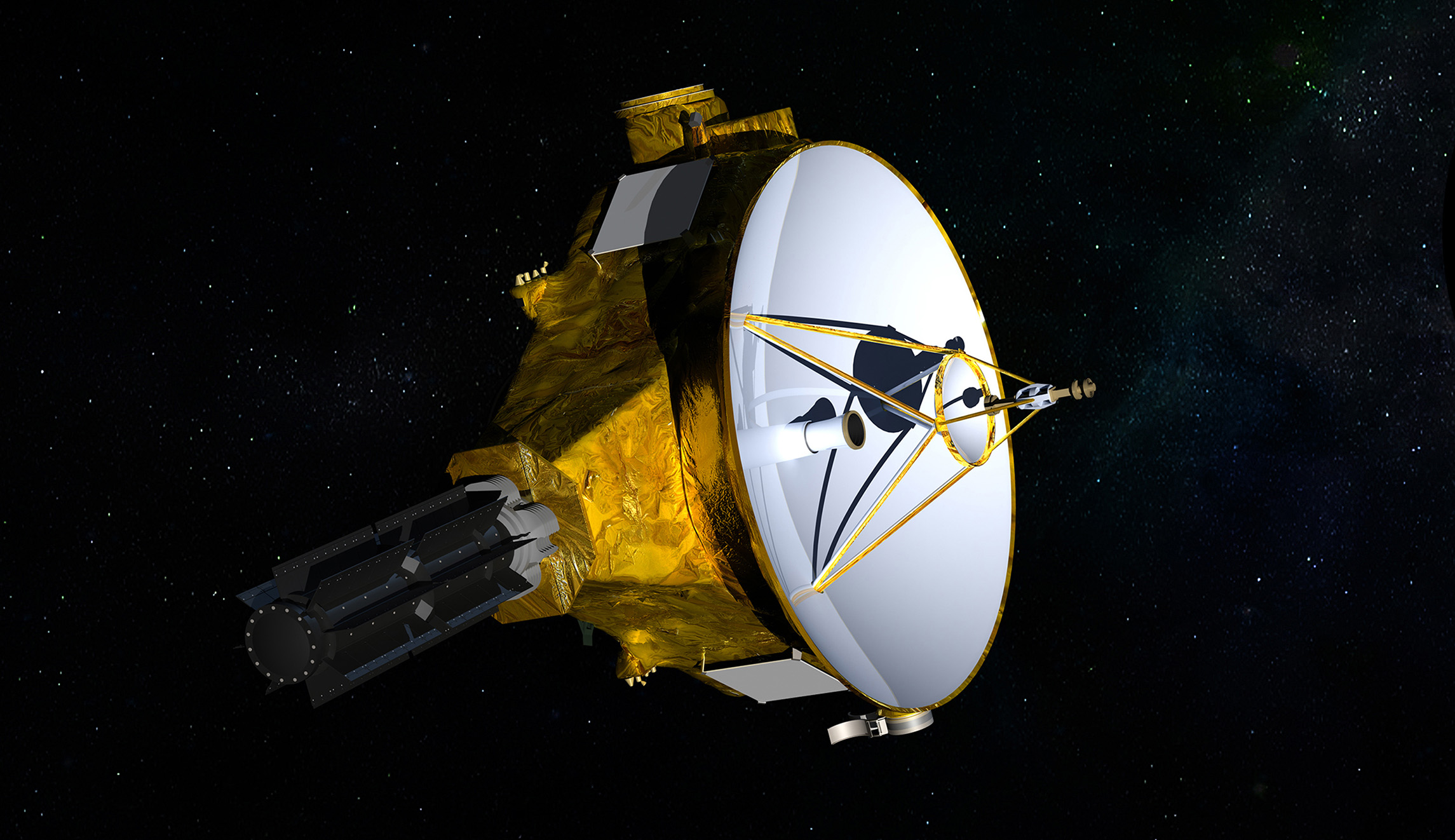
NASA’s New Horizons spacecraft phoned home on New Year’s Day after reaching and photographing the most distant object that humans have ever explored in the solar system.
The flyby in the early hours of Tuesday morning occurred 4 billion miles from Earth, at a small celestial body known as Ultima Thule, which is located a billion miles beyond Pluto. The New Horizons team, whose spacecraft launched in 2006 and notably gathered data from Pluto in 2015, said it plans to share the first high-resolution image from the spacecraft’s latest target on Wednesday.
Recommended Stories



Ultima Thule, whose name can be loosely translated as “farthest point,” is part of the Kuiper Belt, a ring in the outer regions of the solar system that NASA believes may hold keys to understanding the origin of the solar system as well as some aspects of Earth’s evolution. New Horizons will transmit more data from the encounter over time, giving scientists a progressively more complete picture.
“Everything looks great” so far, Alice Bowman, New Horizons’ mission operations manager, said in a Tuesday morning press briefing. “We are definitely looking forward to getting down this science data so all of our scientists and the world can see what the outer solar system — the origins of our solar system — have to hold for us, what surprises.”
NASA Administrator Jim Bridenstine celebrated the accomplishment, writing in a Twitter post: “This is what leadership in space exploration is all about.” American initiatives in space have been a priority for the Trump administration, whose Commerce Department has attempted to facilitate access for U.S. businesses as the president focuses on military dominance beyond Earth’s atmosphere.
Confirmed! @NASANewHorizons flew by the most distant object ever visited by a spacecraft. Congratulations to the New Horizons team, @JHUAPL and the Southwest Research Institute for making history yet again! pic.twitter.com/t47BOmo7c1
— Jim Bridenstine (@JimBridenstine) January 1, 2019
New Horizons began transmitting pre-arrival images, taken from about a million miles away from Ultima Thule, on New Year’s Eve, said Alan Stern, the team’s principal investigator. One of them, which shows an object resembling a bowling pin, tells scientists that the body may be either a cylindrical object with a lobe at either end or two spheres orbiting each other, he said.
The overnight vigil with the spacecraft’s team at Johns Hopkins University’s applied physics lab in Laurel, Md., where New Horizons was built and is controlled, was a “real thrill,” said mission engineer Chris Hersman.
As the craft drew progressively closer to its target, the mission team focused on the communications technician monitoring its feedback. “As soon as he started smiling, we knew things were going well,” Hersman said.
