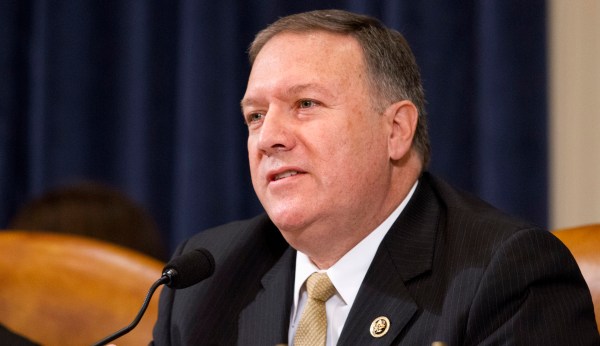
Chinese President Xi Jinping is establishing a “new evil empire,” a top senator warned Wednesday, aided by multinational and even American corporations despite the Communist regime’s disregard for human rights.
“[W]e must stop our own companies from helping China build this new evil empire,” Sen. Tom Cotton, R-Ark., said in a speech at the Hudson Institute. “This is the 21st century rope that capitalists will sell to hang themselves.”
Recommended Stories

The senator, whose assignments include the Select Committee on Intelligence and the Armed Services Committee, didn’t shy away from naming names, such as “Thermo Fisher Scientific, which sells the DNA sequencers China uses to build genetic dossiers on its ethnic minorities,” and “Google, which is performing cutting-edge AI research in China and contemplating even greater investment in that country.”
President Ronald Reagan famously used the phrase “evil empire” to describe the Soviet Union in a 1983 speech. Cotton’s reprise calls attention to the analogy American officials see between the rivalry with the USSR and contemporary U.S.-China relations, which have entered a “Cold War” phase, according to one prominent CIA officer. The Arkansas Republican issued his rebuke while discussing China’s brutal repression of the Uighur ethnic minority, which he believes foreshadows more bellicose posturing against the United States.
“China has a plan for the world, and it’s as concrete as the prison cells where it keeps dissenters,” Cotton said. ”Make no mistake: The brutal police tactics in Xinjiang are not just an assault on that province’s native people, although they’re surely that. They’re also an assault on the American-led world order and a disturbing premonition of an alternative world order — one controlled by the Chinese Communist Party and one that ends in Room 101.”
That last phrase was a reference to George Orwell’s 1984, and it’s not just Cotton who sees dystopian dangers in China’s use of technology for domestic repression and foreign espionage. The senator’s speech took place just minutes prior to a panel discussion at another think tank on the technological threats posed by Xi’s government, which has implemented a high-tech surveillance regime in Xinjiang Province, populated by Uighur Muslims.
“It should give us pause about the way that country would use data in the future,” Rob Strayer, a deputy assistant secretary of state and cybersecurity expert, said during a conversation at the Center for Strategic and International Studies. “It would be naive to think … [China] would treat our citizens better than it treats its own citizens.”
U.S. and allied powers have grown increasingly alarmed about the use of Chinese technology in Western telecommunications industries, particularly the popularity of smartphone makers Huawei and ZTE. American lawmakers identified the telecom companies as potential assets of Chinese spy services as early as 2012, which has led more recently to calls for the companies to be blocked from Western networks. The controversy raises the prospect of Chinese companies being expelled from Western communications systems, government officials allowed, although they stopped short of declaring a “tech Cold War” with Beijing.
“I don’t believe the U.S. is going to allow unfettered or unmitigated presence in our telecommunications network by a company controlled by a foreign power, with whom we have long-term strategic competition and questionable rule of law,” the Department of Homeland Security’s John Costello, a lead strategist at the Cybersecurity and Infrastructure Security Agency, said at CSIS. “I do not believe that anyone wants a bifurcated system, but we have to maintain our national security and our principles as a nation.”