

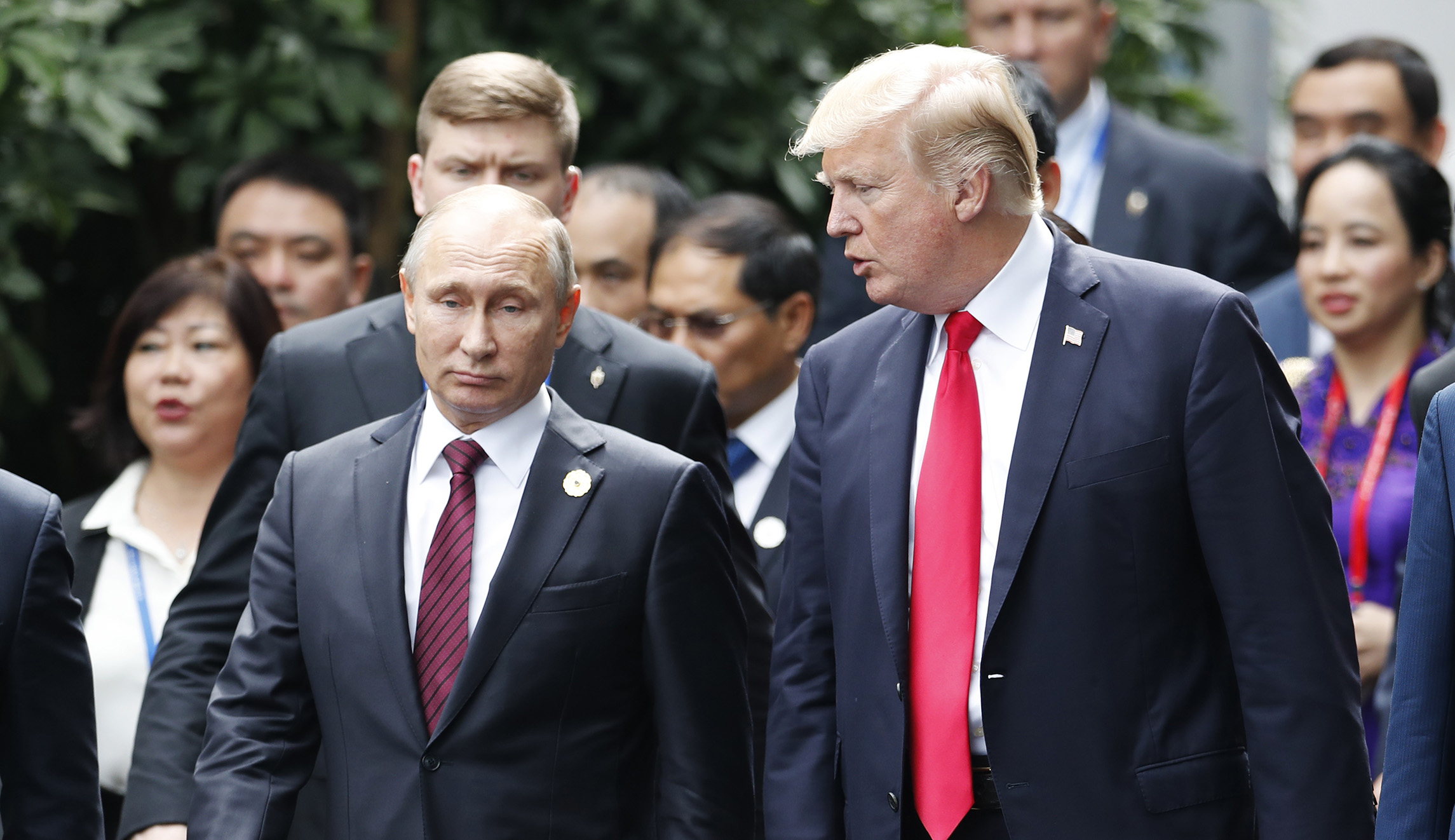
President Trump’s opposition to a controversial energy pipeline connecting Russia to western Europe has nothing to do with boosting sales for American gas companies, a senior State Department official argued Monday.
“U.S. opposition to Nord Stream 2 is rooted in our abiding concern that the pipeline presents broad geo-strategic threats to Europe’s security,” Frank Fannon, the assistant secretary of state for energy resources, told reporters Monday.
Recommended Stories


Secretary of State Mike Pompeo’s team has intensified opposition to the completion of the pipeline in the weeks since Russia seized three Ukrainian naval vessels. Western European countries agree that Russia poses a threat to the European Union and NATO powers, but German officials also believe that Trump is using national security measures — such as sanctions on Russian energy companies — to compel European allies to purchase American gas.
Fannon tried to allay that suspicion while arguing that Europe needs to have a diverse range of energy suppliers, beyond Russian influence.
“America’s call for diversification preceded our recent position as [a liquefied natural gas] exporter,” he said, making a point to praise a major European gas project. “Our steadfast support for the $40 billion-plus Southern Gas Corridor has spanned multiple administrations and continues today, despite the fact that there is no direct American investment in that project.”
That nod to “multiple administrations” is a reminder that the U.S. warnings about Russian energy products predate the inauguration of Trump, who used the threat of tariffs to negotiate a deal in which the EU agreed to increase U.S. natural gas purchases. Trump has also renewed sanctions that interfere with Europe’s ability to invest in the Iranian energy industry — a policy that stems from his dislike for the 2015 Iran nuclear deal and the Shia Muslim regime’s regional aggression.
Meanwhile, Congress mandated sanctions on Russia’s energy sector in response to Moscow’s aggression in Ukraine and Syria, as well as the 2016 election interference.
Russian President Vladimir Putin argues that these sanctions are little more than subsidies for American companies, at the expense of European consumers.
“I would call them particularly cynical because they amount to an obvious attempt to use one’s geopolitical advantages in the competitive struggle in order to protect one’s economic interests at the expense of one’s allies, as in this case,” Putin said of the Russian energy sanctions in 2017.
Fannon maintained that Putin is the one with the cynical position.
“Unlike the United States, Russia’s energy companies are an extension of the Russian state and the Russian state uses energy for coercive political aims,” he said. “Through Nord Stream 2, Russia seeks to increase its leverage over the West while severing Ukraine from Europe.”
