

It is said that the best gift a writer can have is an unhappy childhood: It will provide material for years to come. In the past, though, it seemed to be an early, doomed love affair that made the writer. Would Dante Alighieri have become simply Dante had he not had his first (and second-to-last) glimpse of Beatrice at the age of 9?
We might have heard of the polymath Johann Wolfgang von Goethe had he not, in his early 20s, fallen in love with the free-spirited Charlotte Buff. But it was the novel that this unrequited love produced, “The Sorrows of Young Werther,” that made him the first star of the Romantic period — and indeed, helped inaugurate the movement.
| On screen |
| ‘Young Goethe in Love’ |
| 2.5 out of 4 stars |
| Stars: Alexander Fehling, Miriam Stein, Moritz Bleibtreu |
| Director: Philipp Stoelzl |
| Rated: Not rated |
| Running time: 102 minutes |
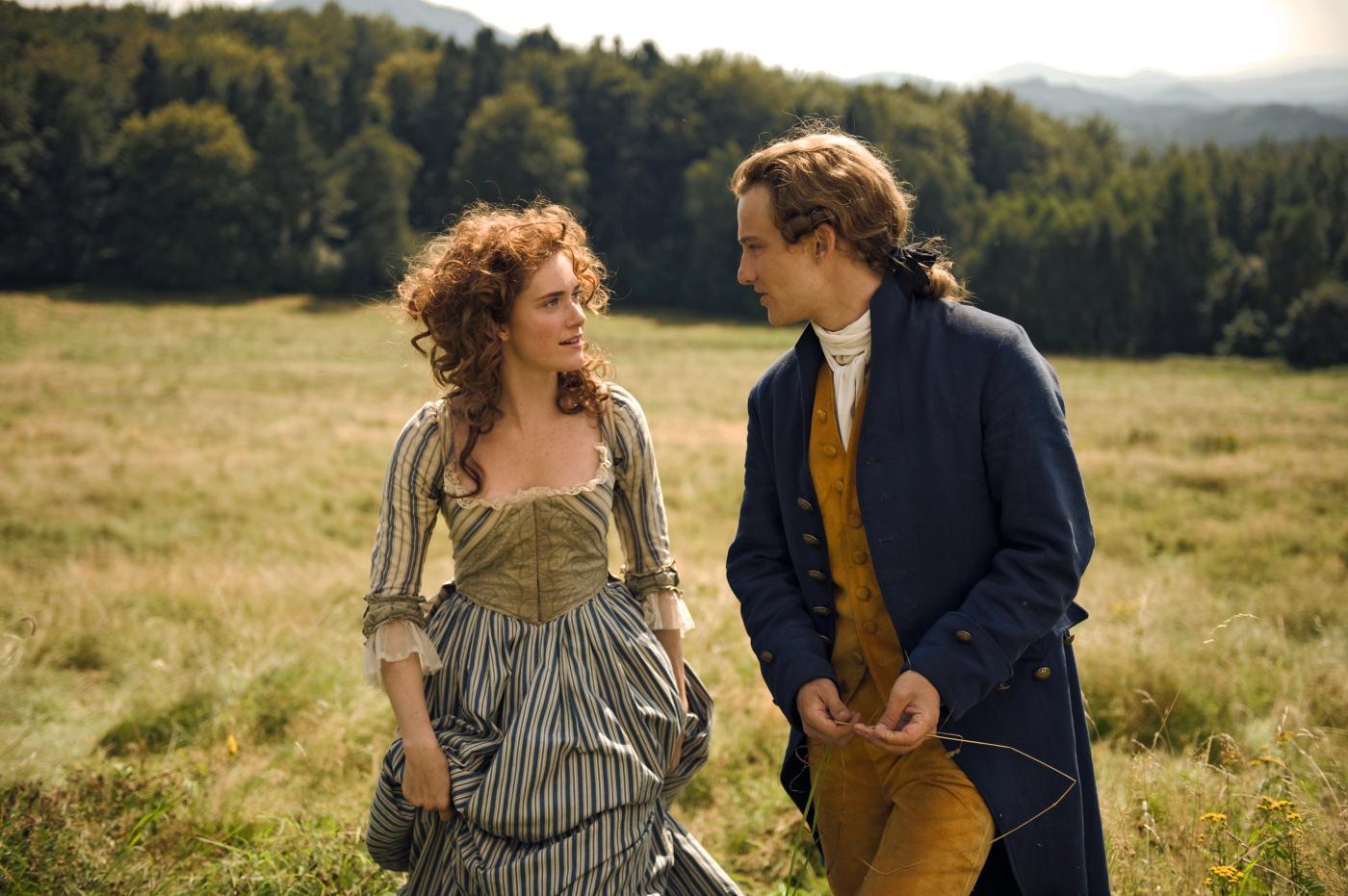
The German costume drama “Young Goethe in Love” dramatizes the real-life events that inspired the book that’s sometimes called the world’s first best-seller. Well, “real-life” used in a very loose sense. “Young Goethe” seems to take even more liberties with the facts than most pictures in the genre. But, also like many films of the type, its charm and energy are hard to resist.
Our hero (played by Alexander Fehling, familiar from “Inglourious Basterds”) is 23 years old in 1772, and unsure of his literary talent. His father isn’t — he’s convinced his son has none. And so he sends the lad to the provinces to complete the legal education that he began — and didn’t pass — in Leipzig.
“The young man is boldly crazy,” one of his law examiners had said, somewhat in disgust, somewhat in awe. This Goethe is something like the Mozart of “Amadeus,” a hedonist who seems an unlikely vessel of the muses. You’d never guess that this silly boy would go on to write great poetry, and also work on geology, botany, and color theory.
His love for the “unbridled,” as he repeatedly calls her, in a single word suggesting a host of connotations, Charlotte (Miriam Stein) is doomed from the start because her father plans to marry her to Goethe’s boorish boss at the courts, Judge Kestner (Moritz Bleibtreu). But the experience would, of course, change his life.
“Young Goethe” suffers from far too many modern cliches, both spoken and narrative, as well as a lax attention to historical detail. But the sparkling young man who can’t stop thinking in poetry, even as he must, for now, live his life in prose, overwhelms the audience just as he does Charlotte — and eventually all of Europe.
