

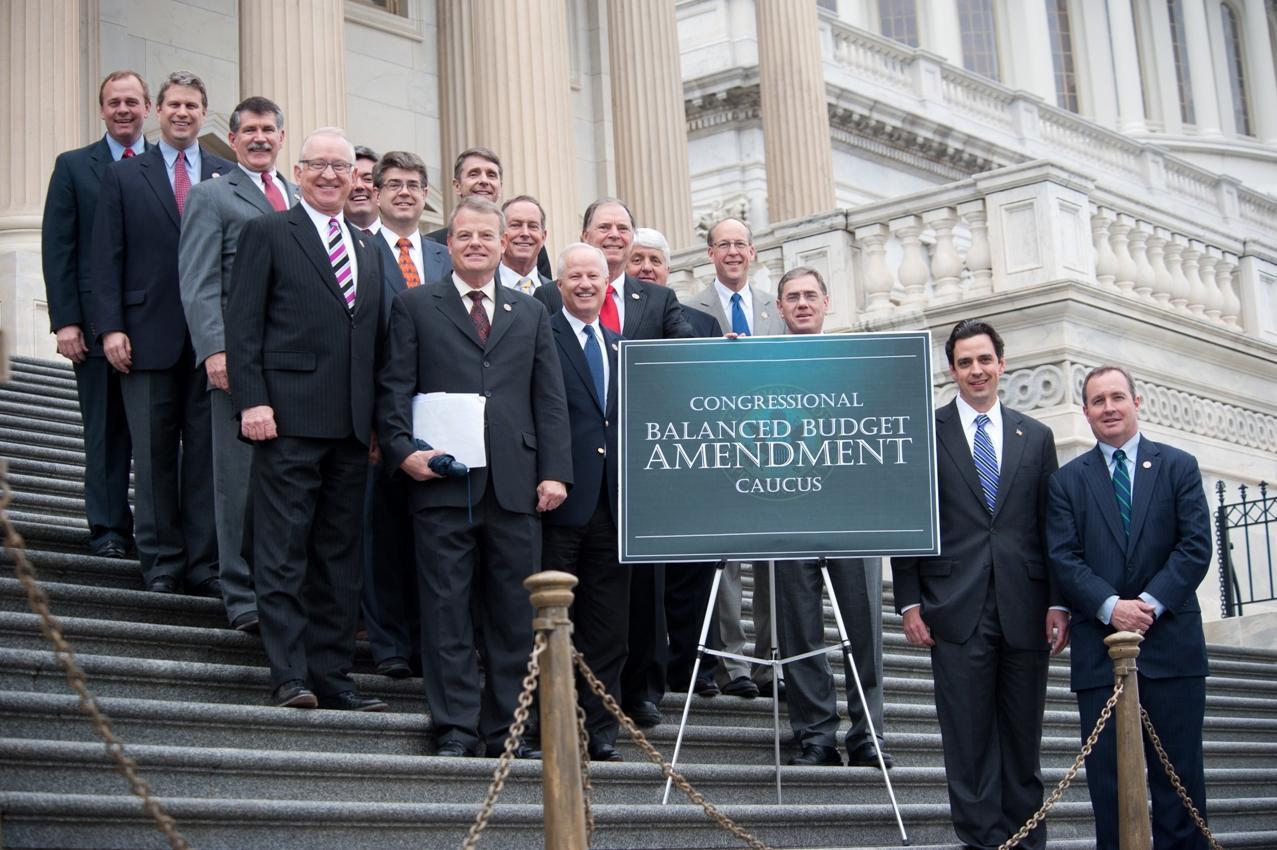
For the first time in nearly 15 years, Congress this week will vote on a balanced-budget amendment, and with the nation’s economy stalled and Europe’s debt crisis rippling across the globe there may be enough impetus for lawmakers to push the amendment through at least one chamber.
The House will take up the constitutional amendment first. If it wins a two-thirds majority there, the Senate would be required to consider an identical version — and need a two-thirds vote to pass it.
If approved, the amendment would prohibit federal spending to exceed revenues the government takes in, unless the extra spending is specifically authorized by a two-thirds vote in each chamber.
Republicans demanded a vote on the constitutional amendment, which would impose a whole new level of fiscal restraint on the federal government, as a condition for allowing President Obama to raise the nation’s debt ceiling, the amount the country can continue to borrow to pay its bills.
“I think this is a key time for members of Congress to show that they understand that a big part of the problem we have here is that the Congress, year after year, puts off making the tough decisions,” said Rep. Bob Goodlatte, R-Va., who introduced the bill on the opening day of Congress this year. “Instead, Congress has replaced those tough decisions with just borrowing more money.”
Goodlatte told The Washington Examiner he expects nearly every Republican in the House to support the bill, even though many would prefer an amendment that also caps federal spending as a percentage of the gross domestic product and requires a supermajority vote to raise taxes.
Goodlatte, who authored the tougher version, said it would be far more difficult to pass such a measure.
“It does not get a lot of Democratic support,” he said.
Still, it won’t be much easier to pass the less restrictive measure either.
For the amendment to pass the House, 290 lawmakers have to support it. Republicans only have 242 votes, so Goodlatte needs nearly 50 Democrats to support it.
“It’s a difficult threshold to meet, 290 votes,” Goodlatte said. “But, there are a lot of Democrats, dozens in fact, who are interested in voting for this.”
Goodlatte’s bill mirrors one the House took up in 1995, the last time it voted on a balanced-budget amendment. At that time, 72 House Democrats voted for the amendment only to have it die in the Senate by one vote.
A second vote in the Senate two years later also failed by one vote.
This time around, far fewer Democrats are expected to back the amendment, despite polls showing bipartisan support for it.
House Minority Whip Steny Hoyer, the No. 2 House Democrat, said recently he will try to convince the chamber’s 192 Democrats to vote against it, calling it a political ploy.
Senate Democrats also are likely to balk at the amendment. If the measure passes the Republican House, however, it would prove thorny for moderate Democratic senators who would have to choose between constituents who favor the amendment and their party, which wants it defeated.
“You are going to have Democrats in more conservative areas who are going to feel a tremendous amount of pressure to go along with it,” said Ted DeHaven, a budget analyst for the Cato Institute, a libertarian think tank.
