

Ken Griffey, Jr. and Mike Piazza were elected to the Baseball Hall of Fame. With his first time on the ballot, Griffey made history, named on 437 of 440 ballots (99.3 percent)—which has baseball left fans wondering how three journalists whose expertise is clearly European Handball got into the Baseball Writers’ Association of America.
It was Piazza’s fourth try at the Hall and he was elected by 83 percent of the voters, a solid showing for the man who hit more home runs as a catcher, 396, than anyone else. He finished with 427 home runs total, a .308 batting average and 1335 runs batted in. The numbers are astonishing, especially for someone taken in the 62nd round of the amateur draft—a round in which clubs pad out their minor league rosters with guys who are basically paid to play catch with the prospects. Piazza broke in with the Los Angeles Dodgers late in the 1992 season and then won rookie of the year in 1993, when he hit .318, 35 home runs and knocked in 112 runs. In 1998, he went to the Marlins in a multi-player deal, and played in only five games before he was traded to the Mets, where he played until the end of 2005 season before signing as a free agent with the Padres and then the A’s, with whom he ended his career in May 2008.
But it’s as a Met that Piazza is entering the Hall, only the second of the Amazins, along with Tom Seaver, to make it to Cooperstown. Piazza led the club to the World Series in 2000, the first subway series ever between the Yankees and the Queens franchise, which the Mets lost in 5 games. That series was perhaps most notable for the bizarre confrontation between Piazza and Roger Clemens, when the Yankees pitcher threw Piazza’s broken bat at him. However, Piazza’s signature moment in a Mets uniform was his game-winning eighth-inning home run against the Atlanta Braves September 21, 2001, ten days after the 9/11 attacks.
“In that particular moment, people just really wanted something to cheer about,” Piazza said later. “It was a blessing for me to be part of it. I’m so fortunate to have been in that situation and to have come through.”
Braves’ third-baseman and future Hall of Famer Chipper Jones remembered that he was “scared to death” of another terrorist attack. I suspect the Mets’ backstop had a little fun at Jones’ expense anyway—he always did. “I call him Larry whenever he comes to the plate,” Piazza told me. “I’m not going to call a grown man ‘Chipper.’ Plus it rattles him.”
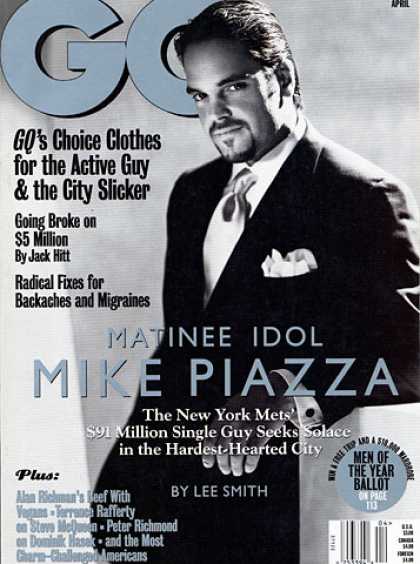
I’d been assigned to write a cover story on Piazza for GQ magazine in the winter of 1998. The concept was that he was stylish, exuded an urban ethnic hip and, already a star on one coast, was on the verge of making it really big in New York. He was an ideal GQ cover. It turned out to be the worst selling issue in the history of GQ, which I blame entirely on the black-and-white shot of Piazza they used on the cover.
We walked around Little Italy, which I think I suggested, hoping that an Italian ballplayer cutting la bella figura would bring the neighborhood out to the street. And it did. We walked by the corner where Gerald Tommaso DeLouise, aka Burt Young, aka “Paulie” from the Rocky epic, was hanging out. But neither Paulie nor Piazza was the biggest Italian-American celebrity on the block that blustery afternoon, for no sooner did we turn onto Elizabeth Street than we saw Martin Scorcese leading a small tour of his old neighborhood. (Piazza actually has some Hollywood blood himself—Maria Bello is a cousin, both from the same Philadelphia suburb.)
The real treat was just watching regular people in the neighborhood look up and see number 31 in the flesh. There was one kid wearing a Mets jacket who nearly collapsed from joy. “Mike,” the kid said with a huge grin. “Mike.” There were a lot of handshakes and short but animated conversations about the Mets’ chances next season and if the big city was agreeing with his (then-)bachelor lifestyle. I don’t recall anyone asking him for an autograph—sometimes with New Yorkers they don’t want to acknowledge celebrity so as not to seem like they’re too excited, like you’re worth getting too excited about, like you’re better than them. But with Piazza it was just because people seemed to feel at ease with him. He was a regular guy. Ok, he was born to a wealthy father, but he became a superstar on his own. Tommy Lasorda may have done Piazza’s dad a favor to take him, however late, in the amateur draft, but he didn’t hit .300 because big league pitchers were doing his pop a solid.
We stayed in touch for a little while after the story. GQ had a huge party for him and the rest of the club, which was a really big night for my sister getting to meet all those Mets—she’s the only Mets fan in the family. When it came time for the Subway Series, my brothers and I were fully behind the Yankees, as we had been our whole lives. Still, it was obvious Clemens was out of his mind. I was rooting for Mike to go deep. The next season, terrorists attacked New York before the playoffs, I moved to the Middle East, and Piazza hit a home run that made us all feel better—even Larry Jones.
Congrats to Michael Joseph Piazza—a great ballplayer, a great American, and a great New Yorker, who will go into the Hall of Fame as a New York Met.
