

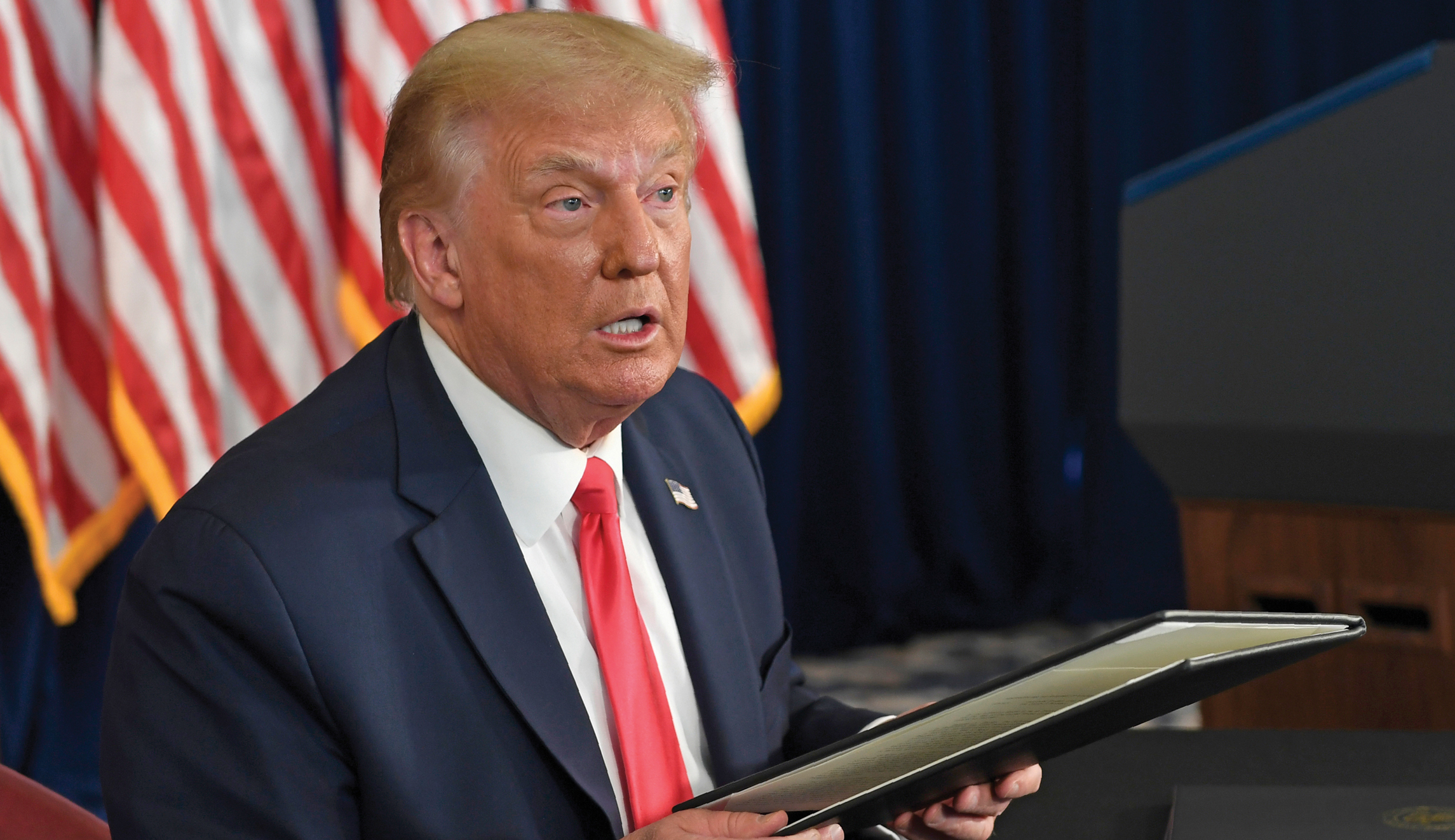
Many, if not all, employers are declining the payroll tax deferral plan that President Trump made available on Aug. 8.
“Virtually all private sector employers are deciding against opting in to the deferral,” said Garrett Watson, a senior policy analyst at the Tax Foundation, a nonpartisan think tank that examines the tax code.
Recommended Stories


Other tax experts have said they have yet to hear of any company taking advantage of the program. The Washington Examiner could not find a single company participating in it.
Several organizations representing small businesses have said that their members will not participate in the deferral program.
“Many of our members will likely decline to implement deferral, choosing instead to continue to withhold and remit to the government the payroll taxes required by law,” the organizations wrote to Congress on Aug. 18 while urging the legislature to pass another relief bill.
Large companies such as Costco, FedEx, Walmart, Macy’s, Procter & Gamble, Wells Fargo, and CVS Health have also opted out.
Parts of the federal government will participate in the program, but that excludes the U.S. Postal Service and the House of Representatives.
“The Office of the Chief Administrative Officer, with the concurrence of the Committee on House Administration, has determined that implementing the deferral would not be in the best interests of the House or our employees,” House Chief Administrative Officer Philip Kiko stated in an email to House employees on Sept. 11.
The time to opt in to the program would have been by Sept. 1, which is when companies could begin deferring the payroll taxes of their employees. The reason behind the likely unanimous rejection of the proposal is because it is risky.
Trump, by memorandum, allowed companies to delay until next year the payment of payroll taxes (not including the 1.4% Medicare tax) incurred between Sept. 1 and Dec. 31 for workers earning up to $104,000 a year.
The move equates to a 6.2% boost in take-home pay, but those taxes would ultimately be due in the first quarter of 2021. This essentially would equate into a 6.2% tax increase next year for participating workers.
“In a year, you will pay the same amount in tax,” Watson said.
Where it gets risky is when taxpayers don’t have the money to pay the tax when it is ultimately due — at which point taxpayers are not only saddled with the levy but also with the interest and penalties that come with failing to pay what was owed on time.
“The penalties attached to the payroll tax are significant,” Watson said.
The IRS has stated that interest and penalties on the “Affected Taxpayer” would begin accruing on May 1, 2021.
Watson notes that the tax agency could go after the employer or the employee for what is due.
“Under the statute, both employer and employee are responsible for remitting it. So they can go after both parties,” he said. “Employees are not off the hook. If the IRS can’t get it from the employer, they may decide to go after the employee.”
Congress could forgive the deferred taxes, but so far, that does not seem to be in the offing. However, if lawmakers did forgive the levy, another problem would be created regarding whether taxes would be forgiven for the many companies that did not participate in the program.
“Do you only forgive the tax for those companies subjected to deferment?” asked Janet Holtzblatt, a senior fellow at the Urban-Brookings Tax Policy Center and a former deputy director of the Individual Taxation Division at the Treasury Office of Tax Analysis.
“If you forgive for those employers who deferred it, what do you do for those employers who did not? There’s no policy reason to forgive it for the first group but not for the second group,” she said.
Forgiving the tax would force the IRS to repay the companies that have already paid it.
The Trump administration is looking to ensure that the payroll tax is essentially forgiven by continually extending the length of the deferral, meaning there would basically be no tax liability because it would never come due.
“As far as the payback is concerned, you know, you could stretch that out for a long period of time. … You’ve got a lot of elbow room to get around that issue,” White House economic adviser Larry Kudlow said on Aug. 19.
Trump has vowed to extend the deferral for as long as he can, assuming he wins reelection in November.
“I can extend it at a certain period. Hopefully, I will be here to do the job,” he said after signing the memorandum on Aug. 8.
