

Regardless of which way the election goes in November, New York’s Chuck Schumer will either become the Senate’s top Democrat or ascend even higher to majority leader. Either way, it will complete his transition from partisan warrior to pragmatic dealmaker, according to people who have worked with him.
Schumer stormed into the upper chamber in 1998 after gaining national attention as one of President Bill Clinton’s most cutting and effective defenders during the impeachment scandal.
The New Yorker quickly became known and ridiculed for grabbing media attention. Former Senate Majority Leader Bob Dole, R-Kan., is credited with being the first to comment that the most dangerous place on Capitol Hill was between Schumer and a television camera.
Schumer led two successful Democratic Senate campaigns, capturing the majority in 2006 and holding it in 2008, using sharp rhetoric to exploit evidence of Republican corruption on Capitol Hill.
Since then, though, Schumer has more often dived into policy and emerged with a reputation as a canny legislator willing to reach across the aisle to strike a deal and get bills passed.
He has promised to lead Senate Democrats the same way. “I’m going to try to reach out to Republicans,” he said during a November CNN interview that his staff point to when asked how their boss will run his caucus or the whole Senate, depending on whether the Dems retake the majority in November’s general election.
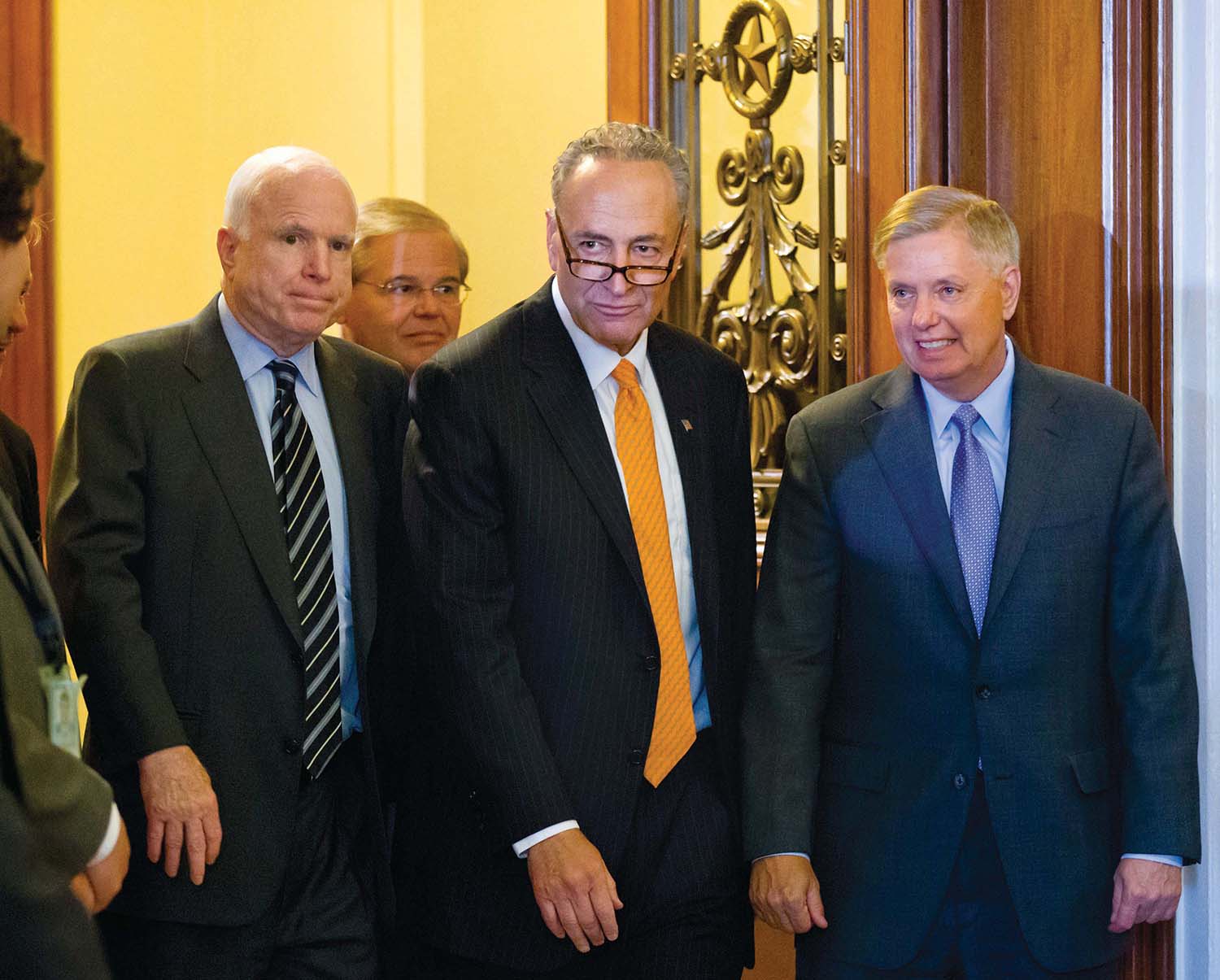
Schumer said he can work well with most mainstream conservatives, referring to his partnerships with GOP Sens. John McCain and Lindsey Graham. (AP Photo)
“There are hard-right Republicans who don’t want to compromise but most … are mainstream conservatives, and I think I can work well — I’ve shown it — with the McCains, the Grahams, the Alexanders, and I’d like to work with them to produce a platform that will get America moving again,” Schumer said, referring to his partnerships with GOP Sens. John McCain, Az., Lindsey Graham, S.C., and Lamar Alexander, Tenn.
Schumer concedes the obvious, that he doesn’t get on with Senate Republican Leader Mitch McConnell, R-Ky., but he nevertheless extended an olive branch to him during the CNN interview, saying, “I’ll be direct with him, I’ll be honest with him and I’ll say, ‘Let’s come meet part way.'”
But McConnell is one of several Republicans who doesn’t believe Schumer is genuine, said a former GOP aide. “More and more Republicans have come to trust him, but McConnell doesn’t,” the aide said.
Both Schumer, who the retiring Minority Leader Harry Reid, D-Nev., ordained last year as his successor, and McConnell will operate under a “trust but verify” system, the aide said.
Stalemate over President Obama’s Supreme Court nominee, Judge Merrick Garland, is straining relations before they formally go head to head, because Schumer has challenged McConnell’s refusal to hold hearings.
It’s also unclear that Schumer can have a productive relationship with House Speaker Paul Ryan, R-Wis.
“I’m worried,” Schumer told CNN. “What’s going to prevail? The Paul Ryan who knows how to compromise, or the Paul Ryan who has these very hard right views on these budget issues, tax issues and many other issues?”
He says that the House Freedom Caucus and its supporters may prevent Ryan from working with Democrats.
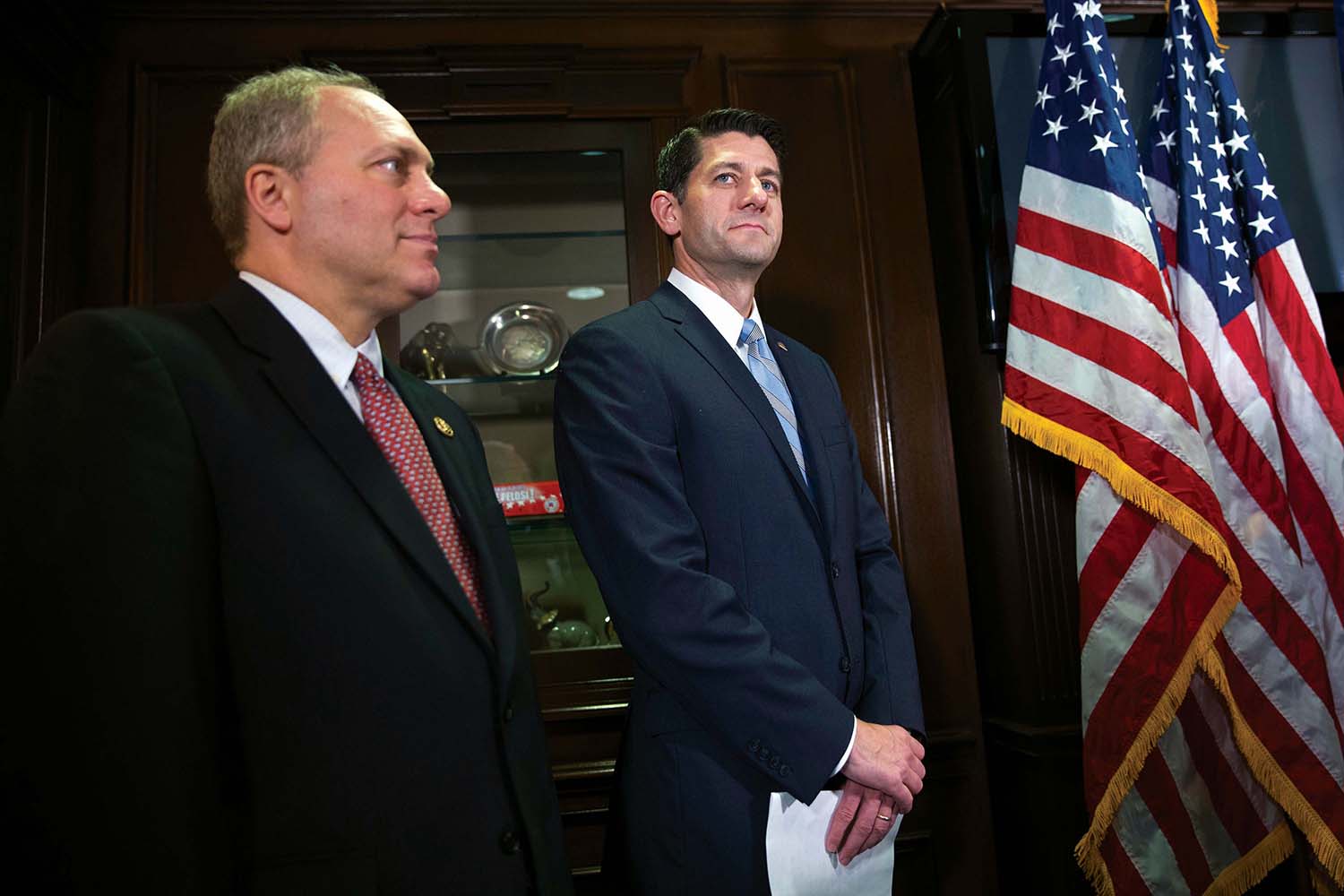
“I’m worried,” Schumer told CNN. “What’s going to prevail? The Paul Ryan who knows how to compromise, or the Paul Ryan who has these very hard right views.” (AP Photo)
Joshua Huder, congressional scholar at Georgetown University, said doubt over the Schumer-Ryan relationship is the “question of the year … I think he would work with Paul Ryan,” but Ryan may not have the flexibility to work with Democrats.
How Schumer handles a new president depends on who it is and whether Schumer is minority or majority leader next year.
His best relationship would be with Hillary Clinton. He campaigned for her this year and supported her in 2008, and the two worked closely together when Clinton represented New York in the Senate, said former Sen. Tom Daschle.
“They understand each other,” said the former majority leader. “I remember so vividly how well they worked together after 9/11. They worked hand-and-glove.”
Schumer’s most acrimonious relationship would probably be with Ted Cruz, the senator from Texas, who grated with almost every other senator on Capitol Hill, Democrat or Republican.
And Donald Trump? How would Schumer deal with him if Trump became president?
It would be interesting, Daschle said. “They both have a deep love for New York … There would be at least the potential for common experience and perception. That could be productive.”
Conventional wisdom is that Clinton and Schumer would rarely be out of sync and would keep their differences private, a stark contrast with Schumer’s increasingly sour relationship with President Obama.
In 2010, Schumer called on Obama to hold Sept. 11, 2001, attack conspirator Khalid Sheik Mohammed’s terrorism trial anywhere but New York City. “My advice to the president is, with a great deal of respect, take New York off your radar screen,” Schumer said during a press conference then. “Find another location.”
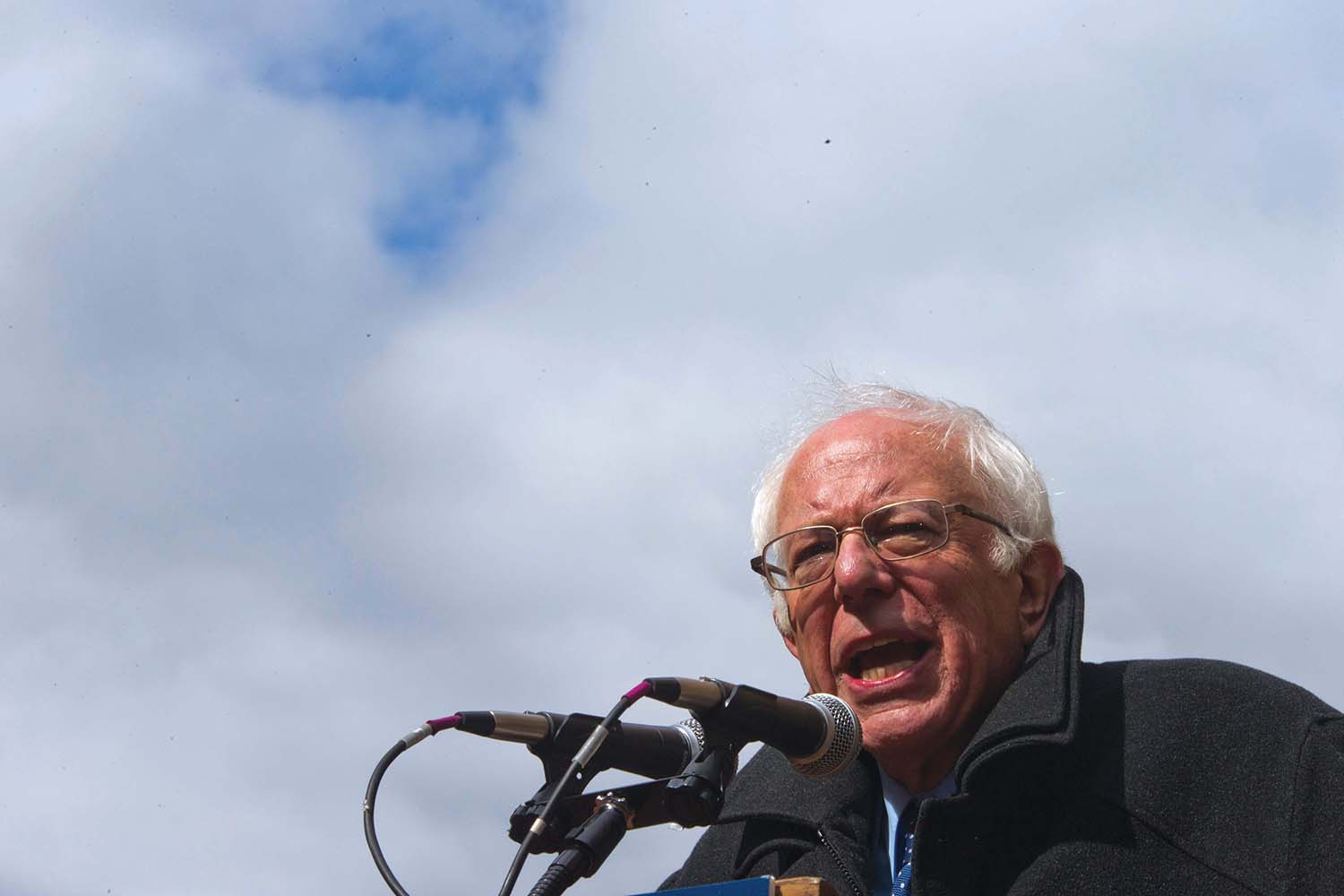
Sen. Bernie Sanders’ populism could put Schumer on the spot as much as it has put Clinton on the defensive. (AP Photo)
That probably did not rile Obama too much, given New Yorkers’ sensitivity to anything 9/11 related. But Schumer’s defiant opposition last summer to the president’s deal with Iran on nukes was a much bitterer clash. Since then, White House spokesman Josh Earnest has taken pot shots at Schumer over the deal and chided him for complaining about how much, or little, Obama planned to contribute to New York’s counterterrorism fund.
Just ahead of Obama’s trip to Riyadh in April, Schumer joined Sen. John Cornyn, R-Texas, in pushing a bill that would allow 9/11 victims’ relatives to sue Saudi Arabia for compensation.
Schumer’s standing among Senate Democrats is, however, so high that no one was either surprised or very upset when he announced that he intended to leapfrog Illinois’ Dick Durbin, the chief whip and Democratic number two in the Senate, to become their leader.
“I find it fascinating that he’s usually the first to call somebody on their birthday,” Daschle said of Schumer’s personal touch. “He has a real appreciation for the chemistry required to work with people on both sides of the aisle. I got elected by one vote. In Chuck’s case, it’s going to be unanimous. So that’s quite remarkable. I certainly envy his start.”
The American Enterprise Institute’s congressional scholar, Norman Ornstein, was equally impressed with Schumer’s smooth ascension. “He has excelled in the last few years at getting along with his colleagues,” Ornstein said. “That he managed to get past Durbin, his long-time roommate, without a meltdown says a lot about both” lawmakers, and Schumer in particular.
But some warn that Schumer could find leading Senate Democrats in the 115th Congress more difficult than Reid found it in the 114th. This is partly because if, as expected, Sen. Bernie Sanders, I-Vt., fails to become the Democrats’ presidential nominee, he will return to the upper chamber with new stature and with the party’s liberal base reinvigorated. His populism could put Schumer on the spot as much as it has put Clinton on the defensive.
Schumer has advocated for Wall Street since he first joined the House Banking Committee in 1981. Sanders, with Sen. Elizabeth Warren of Massachusetts and Wisconsin’s Russ Feingold, who is expected to topple Sen. Ron Johnson, will push for legislation embodying his proposals to regulate Wall Street even more.
A President Hillary Clinton could have to make good on her promises, forced by Sanders, on the campaign trail to do the same.
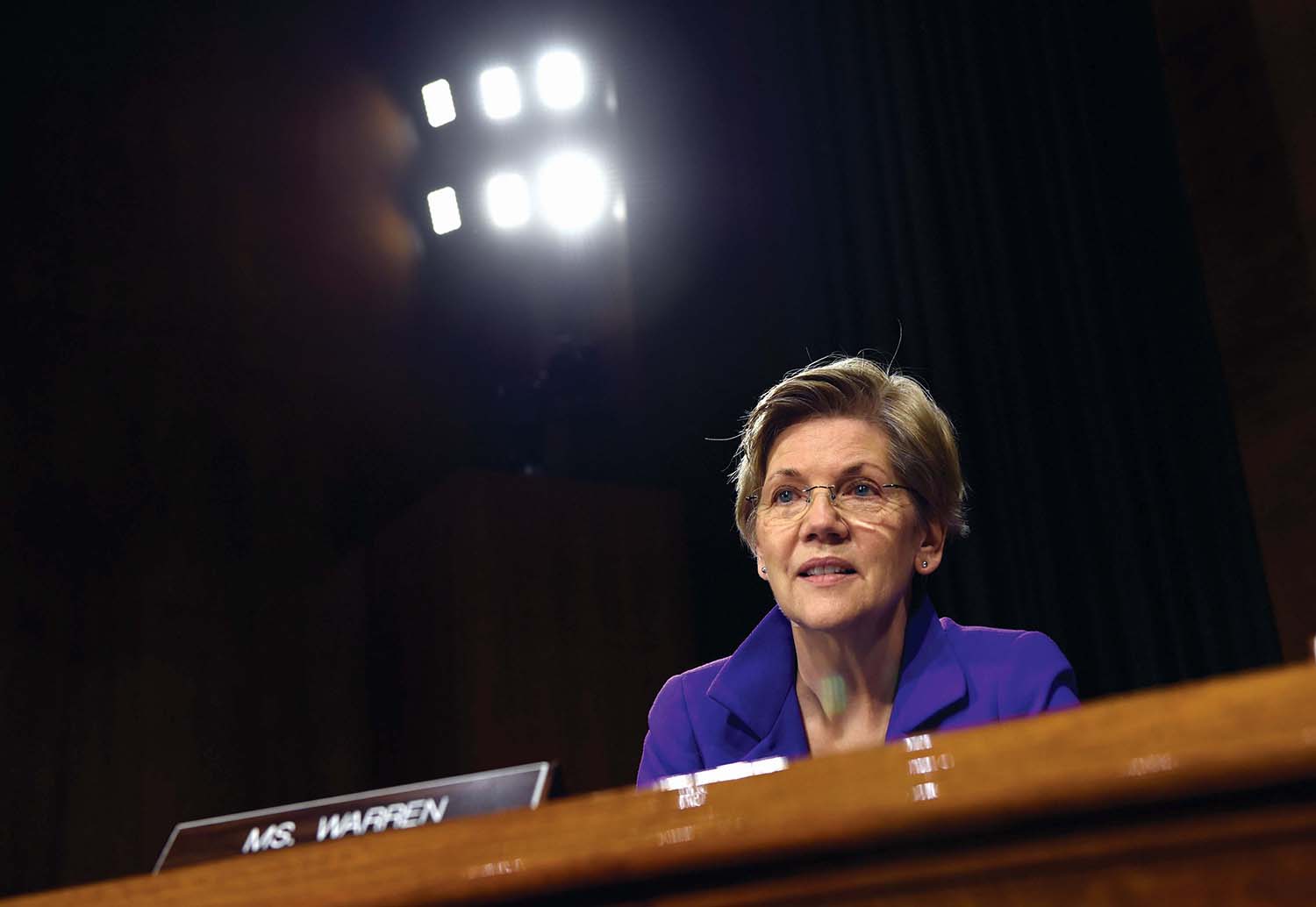
Sanders, with Sen. Elizabeth Warren, will push for legislation embodying his proposals to regulate Wall Street even more. (AP Photo)
A former Democratic Senatorial Campaign Committee staffer under Schumer said, “The bubbling of populist anger in” the party base could create a more liberal Senate Democratic Caucus, which could be tricky for the more moderate Schumer, adding that Clinton would push Wall Street reform because “she can’t risk proving her critics right.”
Most Republicans acknowledge that Schumer would be a formidable opponent as majority leader.
Kevin Madden, spokesman for Mitt Romney’s presidential campaign and one-time spokesman for former Rep. John Sweeney, R-N.Y., said Schumer brings a “formidable” skill set to his new role. “He’s a very skilled operator, he is dogged in his determination. One of the hallmarks of his success has been he doesn’t look at every issue … through just one angle. I think he explores and war games from … a 365-dgree assessment of every situation.”
Most Republicans also say Schumer was the most successful chairman of the DSCC, and admire his fundraising prowess. In his two turns running the DSCC, the committee raised $121 million and $163 million, respectively. He closed 2015 with more than $24 million in his own campaign war chest, although his re-election is not in jeopardy. And in 2014, he cut the DSCC a $1 million check from his campaign fund.
But one former National Republican Senatorial Committee staffer warns not to believe the hype.
“The biggest takeaway in these type of positions is it’s better to be lucky than good,” the former staffer said. Schumer presided during two perfect cycles for Democrats, the staffer said.
In 2006, President George W. Bush was in the middle of his second term, historically bad elections for the incumbent party and voters were dissatisfied with the Iraq War and dismayed by the bungled response to Hurricane Katrina. Democrats had fewer seats than their opponents to defend. In 2008, Obama fever was at its peak and new voters came out in droves to support him and his party’s down-ballot candidates.
“You can look like a genius one cycle” and a buffoon the next, depending on factors far outside a committee head’s control, the former GOP staffer said, saying no one doubts McConnell’s strategic abilities, yet the NRSC under his leadership in the 1998 and 2000 cycles didn’t pick up one seat.
The former staffer also questioned the assumption that Schumer has evolved so much from his old days when he would hold press conferences on Sundays to take advantage of the slow news cycle and dominate the headlines.
“I think that Schumer is probably very, very good historically about being all about Schumer. It will be interesting to see if he can transition that into what is good for the whole team,” the staffer said.
