

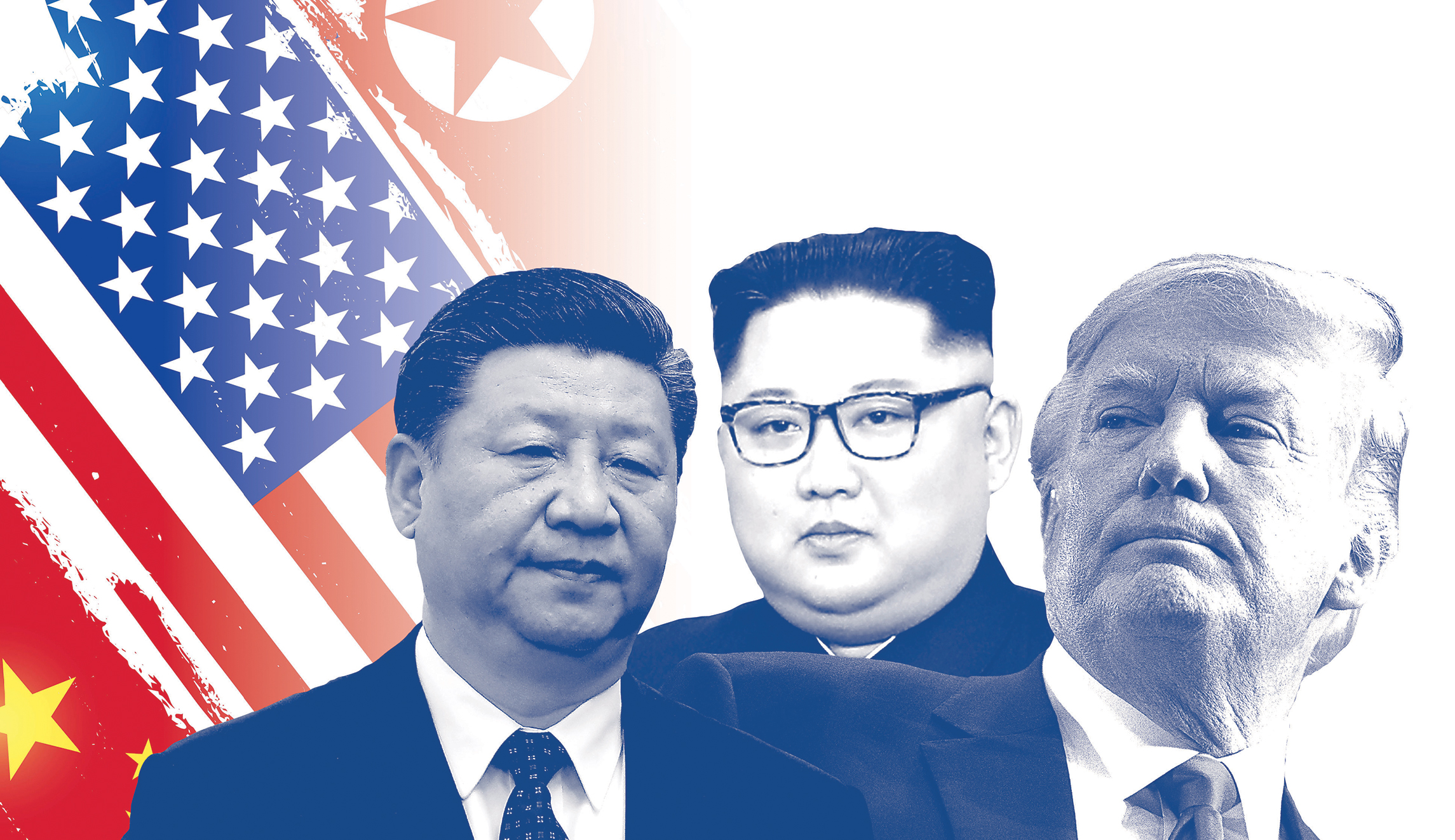
If President Trump sits down with North Korean dictator Kim Jong Un in Singapore this month, his success in ridding the peninsula of nuclear weapons will depend largely on whether America’s “maximum pressure” campaign has convinced the tyrant he needs to change strategies.
And yet, conservative national security experts and Republican lawmakers believe that the administration has stopped well-short of true “maximum” pressure, even though it might have strengthened his hand against the obstinate regime.
Recommended Stories


“Maximum pressure is not maximum; there’s still many things we’re pulling our punches on,” The Heritage Foundation’s Bruce Klingner, a former CIA deputy division chief for Korea, told the Washington Examiner.
Anthony Ruggiero, an ex-aide to Sen. Marco Rubio, R-Fla., and now a senior fellow at the Foundation for Defense of Democracies, agreed. “Certainly, you can term it, maybe, moderate pressure,” said the sanctions expert, who spent more than 16 years in the State Department and Treasury Department.
That’s a far cry from the White House line, which is that maximum pressure and the threat of nuclear annihilation are what brought Kim to the table.
The on-again-off-again drama over the Singapore summit obscures a more fundamental reality: North Korea will likely refuse to accept the U.S. demand that these negotiations end with loss of their nuclear weapons. And yet, the sanctions imposed on North Korea are milder than those directed against Iran for the past decade, experts say. Trump has not targeted Kim’s main backers, the Chinese, with the sort of punitive measures faced by the mad-as-hell political leaders of America’s closest and richest allies in Europe. China is crucial to Trump in securing any settlement of the nuclear crisis in the Korean peninsula.
“This is a three-party negotiation,” Sen. Ron Johnson, R-Wis., a member of the Foreign Relations Committee, told the Washington Examiner. Having said that, however, he added, “I have no idea where it’s going to end up.”
Trump’s original goal was unambiguous. “We will only engage in talks with North Korea when they exhibit a good-faith commitment to abiding by the Security Council resolutions and their past promises to end their nuclear programs,” then-Secretary of State Rex Tillerson told the United Nations Security Council in April 2017.
Tillerson is gone, but his successor didn’t change official policy. Yet Trump is now preparing for a historic face-to-face meeting with an international pariah even though the two sides don’t agree on such basics as the meaning of “denuclearization.” No one, not even the most fervent Republican supporters of the summit, disagree with this.
“North Korea believes in ‘sufficient’ denuclearization whereas the U.S. talks about complete denuclearization,” said Republican Florida Rep. Ted Yoho, who chairs the House Foreign Affairs subcommittee for the Asia-Pacific region. “Those definitions must be agreed upon to move forward for further talks. That’s why it’s imperative to have this first talk.”
A flurry of U.S.-North Korea meetings in Singpore and New York have, however, raised expectations. “I think the summit will happen,” a senior administration official told the Washington Examiner. “South and North Koreans now feel invested in it and need it to happen.”
Acknowledging Beijing
To succeed, Trump cannot focus purely on our adversaries in Pyongyang. He and his team must also navigate the diplomatic cross-currents created by the fraught interests of South Korea, China and Japan, which have intensified since 2017, when Kim fired two intermediate-range ballistic missiles over a Japanese island and tested an intercontinental ballistic missile that landed in the Sea of Japan.
American presidents have long warned of a preemptive military strike against North Korea to stop it from acquiring the ability to fire a nuclear weapon effectively at the United States. In the past year, Kim’s regime has detonated a massive nuclear bomb and launched two intercontinental ballistic missiles capable of reaching the American mainland. It’s not certain that North Korea can yet combine its nuclear and missile technologies successfully, but the parallel advances, and the prospect of their deadly combination, have heightened Korean and Chinese concerns about an American attack, perhaps especially with Trump in the White House.
“Trump is a wild card to China,” said Johnson, who was part of a March congressional delegation to Beijing. “One of the reasons that I went to China was to convey my personal belief that I don’t think Trump is bluffing that he is not going to allow North Korea to marry those two technologies, nuclear and ICBM technology. I think that’s Trump’s strongest trump card.”
Trump’s hand may be weakened by South Korean President Moon Jae-in, who is naturally troubled by Kim’s threat to strike south across the 38th parallel at Seoul if America launches an attack. Seoul, the South’s capital, is home to 25 million people and is within easy range of the North’s artillery, to say nothing of nuclear weapons.
“You’ve got a South Korean president who is far more eager to engage and far more receptive to North Korean entreaties than his conservative predecessors,” Klingner, the former CIA analyst, acknowledged.
But if Trump or a future U.S. administration allow North Korea to develop the ability to fire nuclear missiles at American cities, other nations in the region seem likely to develop nukes of their own. “Is it in China’s best interest to have Japan fully nuclearized? Or South Korea?” Johnson asked rhetorically. The question answers itself.
U.S. has leverage
Kim may genuinely want a deal. Rubio doubts that the young autocrat will ever surrender his entire nuclear weapons and ballistic missile program, but he still judges that Kim is on shaky ground.
“I don’t think we need to understate the amount of leverage we have,” said the Florida senator, who sits on the Foreign Relations and Intelligence committees. “I think there’s a real open question whether, if current trends continue and nothing changes, whether Kim Jong Un will be in power for another decade. There are strong reasons to believe that there is internal resistance to his leadership that could very well force his hand if he doesn’t come up with a deal here.”
Rubio said China, too, is not punching Kim hard. “The Chinese have done more against North Korea than they’ve ever done before, but as I have said, they’re not going to do everything they can do,” he said. “They’re calibrating how much of the North Korean economy they want to hit because they don’t want to have a collapse [of the regime].”
That perhaps argues for Trump to impose sanctions on Chinese people and companies that do business with North Korea. Yet, in a deal struck almost simultaneously with the initial cancellation of the summit, the president eased sanctions on a Chinese tech company that had been blacklisted for helping North Korea and Iran circumvent sanctions.
“Chinese banks are violating U.S. law and are allowed to do so for things — because I have the benefit of having also worked on Iran sanctions — for things that, if European or other banks had done for Iran sanctions, they would have been punished long ago,” said Ruggiero, whose think-tank, FDD, worked closely with the Trump administration on the new Iran policy.
For perspective, Obama’s Treasury Department fined a French bank $8.9 billion for violating sanctions on Sudan and Iran in 2014. “The U.S. imposed $12 billion in fines on European banks for money laundering for Iran,” The Heritage Foundation’s Klingner recalled in February.
By contrast, The House Foreign Affairs Committee cited 12 Chinese banks for North Korean money-laundering in September, but only one small one has been punished. Trump has only lightly enforced a recent federal law punishing Russia and China for paying North Korea for slave labor. “It’s a mandatory sanction,” Ruggiero said.
Yoho, says he is “proud” of administration efforts so far, but acknowledged that there are nearly 12 dozen shell companies in Hong Kong helping North Korea evade sanctions.
“The president’s trying to have a little leeway to operate in good faith with China,” said Yoho, “I’ve just seen too many deceptive moves by the Chinese. So I think if we, from the committee, put the pressure on and call out the administration via the Treasury Department and say ‘these things need to be sanctioned,’ they have to ratchet that up. And then China has to know that it’s not just the administration they’re dealing with.”
Trump’s defenders say he has been more aggressive with Kim than any previous president. “A term like ‘maximum pressure’ is all relative, right?” Johnson said. “Maximum pressure is way more pressure than any other administration has ever put on them.”
One of former President Barack Obama’s Korea experts agrees. “The Trump administration did more than the Obama administration in terms of pressure,” said Sue Mi Terry, a leading U.S. intelligence official and policy maker in the first two years of Obama’s presidency. “So that’s what got finally the Chinese to implement sanctions and do more. It got everybody to do more.”
China has taken steps
China has for years supported or permitted smuggling to undermine sanctions, but with Trump in the White House it has tightened enforcement. It also allowed new sanctions to pass through the United Nations Security Council. But Beijing is still playing both sides of the fence. In September, it agreed to a Security Council resolution slashing fuel supplies to North Korean but it also joined Russia to block a proposal that would have imposed a complete oil embargo.
“As Chinese crude oil flows to North Korean refineries, the United States questions China’s commitment to solving an issue that has serious implications for the security of its own citizens,” then-Secretary Tillerson said at a Security Council meeting in December.
Chinese President Xi Jinping’s envoy rejected the rebuke and accused Washington of provoking North Korea by “scaling up response capabilities by force” and conducting military exercises with South Korea. Xi, who has met twice with Kim in recent weeks, may put pressure on him to abandon nuclear weapons only if Trump agrees to American military withdrawal from the Korean Peninsula. China is playing a devious great power game all around its vast perimeter, from India to the northern Pacific, and a shrinking American presence in its sphere of influence would suit Beijin nicely.
“‘’Listen, you give this crap up, but what you have to get for it is, you got to get the U.S. to pull out,’” said Johnson, characterizing the conversation he suspects took place between the two Communist leaders. “‘That’s your price for complete denuclearization.'”
Chinese regional aggression, especially its massive illegal build-up of a military presence on disputed islands controlling the world’s busiest sea lanes, can only diminish the appeal in Washington of any such deal. China wants Kim to resist the deal that Secretary of State Mike Pompeo has offered, which is that the North Korea will get access to American investment if it denuclearizes. A U.S.-North Korea “future defined by friendship and collaboration,” as Pompeo put it, would strengthen America’s position on China’s southern doorstep.
China is striking a balance between support and pressure on North Korea so it can keep all its leverage while mitigating the risk that Trump will start a war in the region. Japanese surveillance photos appear to show a Chinese-flagged vessel transferring fuel to a blacklisted North Korean oil tanker in the dead of night. China is not a true partner but a devious rival of the United States, especially, and everyone knows it.
Xi was helped, some experts say, by Kim first demonstrating that his nuclear weapons and ballistic missile programs were nearly ready, and then pivoting to a charm offensive. His overtures at the Winter Olympics in Pyeongchang, and yet more his hugs with Moon in the demilitarized zone between the warring nations, plus the release of three American hostages, all provided a classic combination of sweet and sour Far Eastern realpolitik. He has diminished “the political will in South Korea and China” to implement sanctions and avoided a U.S. strike, according to Terry.
“All the moves that Kim Jong Un has played are pretty brilliant,” the former top CIA analyst said. “It’s already eroding, sanctions implementation…So North Korea is already much better off than where they were in November and December.”
Next moves
Whether that’s true depends on what Trump does next, Ruggiero said. If North Korea refuses to take quick, meaningful strides toward denuclearization, the Treasury Department can impose secondary sanctions on Chinese institutions, lower the boom on companies that employ North Korean forced labor, while the U.S. and regional allies “start to interdict these vessels” that smuggle goods to the regime.
“If these talks break down, the administration is going to have to start doing more aggressive implementation of sanctions and things that, in the past, they likely decided were too aggressive or too dangerous,” Ruggiero said. “And they’re going to have to move to that next level rapidly.”
The president would have to resist the temptation to declare victory when it was no such thing. “If Trump says it has not been unsuccessful, then they’re not going to pursue maximum pressure, right? They’re not going to go after Chinese banks,” Terry said. “How can they do a secondary boycott if they are calling it a success and they’re working with North Korea?”
If he takes that approach, North Korea will “get everything they want,” she said. “They got to wait out this administration, and we will call it a success and move on, and these people leave, and another administration will come in, and later down the road, North Korea says, ‘yeah we still have everything, thanks.’ ”
Trump can avoid some of that risk if he refuses to provide sanctions relief, but Chinese lifelines could give North Korea the help it needs even without a deal. Then it may be up to Congress to take a larger role.
“These sanctions, if we apply them the way we’re supposed to, you’re going to have good negotiations coming out of this,” Yoho said. “And China can play a big role in that. They can facilitate that or they can work against bringing peace to that peninsula.”
