

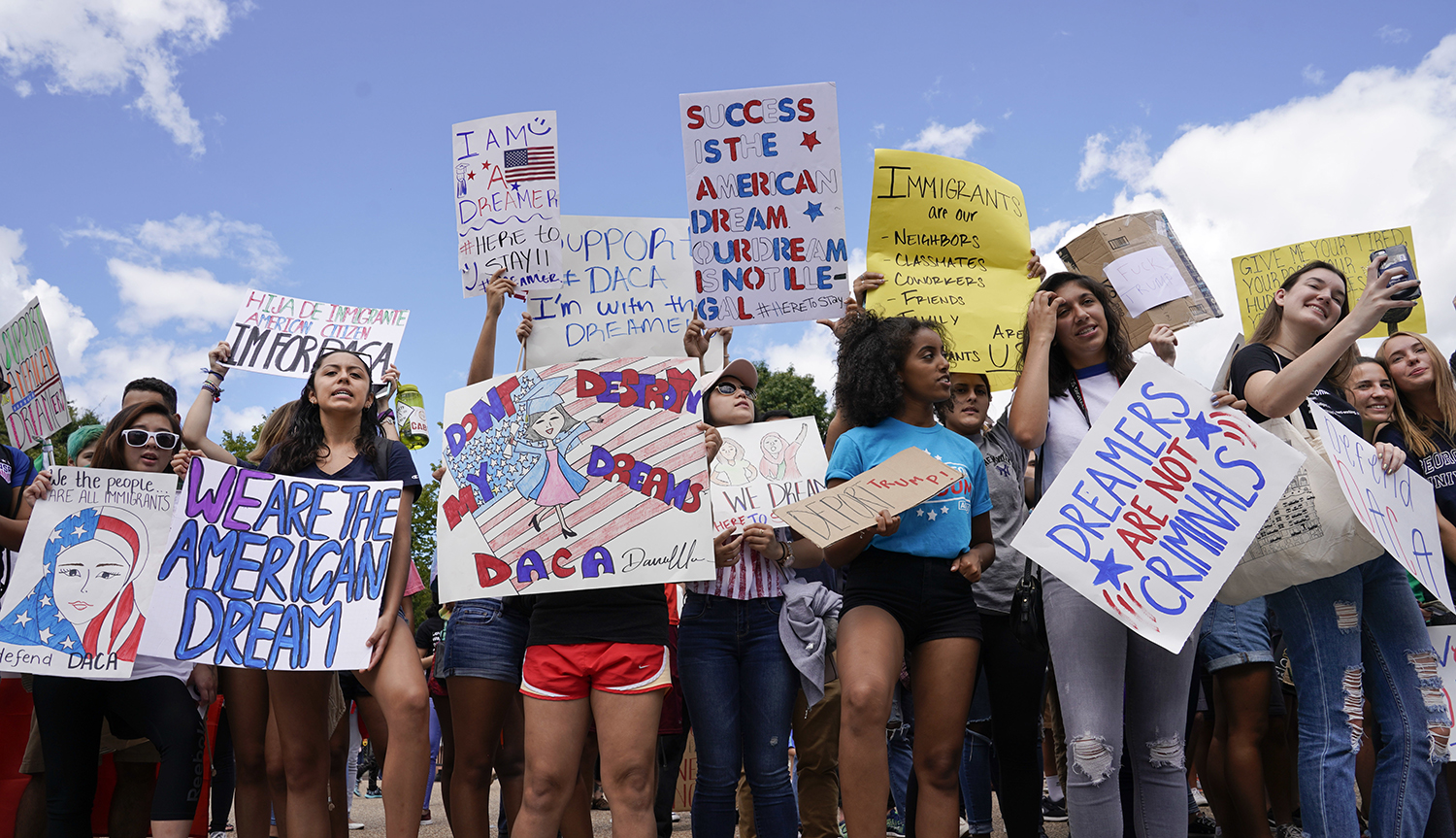
President Trump is facing five lawsuits over his decision to rescind the Deferred Action for Childhood Arrivals policy, just three weeks after Attorney General Jeff Sessions made the announcement.
Each of the lawsuits cites different reasons they allege President Trump and his White House should not have moved to undo former President Barack Obama’s 2012 executive action that gave out two-year work permits and a pledge not to deport nearly 800,000 immigrants who came to the U.S. illegally as children.
Recommended Stories


The first lawsuit was brought by 15 states and the District of Columbia the day after the Sept. 5 announcement. The plaintiffs — New York, Massachusetts, Washington, Connecticut, Delaware, Hawaii, Illinois, Iowa, New Mexico, North Carolina, Oregon, Pennsylvania, Rhode Island, Vermont, and Virginia, and D.C. — claim that revoking DACA would violate components of the Fifth Amendment, along with the Administrative Procedures Act, which “prohibits federal agency action that is arbitrary, unconstitutional, and contrary to statute.”
The suit was filed in federal court in the Eastern District of New York and alleges that rescinding the program was a “culmination” of Trump’s “oft-stated commitments — whether personally held, stated to appease some portion of his constituency, or some combination thereof — to punish and disparage people with Mexican roots.”
The state attorneys general have cited different reasons for getting involved, including that ending DACA would cost “hundreds of thousands of the States’ residents, injure State-run colleges and universities, upset the States’ workplaces, damage the States’ economies, hurt State-based companies, and disrupt the States’ statutory and regulatory interests.”
The University of California announced a second lawsuit against the administration Sept. 8, focused specifically on Acting Homeland Security Secretary Elaine Duke.
Under the leadership of UC President Janet Napolitano, the school alleged Trump’s decision violated the rights of the school and its students because it is “nothing more than [an] unreasoned executive whim.”
“As a result of the Defendants’ actions, the Dreamers face expulsion from the only country that they call home, based on nothing more than unreasoned executive whim,” the complaint states. “The University faces the loss of vital members of its community, students and employees. It is hard to imagine a decision less reasoned, more damaging, or undertaken with less care. … Defendants’ capricious rescission of the DACA program violates both the procedural and substantive requirements of the APA (Administrative Procedure Act), as well as the Due Process Clause of the Fifth Amendment.”
The university’s lawsuit is different than the others because of Napolitano’s previous history. She served as DHS secretary during Obama’s first term in office and oversaw the and rollout of DACA in 2012. The school is suing partly in defense of approximately 4,000 students who are illegal immigrants.
Attorneys general in California, Maine, Maryland, and Minnesota submitted a third complaint Sept. 11 that the repealing of DACA “may lead to the untenable outcome that the [Trump] administration will renege on the promise it made to Dreamers and their employers that information they gave to the government for their participation in the program will not be used to deport them or prosecute their employers.”
Like a number of the DACA lawsuits, the plaintiffs claimed the Trump administration violated the Administrative Procedure Act and the Regulatory Flexibility Act because it did not give the public proper notice or ask for public comment before announcing its decision.
On Sept. 18, the National Association for the Advancement of Colored People (NAACP) said it was taking legal action to defend the 80 percent of DACA recipients who were brought to the U.S. from Mexico, the 36,000 people from Africa, and others from Caribbean nations.
NAACP sued Trump, Sessions, Duke, U.S. Citizenship and Immigration Services, U.S. Immigration and Customs Enforcement, and DHS for “unlawfully reneging on their promise to protect young, undocumented immigrants of color living in the United States.”
It claimed that ending the program would violate the Due Process Clause of the Fifth Amendment, the Administrative Procedure Act, and the Regulatory Flexibility Act, according to the complaint filed with the U.S. District Court for the District of Columbia.
That same day, six DACA recipients — two middle school teachers, an attorney, a medical student, a Ph.D. candidate, and a law student — filed a lawsuit in the U.S. District Court for the Northern District of California. The complaint is the first from any of the 800,000 DACA recipients.
“The decision to end the DACA program is a broken promise and an unprecedented violation of the constitutional rights of Plaintiffs and other young people who relied on the federal government to honor that promise,” the document said.
“Notwithstanding the severe harm it will inflict, the government arbitrarily decided to break its promises to Plaintiffs and hundreds of thousands of other Dreamers by terminating the DACA program,” the plaintiffs allege. “This cruel bait and switch, which was motivated by unconstitutional bias against Mexicans and Latinos, violates the equal protection component of the Fifth Amendment, the due process rights of Plaintiffs and other DACA recipients, and federal law, including the Administrative Procedure Act. Plaintiffs therefore seek equitable and injunctive relief to enjoin this unlawful and unconstitutional action, and respectfully request that the Court compel the government to honor its promises and uphold its end of the DACA bargain.”
Tens of thousands of people whose DACA protection is set to expire in the next six months will lose their protection from deportation and work permits this year under the Trump administration’s plan to start phasing out the program unless they reapply for a two-year renewal by Oct. 5.The Trump administration has said phasing out DACA will give Congress time to write legislation dealing with current DACA recipients, if it so chooses. That action was prompted by a group of conservative state attorneys general that threatened in June to sue the Trump administration if it did not rescind DACA by Sept. 5.
