

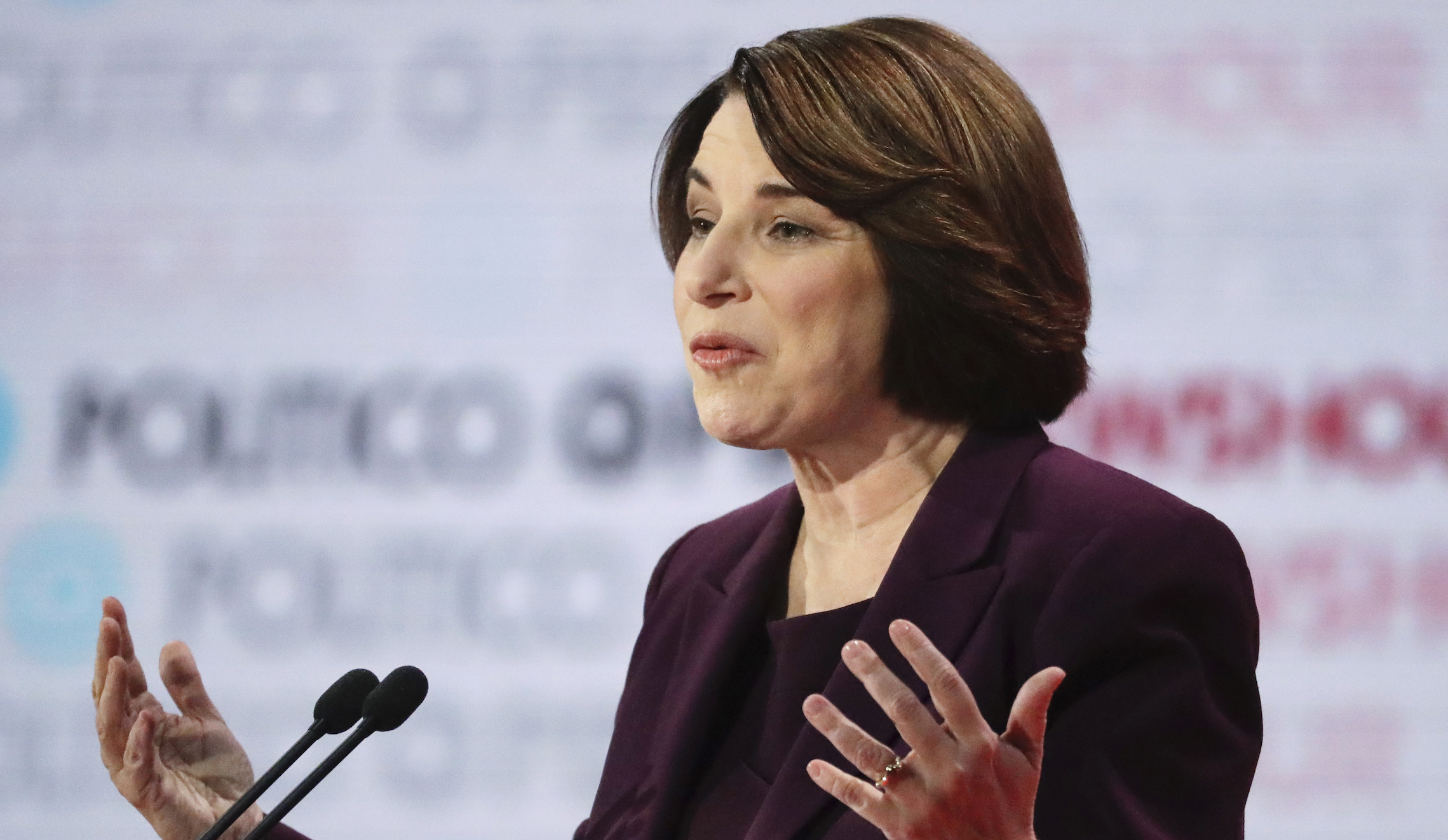
Amy Klobuchar’s late surge in Iowa will make her a target when the top 2020 Democratic presidential candidates next debate in Des Moines on Jan. 14.
The U.S. senator for Minnesota’s prosecutorial record is likely to be a principal line of attack.
Recommended Stories



“She’s a cop” rhetoric helped doom the White House bid of California’s Sen. Kamala Harris. She had emphasized her experience as San Francisco district attorney, California attorney general, and prosecutor in Alameda County.
Klobuchar, 59, the other former prosecutor in this Democratic primary, has so far sidestepped the same level of scrutiny, mostly whipped up by liberal criminal justice reform activists.
She quit corporate law in 1998 to run for Hennepin County attorney and won her race by less than a percentage point. As chief prosecutor for Minnesota’s most populous county, including Minneapolis, the Yale graduate and University of Chicago-trained lawyer vowed to be “tough on crime” to overturn the city’s “Murderapolis” reputation, a nickname it earned in 1995 after its homicide record peaked.
During her police union-backed campaign, Klobuchar adopted former New York City Mayor Rudy Giuliani’s and his police commissioner William Bratton’s “broken window” approach to law and order, a stance taken by many Democrats and Republicans at the time, which meant a crackdown on minor offenses to prevent an escalation to more serious crimes.
Once in office, she pushed for harsher penalties for nonviolent and repeat offenders, such as drug dealers, drunk drivers, graffiti taggers, check forgers, and fathers who didn’t pay child support, regardless of whether the offenders were minors.
Klobuchar also supported school truancy prosecutions, according to a Vox report, a position Harris was crucified for this election cycle. Those kinds of tactics, liberal critics argue, disproportionately affect minority and poor communities. In Klobuchar’s case, it helped build her statewide profile, resulting in an easy Senate win in 2006 for an open seat.
Now, campaigns of 2020 Democratic primary critics of Klobuchar are likely scrutinizing these and other episodes from her law enforcement past.
Police shot and killed more than two dozen people, while another four died in custody during Klobuchar’s tenure as district attorney, an American Public Media report found. She directed all but one case to a grand jury, and none of the officers involved were charged. One of the more controversial cases was the strangling of Christopher Burns, 44, in 2002, the same year a race riot broke out in north Minneapolis.
Burns, an unarmed black man, had the cartilage around his throat fractured when two officers put him in a sanctioned chokehold after he resisted arrest. The officers had been called to his Minneapolis home to respond to a domestic violence complaint. His 4-year-old daughter, one of his three children, witnessed his death. His fiancee was awarded $300,000 from the City of Minneapolis in a civil lawsuit over the incident, which the convened grand jury ruled as a “justifiable homicide.”
Klobuchar has been criticized for her record, but the worst may be yet to come as her political stock rises ahead of Iowa’s opening nominating contest on Feb. 3.
Shortly after she announced her White House bid in February, Klobuchar was hit over claims there were racial disparities in the way she enforced the law in Hennepin County more than a decade ago.
“I don’t have a perfect record. But I promise you, every single day in that job, I tried to put myself in other people’s shoes to try to do the right thing,” she said in March.
The same month, she conceded that she could have done “better” during her two terms. She touted her efforts to diversify her office, her team’s “community prosecution model” aimed at creating closer ties with the community, and her collaboration with the Innocence Project in a pre-Black Lives Matter era before cellphones were ubiquitous, to ensure interrogations were videotaped, DNA testing standards were met, and eyewitness identification processes were as impartial as possible.
“There was a 65% decrease in incarceration of African-Americans when you go from the beginning of my term to the end,” Klobuchar said. That answer, derived from Vera Institute of Justice data, glosses over the fact that although Hennepin County’s jail population dropped by more than two-thirds, the county’s prison population during the same time period only went down by about 14%, reflecting statewide trends, but still higher than the national average.
Klobuchar doesn’t shy away from her prosecutorial past.
During her 2020 announcement address, she hyped how she’d always believed “in doing my job without fear or favor” and “not only convicting the guilty but protecting the innocent.” Yet she also upset activists for endorsing the use of grand juries during 2014 Senate hearings on civil rights after the race-infused unrest in Ferguson, Missouri, sparked by a white police officer fatally shooting black teenager Michael Brown. She rankled the same stakeholders with her response to the shooting death of Philando Castile, 32, during a 2016 traffic stop in Falcon Heights, Minnesota.
But unlike Harris, criminal justice reform isn’t a central plank of her 2020 platform. Instead, she’s prioritizing expanding prescription drug access, an antitrust clampdown, and investing in rural America, such as with infrastructure and internet projects.
Despite the Democratic base’s heightened sensitivity to criminal justice matters, she’s also jockeying for a center-left lane rather than Harris’s confused attempt to straddle the entire left side of the political spectrum.
Washington, D.C.-based lawyer Douglas Gansler, who was Maryland attorney general at the same time Harris was her state’s top cop, defended Klobuchar’s embrace of her prosecutorial background.
“Being a prosecutor should be an asset to anybody running for president — not only because people want to feel safe domestically and internationally, but because she is better able to prosecute her case to the American people on her issues,” Gansler, 57, a Democrat, told the Washington Examiner.
Bob Ney, a former Republican Ohio congressman who in 2007 was sentenced to 30 months in prison for conspiracy charges and making false statements regarding Jack Abramoff’s Native American casino lobbying scandal, said her prosecutorial record would a liability at a time of increased, and often critical, focus on criminal justice reform.
But Ney, 65, predicted liberals wouldn’t judge Klobuchar “as harshly” as they did Harris, particularly as she emphasizes her Senate experience over her time as a prosecutor.
“[Klobuchar] did take a ‘tough on crime’ approach. Even crimes of graffiti, she had some things on record, and drug offenses. I just think Kamala Harris was more high-profile,” he said. “But if you look at the criminal justice system and how people today look at it, especially in the progressive community, I think [Klobuchar’s] going to take her fair share of hits, it just hasn’t been out there or focused on too much at this point in time because she was not out front or gaining at all.”
