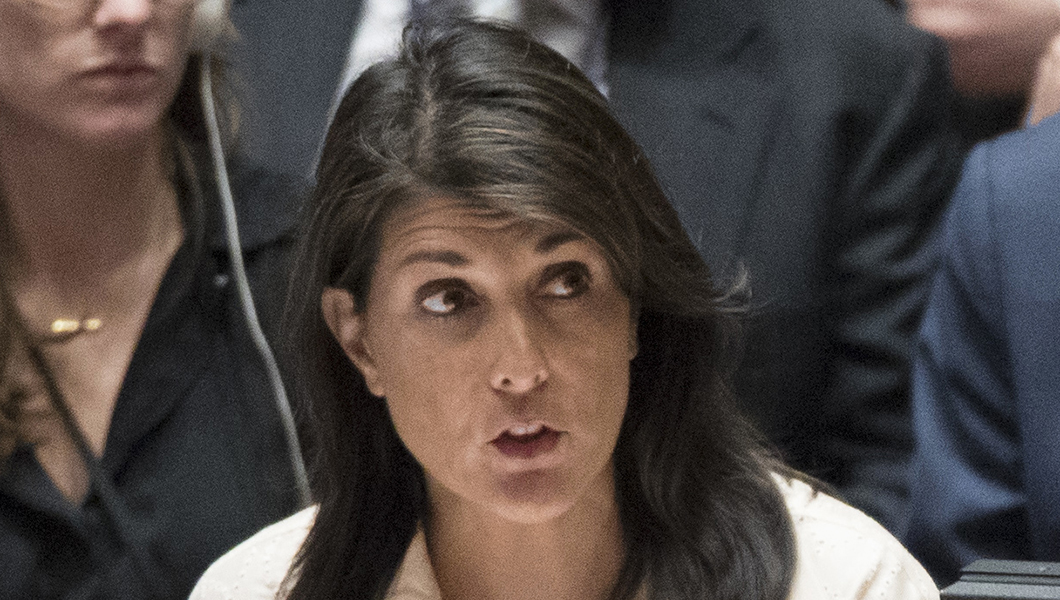
Russian and Syrian regime forces are behaving like “terrorists” in their assault on a rebel-held city of Idlib, a top U.S. ambassador told the United Nations.
“It is a disgusting tactic of terrorists, not professional soldiers,” Ambassador Nikki Haley told the U.N. Security Council.
Recommended Stories
She was referring to so-called “double-tap” airstrikes, in which pro-regime forces conduct two airstrikes in the same area, timing the second to target the first responders who flock to the scene after the first barrage. The most famous first responders are known as the White Helmets, but Russia maintains that they are terrorists who have joined the effort to overthrow Syrian dictator Bashar Assad.
“We’ve heard a lot of talk today but we haven’t seen any actions to indicate that Russia, Iran, and Assad are interested in a political solution,” Haley said. “The United States is long past taking Russia and Iran at their word that they are interested in protecting civilians in Idlib from further violence.”
Her Russian counterpart dismissed those remarks, and backed Assad’s play for territorial control instead.
“All the incantations we hear abut Idlib they are a result not only of concern for the civilians that live there,” Ambassador Vassily Nebenzia said after Haley spoke. “They are explained rather by an attempt in any way possible keep a major terrorist enclave in Syria and thus prevent restoring the full control by the Syrian government over its territory. We appeal to you, exhort you to give up on those attempts and to become involved in a political settlement.”
Idlib is the last major provincial capital held by anti-Assad forces. About 10,000 members of Syria’s al Qaeda affiliate are in the city, according to U.N. estimates. There are about 100,000 anti-Assad fighters in the city, according to other western estimates, because a variety of opposition groups have retreated to the city as Assad took control of other landmarks.
“No matter what type of weapons or methods are used, the United States strongly opposes any escalation of violence in Idlib,” Haley said.
Nebenzia understood Haley to be threatening the kind of western retaliation previously reserved for punishing Assad’s use of chemical weapons, although Russia denies that Assad has carried out the gas attacks.
“I heard the position expressed by our western partners and it became nuanced,” he said, through a U.N. translator. “The wordings started sounding basically along the lines that force against a sovereign state, Syria, can be used and not only related to the alleged use of chemical weapons, but, basically, also if there is a military operation in Idlib as well. Could you not switch notions here? We are not referring to a military operation but to an anti-terrorist operation in Idlib.”
Russia wants western powers to help rebuild Syria, despite their opposition to the Syrian regime and Assad’s tactics during the long-running civil war. Haley maintained that it would be “absurd” to reconstruct territory capture by Assad.
“Russia and Iran are demolishing Idlib and asking us to call it peace,” she said.
