

If you’re looking to commemorate Václav Havel’s death you could do worse than read this piece by Anne Appelbaum on the famous Czech from THE WEEKLY STANDARD archives, “Rebel with a Cause: Vaclav Havel from dissident to president.” It’s a warts-and-all assessment, but Appelbaum notes that Havel’s flaws couldn’t begin to outweigh the import of some of his ideas:
His famous 1979 essay, however, “The Power of the Powerless,” isn’t hampered by that flaw. Clear and concise in an almost Anglo-Saxon fashion, it is also just about the only political tract written by the 1968 generation that actually had any international influence and merits re-reading. By contrast, the writings of Miklos Haraszti (a Hungarian of comparable glamour) now seem dated: His book, The Velvet Prison, will be relevant only to historians of Hungary. The same is true of Michnik (perhaps the only Pole of comparable fame). Michnik’s most celebrated essay — a tactical argument in favor of reconciling the Polish Church and the “Lay Left” (in order to fight communism) — doesn’t have relevance anymore even in Poland, where the Church and the “Lay Left” (led by Michnik) are again at loggerheads.
But “The Power of the Powerless” sums up the theory of resistance to totalitarianism in a way that is relevant not only to Central Europeans but to anyone living under a regime that tries to control every aspect of its subjects’ lives, from work to school to leisure. To fight such a state — and to live an ethical, moral life — Havel promoted the notion of “living in truth.” This did not necessarily mean going to demonstrations or waving banners. Instead, Havel advocated living one’s everyday life as if the regime did not exist, to the extent that was possible.
In a totalitarian society, this was a genuine form of resistance, and by the late 1980s, it was widely practiced across the region. The first time I went to Poland in 1987, I stayed with friends. According to the law, I was supposed to register with the police the fact that I was staying in a private home. “We don’t do that,” my friends told me. “We don’t believe the police have the right to know who stays with us.” I didn’t register — and because thousands of other people didn’t either, the law gradually became unenforceable.
Just how profound is this notion of “living in truth”? Early this year, also in the pages of THE WEEKLY STANDARD, Ellen Bork reported that Havel continues to inspire Chinese dissidents:
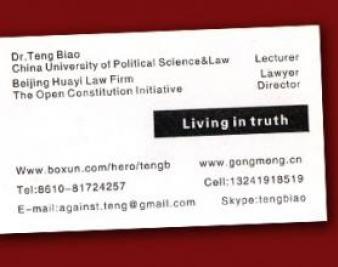
Teng Biao’s business card displays the motto “living in truth.” The phrase comes from former Czech dissident and president Vaclav Havel, who used it to describe resistance to totalitarianism. In his famous essay “The Power of the Powerless,” Havel wrote that “living in truth” depends “not on soldiers of its own, but on the soldiers of the enemy as it were—that is to say, on everyone who is living within the lie and who may be struck at any moment (in theory, at least) by the force of truth.” That is the potential of Teng Biao, wherever he is, and of his fellow dissidents.
It would seem that “living in truth” makes for a pretty impressive epitaph.
