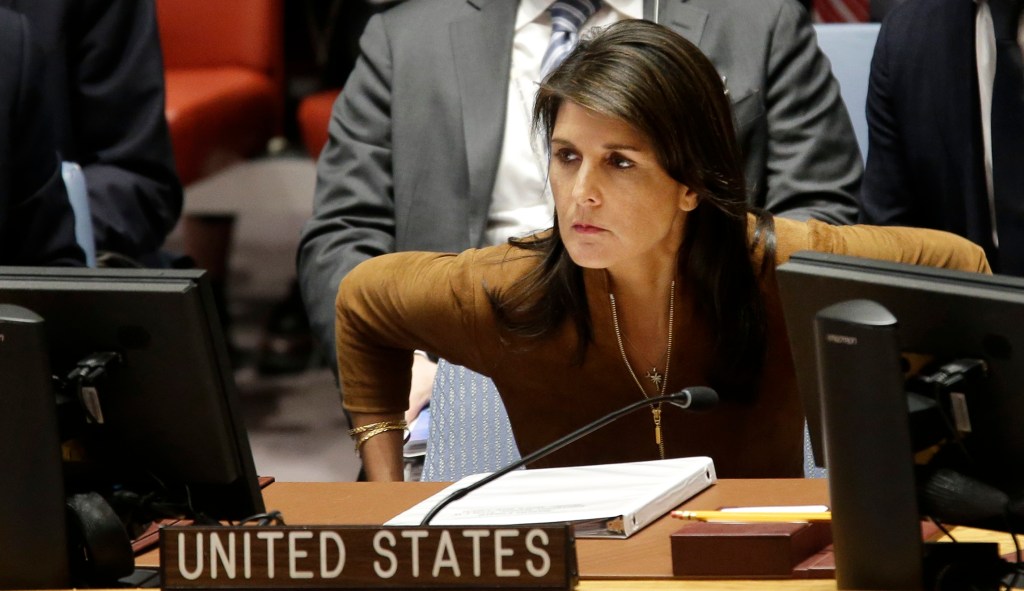
Ambassador Nikki Haley renewed her threat to cut foreign aid for countries that oppose the United States at the United Nations, after a State Department review showed agreement with the U.S. plummeting over the last year.
“The American people pay 22 percent of the UN budget — more than the next three highest donor countries combined,” Haley said Thursday evening. “In spite of this generosity, the rest of the UN voted with us only 31 percent of the time, a lower rate than in 2016. That’s because we care more about being right than popular and are once again standing up for our interests and values. Either way, this is not an acceptable return on our investment. “
Recommended Stories

That was a double-swipe at the U.N. and former President Barack Obama’s administration, as the 31 percent average is “a 10 percentage point drop from 2016” under the State Department’s calculations. Haley’s response renewed a threat previously leveled in December, when the U.N. General Assembly voted to condemn President Trump’s decision to recognize Jerusalem as the capital of Israel and move the U.S. embassy to the ancient city.
“President Trump wants to ensure that our foreign assistance dollars — the most generous in the world — always serve American interests, and we look forward to helping him see that the American people are no longer taken for granted,” she said.
The voting record compiled in the report might overstate the divergence between the United States and other countries, according to a caveat in the report.
“The vast majority of resolutions in various UN bodies are approved by consensus where no votes were taken,” the reports says. “Overall voting correlation between countries is highly dependent on the types of resolutions that come to a vote. For example, in the UNGA, Israeli-Palestinian issues account for approximately one-quarter of resolutions that are adopted with a vote, skewing the voting coincidence metrics for countries that oppose these resolution.”
But the disagreements could also be seen by focusing on the rarity with which the United States supported U.N. General Assembly resolutions.
“In 2017, the United States voted against more UN General Assembly resolutions (71 percent) than any other UN member state,” the report says. “The average UN member state voted against six percent of resolutions. In 2016, the United States also voted against the most resolutions (58 percent).”
The report, an annual review that has taken place since 1984, could function in the Trump administration as a roadmap for foreign-aid cuts. “When we arrived at the UN last year, we said we would be taking names, and this list of voting records speaks for itself,” Haley said.