

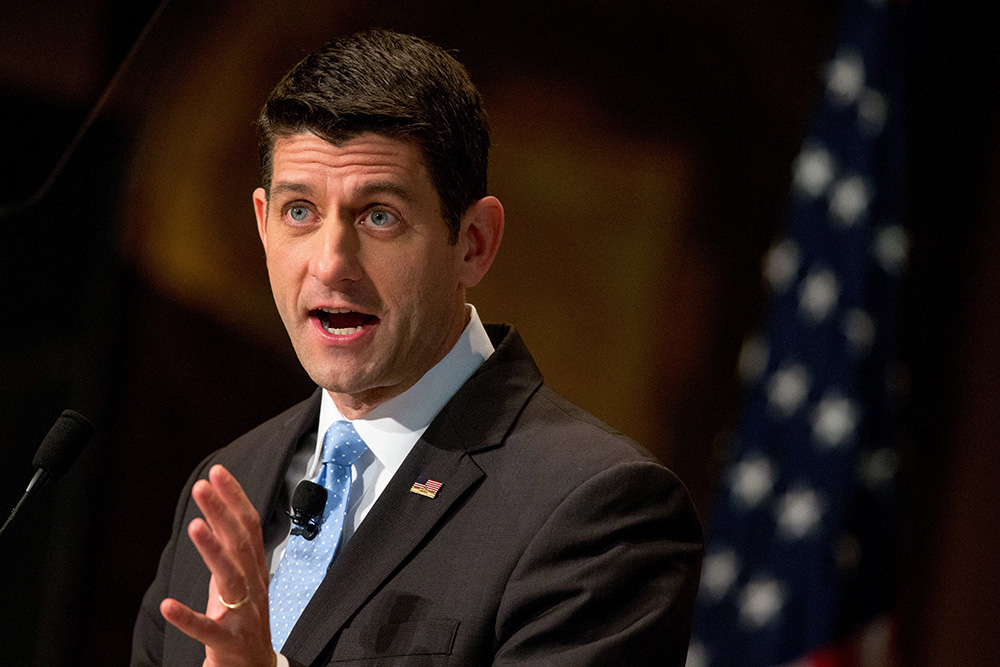
Paul Ryan dropped a bombshell on the Republican Party Thursday, refusing to endorse Donald Trump as its presidential nominee.
The shock announcement escalated the House speaker’s fight with the New York businessman over the direction of the GOP, deepening the rift between traditional, Reaganite conservatives and the surging, populist movement led by the presumptive nominee.
Recommended Stories


Ryan, the nation’s highest ranking Republican until now, had chastised Trump throughout the primary campaign for uncivil conduct and an agenda the deemed both incoherent and insufficiently conservative. But doing so before Trump had defeated all his rivals in the primary, and all-but guaranteed himself the nomination, is one thing.
Speaking against the titular head of his party is quite another, much less refusing to support him now, at the outset of a contentious campaign against likely Democratic presidential nominee Hillary Clinton. Ryan’s astonishing intervention was, say his aides, a deliberate and calculated decision to challenge Trump.
The comments by the Wisconsin congressman, and Trump’s response, shined a glaring spotlight on to the titanic battle now raging for the soul of the 162 year-old party, laying bare the deep ideological and moral fissures wrought by the 2016 campaign.
“Ultimately, it was a gut call,” said a Republican source familiar with Ryan’s thinking. “He gave a voice to many of his House colleagues, to many of his fellow conservatives.”
Ryan spoke out Thursday during an interview on CNN with an incredulous looking Jake Tapper.
The Washington journalist repeatedly offered Ryan opportunities to qualify his tough words for Trump, or walk them back, but the speaker wouldn’t budge. The GOP’s 2012 vice presidential nominee didn’t foreclose endorsing Trump down the line, but said he wants to see the celebrity billionaire adopt a more conservative agenda and present a more inclusive persona.
“I think what a lot of Republicans want to see is that we have a standard-bearer that bears our standards and that unifies all the wings of the Republican Party,” Ryan said. “I think what is required is that we unify this party. And I think the bulk of the burden on unifying the party will have to come from our presumptive nominee.”
Trump responded in a prepared statement, mild by his standards but in terms that suggest he doesn’t have any intention of altering his approach. “I am not ready to support Speaker Ryan’s agenda. Perhaps in the future we can work together and come to an agreement about what is best for the American people. They have been treated so badly for so long that it is about time for politicians to put them first!”
Trump is a populist who rejects traditional Republican dogma — dogma that Ryan has helped shape over the past decade.
Ryan supports overhauling entitlements like Medicare and Social Security; Trump has campaigned on leaving the programs as-is. Ryan supports free trade; Trump is a protectionist. Ryan’s foreign policy resembles the internationalism of President Reagan; Trump is an isolationist who describes his strategy as “America First.”
Ryan supports immigration reform; Trump wants to reduce legal immigration and actively round up and deport illegal immigrants. Ryan’s wing of the party doesn’t agree on everything, but are for the most part small-government conservatives who believe in free markets. Trump envisions a greater role for the federal government, believing that the problem with Washington has been bad management.
A House Republican aide with ties to leadership told the Washington Examiner that Ryan’s remarks were an attempt to push Trump to be more reasonable.”
“Remaining divisions after the nomination battle is settled have typically been the result of hurt feelings and bruised egos. But this is different,” said a veteran GOP campaign strategist. “Trump has supported single-payer health care, said George W. Bush should have been impeached, and helped finance the Pelosi-Reid takeover of Congress in 2006. And now everybody is just supposed to ignore the facts and fall in line because Trump decided a few years ago to put an ‘R’ next to his name?”
It’s these differences stark differences in policy, not to mention Trump’s perceived insensitivity toward ethnic minorities and penchant for tarring his opponents with personal insults, that have Republicans acknowledging that their party is much more divided than usual as the 2016 primary comes to a close.
Ryan is the most prominent Republican to withhold support from Trump, but he’s not the only one. Sen. Ben Sasse of Nebraska and Rep. Ann Wagner of Missouri, also are holding out, as are many well-known conservative thinkers, activists and big time contributors. All are repelled by Trump, both his policies and his behavior.
Still, there are many party stalwarts that begun to come around, some enthusiastically. Senate Majority Leader Mitch McConnell is backing Trump, as are some prominent members of the Republican National Committee and luminaries like former House Speaker Newt Gingrich. Even some GOP donors have started to come around, despite Trump spending the last year referring to them as crooks.
Republicans optimistic about the party’s ability to unify say that Clinton is the perfect antidote for what ails them. They predict the GOP will emerge from the July convention in Cleveland healed.
“It’s going to take time. Trump has to do his part to bring us together, but most Republicans are already there because they reject Hillary,” said Henry Barbour, an RNC committeeman from Mississippi who supported one of Trump’s rivals in the primary.
