

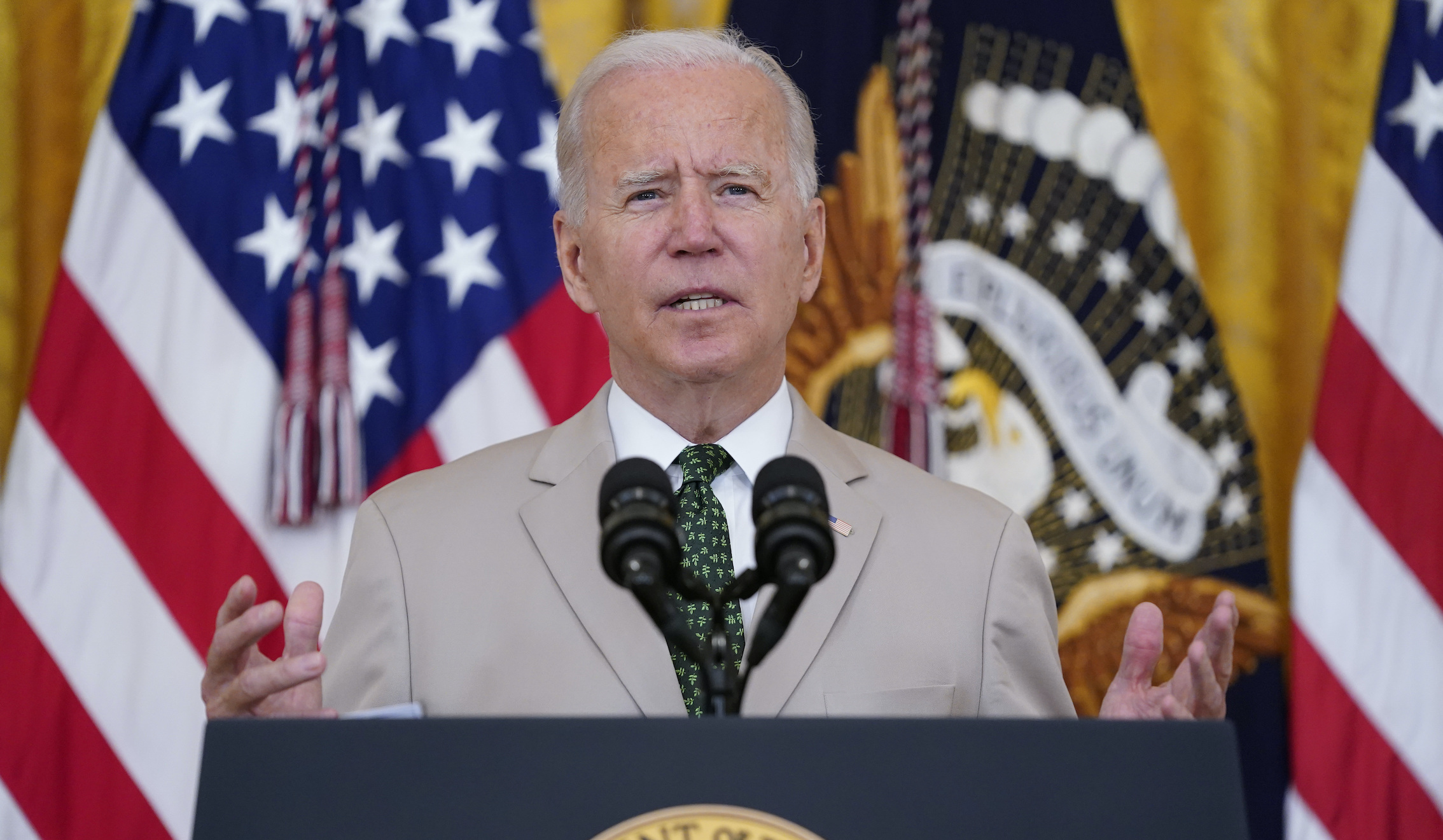
President Joe Biden’s expensive infrastructure and social welfare packages are exacerbating the Democrats’ challenges with the federal budget deficit and debt limit negotiations as he and congressional allies brace for the 2022 midterm elections.
Biden’s $1.2 trillion bipartisan brick-and-mortar bill and its Democratic $3.5 trillion social welfare and environmental reconciliation counterpart are hindering discussions with Republicans over raising the debt ceiling after the 2019 deal expired last month and the Treasury Department started operating under “extraordinary measures.”
Recommended Stories


CORONAVIRUS RESURGENCE CATCHES BIDEN OFF GUARD
Biden and congressional Democrats are under pressure to lift the debt limit before Sept. 30. After that deadline, the federal government will run out of money, and the country will default on its loans. But their task is complicated by the August recess and a lack of public understanding regarding the process, which actually aids Republicans looking to score political points before the 2022 cycle.
The greatest misconception about the debt cliff is that it concerns money that has already been borrowed, according to Shai Akabas, the Bipartisan Policy Center’s economic policy director.
“Many people will understandably associate an increase in the debt limit with enabling lots of new government spending, especially when it’s paired with a large piece of spending legislation,” he told the Washington Examiner. “There is a danger that these issues get conflated for the public in a way that does not necessarily reflect particularly well on the congressional leadership’s agenda.”
For Akabas, Democrats and Republicans are “playing chicken” with the debt ceiling. That is in response to reports that Senate Majority Leader Chuck Schumer is seeking to suspend the $28 trillion borrowing cap through a stopgap funding bill, which would avoid a government shutdown at the end of next month. His strategy corners Republicans into recording their vote while underscoring how the GOP allowed the country to take on further obligations and contributed to the deficit under former President Donald Trump. It also provides political cover for his own party ahead of 2022.
“The events on Capitol Hill help to reinforce preexisting notions,” he said. “If a voter thinks that Democrats are predisposed to spend more than that voter thinks is necessary, this type of event could reinforce that notion. And similarly, if a voter is inclined to think that Republicans are being obstructive and irresponsible, then this debate could reinforce that notion as well.”
Republicans contend they have given Democrats advanced notice of their position and that they can act alone. That negates the GOP’s culpability if the country’s credit rating is downgraded, they say.
Akabas criticized Democrats and Republicans for only superficially addressing the debt limit. He argued the two sides are merely jockeying to be the one “perceived” to take the problem “more seriously.” His argument runs parallel with House Republicans in 2011 who disagreed with former President Barack Obama over borrowing reforms.
“Both parties have come to realize that it is not serving anybody’s interests from a substantive perspective,” he said. “It has not been the catalyst for debt reduction that many people hoped it would be, and it’s put the U.S. economy at risk time after time.”
Akabas urged lawmakers to consider “mostly or fully paying for the new things we want to do” so the country could pivot to “how we make up for lost time with past decisions.” About $3 trillion was added in red ink during the financial year 2021 alone, the largest yearly deficit compared to the overall size of the economy since World War II.
Debt ceiling talks coincide with the prospective passage of Biden’s infrastructure proposals. But his bipartisan accord took a hit this week when the Congressional Budget Office found it would add $256 billion to the deficit over the next decade. The CBO’s announcement prompted Tennessee Republican Sen. Bill Hagerty to hold up proceedings, though the White House and the Senate negotiators have defended their numbers.
“As expected, CBO confirms half the bill is paid for with new revenue that ‘scores,'” Sen. Mitt Romney tweeted. “The other half is paid for with savings and other revenue (unused UI, unused COVID $) that don’t score under their rules, but they are real dollars,” the Utah Republican wrote, referring to untapped unemployment insurance and other funding allocated through the $1.9 trillion coronavirus package.
In the meantime, the White House is imploring lawmakers to cooperate on the debt limit because it is the “responsible step for our country.”
CLICK HERE TO READ MORE FROM THE WASHINGTON EXAMINER
“The president believes that Democrats and Republicans should move forward, as they did three times during the last administration, to raise the debt ceiling — something that they did even in the wake of the former president putting in place a $2 trillion tax cut that certainly did not do anything to reduce the deficit,” press secretary Jen Psaki said this week.
