

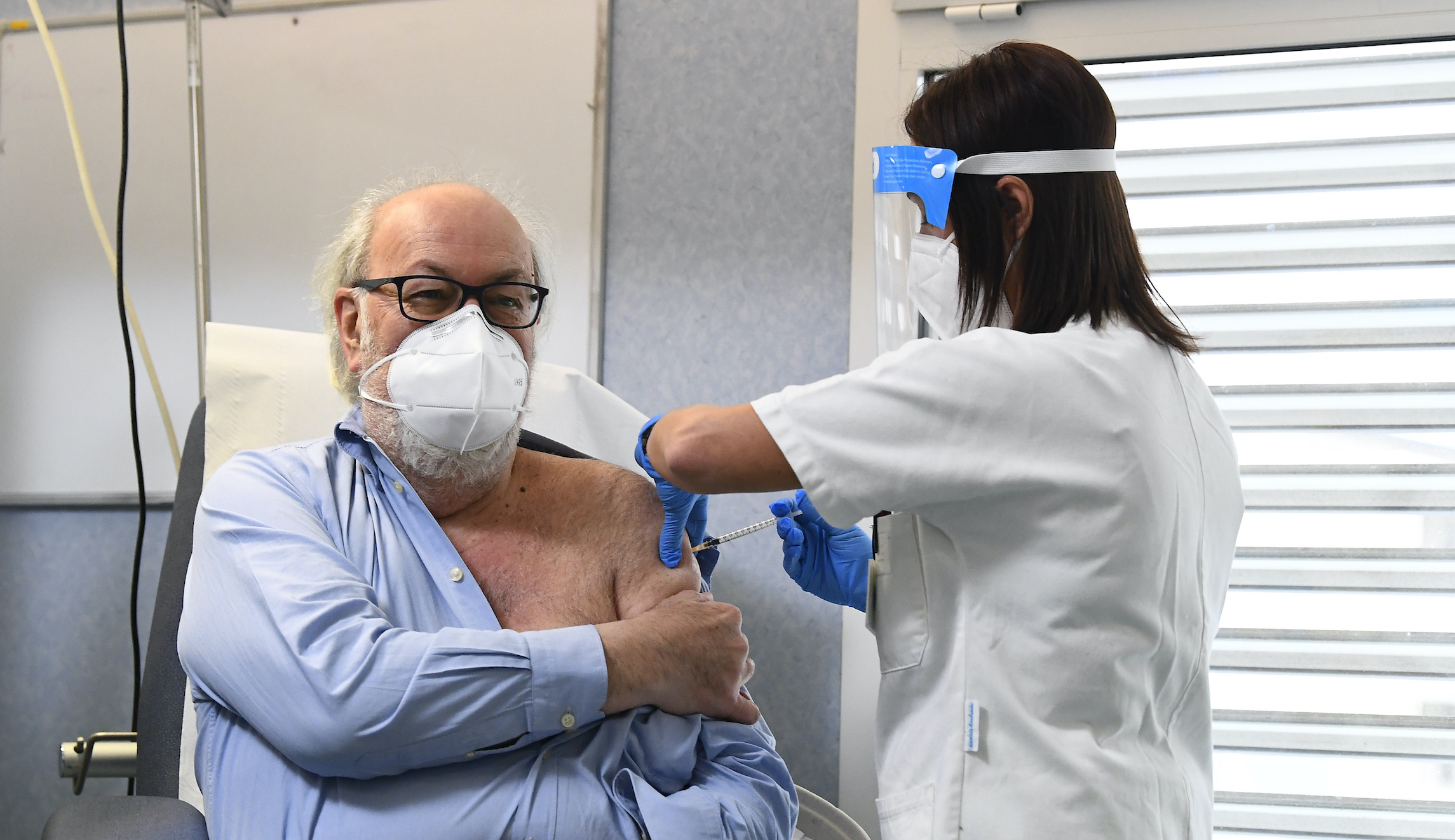
The Trump administration said Monday that far more have been vaccinated in the United States than estimates suggest, meaning that the rollout is faster than the numbers indicate.
“That 2 million number is probably an underestimate,” Adm. Brett Giroir, Health and Human Services assistant secretary, said on Good Morning America Monday. “We certainly expect that to be a multiple of 2 million.”
Recommended Stories


Vaccine administration data collected by the Centers for Disease Control and Prevention shows that 1.94 million shots have been given in the U.S. since the distribution process began on Dec. 14.
Giroir, who also serves as testing czar on the coronavirus task force, added that the lag time between administering the shots and reporting the number of shots given each day is about three to seven days, meaning the actual number of vaccinations will balloon in the coming days as more data reaches the CDC.
“By the end of this week, in the hands of the states, over 15 and a half million doses,” Giroir said. “We will have another allocation on Tuesday, that’s the rhythm … So 20 million doses will be distributed to the states by the first week in January.”
The Trump administration will ship over 4.7 million doses this week. Giroir added that the government will ship out “probably another 30 million doses in January, another 50 million in February.” The administration said in early December that as many as 100 million people could be inoculated by the end of February, constituting most of the vulnerable population.
There are 334,116 confirmed coronavirus deaths in the U.S. and over 19.2 million confirmed cases. Current case totals are undercounts, given that many infections go undetected and undiagnosed.
Maryland-based vaccine manufacturer Novavax launched phase three trials of its two-dose coronavirus vaccine Monday, the fifth company to do so since the pandemic began. The company will enroll up to 30,000 volunteers in the U.S. and Mexico in sites “where transmission rates are currently high, to accelerate the accumulation of positive cases that could show efficacy,” the company said.
The sample will be broken into two cohorts, people ages 18 to 64 and people over 65, to test the safety of the two-dose vaccine and its effectiveness in preventing COVID-19. The trial is funded by the Trump administration’s vaccine development initiative Operation Warp Speed, which awarded Novavax $1.6 billion in July to develop the shots.
South Dakota Gov. Kristi Noem said her state has “perhaps the strongest economy in the country” after refusing to implement lockdowns. Data from the South Dakota Department of Labor and Regulation shows the unemployment rate decreased by 0.2% to 3.5% in November.
Zhang Zhan, a Chinese citizen journalist who documented the pandemic early on in Wuhan last February, was convicted of “picking quarrels and provoking trouble,” her attorney Zhang Keke told CNN. Zhang Zhan, 37, was wheelchair-bound at the Monday sentencing hearing because she has become frail and weak while in the custody of Chinese authorities, according to her lawyer.
Zhang was detained in May by government officials, who argued she was guilty of “publishing large amounts of fake information” and was giving interviews to foreign news outlets to “maliciously stir up the Wuhan COVID-19 epidemic situation.” Her lawyer pushed back on the notion and said no evidence was presented to back up that claim.
According to Dr. Celine Grounder, President-Elect Joe Biden will invoke the Defense Production Act to aid in the production of coronavirus vaccines. The law enables presidents to force companies to prioritize manufacturing for national security. Invoking it could help vaccine manufacturers secure the materials needed to make the coronavirus vaccine.
“The idea there is to make sure the personal protective equipment, the test capacity, and the raw materials for the vaccines are produced in adequate supply,” Grounder, a member of Biden’s COVID-19 advisory board, told NBC’s Squawk Box Tuesday.
The World Health Organization warned that the coronavirus pandemic might be relatively mild compared to future outbreaks. Dr. Michael Ryan, the executive director of the WHO’s Health Emergency Program, said the reason for the pandemic not being the big one is that the case fatality rate for the coronavirus is “reasonably low compared to other emerging diseases.” He did not specify what those emerging diseases were.
“This pandemic has been very severe. It’s spread around the world extremely quickly and affected every corner of this planet. But this is not necessarily the big one,” Ryan said at a WHO press conference on Monday.
South African President Cyril Ramaphosa has reimposed a ban on alcohol sales, ordered all bars to close, and made violating the country’s mask mandate a criminal offense in an effort to stave off another coronavirus surge, the Associated Press reported. The new restrictions go into effect at midnight on Monday.
“As we had to in the early days of the lockdown, we now have to flatten the curve to protect the capacity of our healthcare system to enable it to respond effectively to this new wave of infections,” he said.
Russian officials admitted that the COVID-19 death toll was more than 3 times higher than previously reported, making it the country with the third-largest number of fatalities. Russian President Vladimir Putin has boasted the country’s low mortality rate since the start of the pandemic, but the Rosstat statistics agency said that the number of deaths due to all causes from January to November had risen by roughly 230,000 compared with the previous year, the Guardian reported.
“More than 81% of this increase in mortality over this period is due to COVID,” said the deputy prime minister, Tatiana Golikova, meaning that more than 186,000 people in Russia have died from COVID-19.
