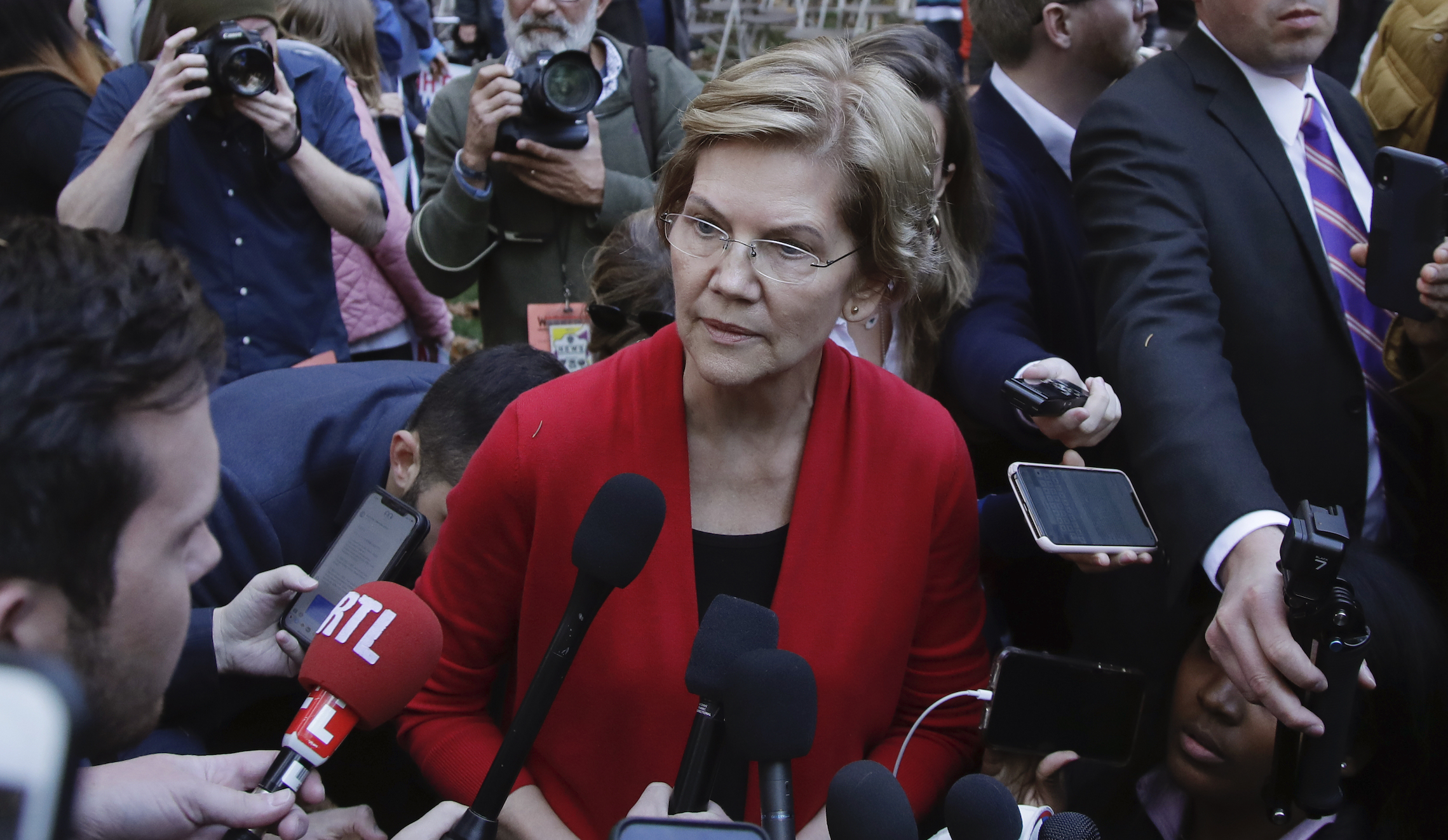
Following liberal Democrats, Warren has moved left on Israel

Published October 31, 2019 6:30pm ET


Elizabeth Warren has done a 180-degree turn on Israel.

Last week she became the third Democratic presidential candidate to declare she was open to cutting U.S. security assistance if Israel does not stop building settlements in the West Bank, joining Bernie Sanders and Pete Buttigieg.

“If Israel’s government continues with steps to formally annex the West Bank, the U.S. should make clear that none of our aid should be used to support annexation,” the Massachusetts senator said via video link at a conference Monday in Washington, D.C., hosted by J Street, a liberal, “pro-peace” Israel advocacy group.

Warren’s stance, laid out also in recent campaign trail statements and in a June Senate resolution, represents a shift in her stance toward Israel.

Around the same time as the Gaza War in 2014, Warren, then a freshman senator, declined to endorse the idea of conditioning U.S. assistance on the halting of settlements, telling a constituent that “there’s a question of whether we should go that far.”

The 70-year-old, who came into politics as a financial policy expert rather than as a diplomat, has also introduced the word “occupation” into her Israeli-Palestinian rhetoric, a sharp contrast to her 2012 Senate bid platform, which voiced her opposition to Palestine’s attempts to join the United Nations. This week at J Street, she underscored the importance of a two-state solution because it “ensures an end to Israeli occupation.” Earlier in 2019, she evoked similar language with IfNotNow activists, an American-Jewish organization against “Israeli occupation.” Two women told her they would “really love it” if she “pushed the Israeli government to end occupation” of Palestinian territories. “Yes, yes. So I’m there,” Warren said in reply.

Warren’s thinking regarding Israel’s right to defend itself has also changed, distancing herself from her previous hawkish image.

At the same 2014 Cape Cod event, Warren, whose first trip abroad as an elected official was to Israel that year, was pressed on her vote in favor of providing $225 million to the state for its “Iron Dome” air defense system. She defended her decision to back the transaction, emphasizing the “special” nature of U.S.-Israeli relations.

“Israel lives in a very dangerous part of the world, and a part of the world where there aren’t many liberal democracies and democracies that are controlled by rule of law. And we very much need an ally in that part of the world,” she said. “But when Hamas puts its rocket launchers next to hospitals, next to schools, they’re using their civilian population to protect their military assets. And I believe Israel has a right, at that point, to defend itself.”

[Opinion: Elizabeth Warren threatens Israel with aid cutoff but slammed Trump for cutting off aid to Palestinians]

Four years later, Warren’s language changed. After Israeli forces killed dozens of Palestinians attempting to breach the Gaza border in 2018, she told the Intercept she was “deeply concerned about the deaths and injuries.” The Israeli military had warned the demonstrators against rushing or damaging the border fence during a period of unrest marking the creation of the state of Israel in 1948.

“As additional protests are planned for the coming days, the Israel Defense Forces should exercise restraint and respect the rights of Palestinians to peacefully protest,” she said.

Her attitude toward the pro-Israel American Israel Public Affairs Committee has morphed as well. She declined to speak at AIPAC’s 2019 annual conference, despite attending dinners hosted by the organization’s Boston chapter in the past, and instead addressed the gathering of the liberal J Street.

“No presidential candidate would have gone and spoken at J Street in the past, speaking to their issues and honestly kind of pandering to them,” said Neil Strauss, the Republican Jewish Coalition’s national spokesman. “It would be one thing to go speak truth to power, but they’re there to tell them they’re with them.”

Warren has argued that criticizing Israel does not diminish the alliance between the two countries. “Israel is a strong ally, an important friend to the United States,” she told American Jewish Committee this summer. “Good friends can disagree and candid expression of concerns does not diminish our friendship. We can and should have an open policy debate.”

Warren’s Israel reflects a broader struggle among Democratic presidential candidates, in part exacerbated by the close relationship between President Trump and longtime Israeli leader Benjamin Netanyahu. Indeed, Warren, whose White House campaign is based on an anti-corruption message, has not been shy about her disapproval of Netanyahu following accusations that he accepted bribes and traded government favors.

The Democratic Party’s shift on Israel is evident in polling. The Pew Research Center found in 2018 that the partisan divide in Israeli-Palestinian sympathies is at its widest point since 1978. In particular, 35% of respondents who identified as liberal Democrats — a crucial component of Warren’s base — sympathized more with Palestinians than the 19% who said they sympathized with Israel, a reversal from past years.

For historian David Pietrusza, Warren’s transition belies “a growing, and perhaps, inevitable trend” toward foreign policy more critical of Israel.

“Right now, the stampede is to the left — and the Democratic Party’s left-wing is hardly pro-Israel,” said Pietrusza. “Hence, Warren — along with Buttigieg — are now in the business of making the ‘right’ Israeli-Palestinian noises to accommodate the ‘left.'”

But he warned, “It would be suicidal even in this Democratic primary season to be perceived as outright ‘anti-Israel,’ no matter how many progressive Democrat rank-and-file may now be more comfortable with Palestine.”

To Israel Policy Forum policy director Michael Koplow, Democratic opposition to settlement-building in the West Bank, home to 3 million Palestinians and roughly 400,000 Jews, is hardly “anti-Israel.” Instead, the party is becoming more anti-Netanyahu, he told the Washington Examiner.

“There is a near-consensus position among congressional Democrats in support of two states and in support of Israel and its security as a valuable ally of the United States,” Koplow said. “There is also a consensus position against annexation, which is why you see candidates — aside from Sanders — specifically tying any talk about conditioning security assistance to Israel to West Bank annexation.”

Yet he acknowledged that Democrats could face political trouble if the party aligns more with freshman Reps. Ilhan Omar of Minnesota and Rashida Tlaib of Michigan, who support the boycott, divestment, sanctions, or BDS, movement.

Although Jewish voters tend to vote more based on domestic policy, Democrats risk alienating some over Israel. “Small numbers of Jewish votes could be determinative in swing states like Florida, Nevada, and Pennsylvania,” said Dan Schnur, a University of Southern California and University of California, Berkeley professor.

The GOP is hoping to seize on that development in those states as well as Arizona, Michigan, and Minnesota said Strauss. “I think for a long time Jews have been comfortable voting on other issues because it felt like both parties were sufficiently pro-Israel, and that could change,” he said.

David Pasch, a former Trump administration official who now advises pro-Israel and Jewish groups through Targeted Victory, cautioned Democrats that some Jewish Americans “don’t feel like they have a political home” in the party anymore “because they’ve become increasingly uncomfortable with the rhetoric.” To Pasch, “Israel-bashing…says much more about where their base is in 2020 than it does about Israeli government policy” since conditions on the ground have not changed.

“They’re talking about an occupation, which is a historically inaccurate term, they’re flirting with the idea of cutting aid to Israel, and they’re refusing to condemn the BDS campaign, which is basically an illegal boycott of Jewish businesses,” he said. “These are positions that would have been totally outside the mainstream, but they’re quickly finding a home within mainstream Democratic politics.”
