

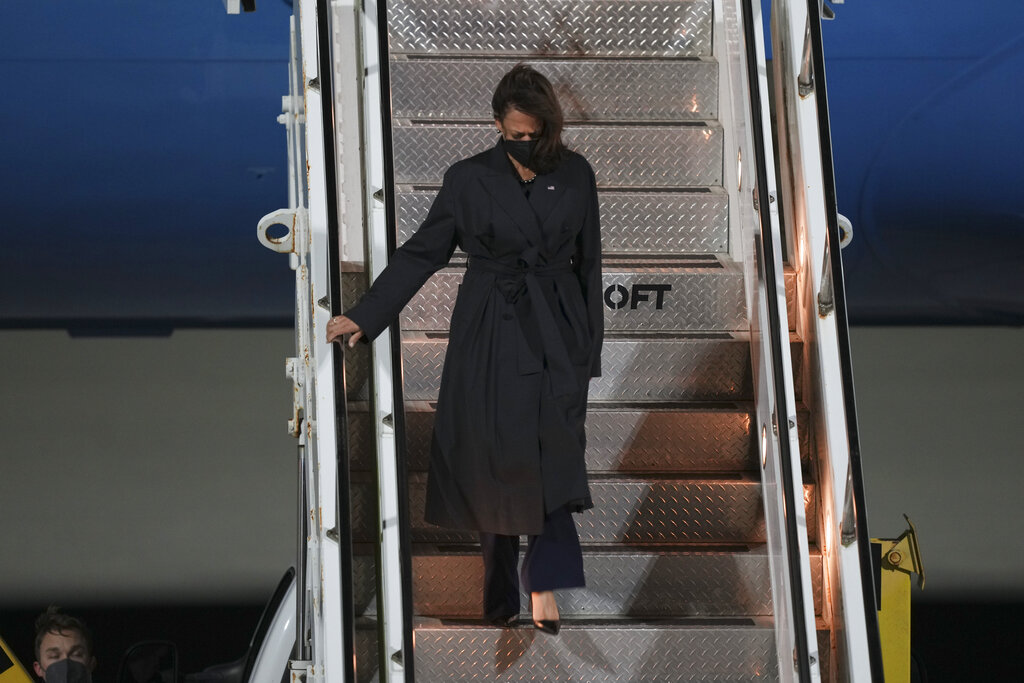
MUNICH — Vice President Kamala Harris is taking on her most important foreign policy assignment yet in Munich, meeting with American allies and partners as the threat of a bloody conflict with Russia looms.
One year into office, Harris has forged ties with prominent foreign leaders and sought to bolster her experience on immigration and defense issues in outer space. But the Munich Security Conference will be a proving ground for the vice president, putting her diplomatic skills to the test.
Recommended Stories


The visit comes as President Joe Biden warned that an attack by Russia on Ukraine could come within days. Harris is leading the American delegation to Munich, where she will be under a spotlight while navigating a series of high-stakes diplomatic engagements.
ANTONY BLINKEN: RUSSIA MIGHT USE CHEMICAL WEAPONS FOR UKRAINE ATTACK PRETEXT
The renewed alarm over a potentially bloody conflict places Harris at the center of the effort to deter Russian aggression. She is scheduled to hold meetings with European leaders and American lawmakers on the sidelines of the conference and deliver a formal address that is likely to be scrutinized closely.
Biden has a long history with the conference. He delivered the Obama administration’s first major foreign policy address in Munich in 2009 on resetting relations with Russia and attended numerous times as a senator, vice president, and a private citizen.
For Harris, the assignment remains a vital opportunity to develop and flex her national security credentials while acting as a trusted conduit to the president.
“She’s not Dick Cheney, in that she’s not somebody who comes to this position with a huge amount of foreign policy experience,” Michael Kimmage, a history professor at the Catholic University of America and former State Department U.S.-Russia expert, told the Washington Examiner.
“She comes from the Senate, and she has well-articulated and well-informed views on foreign policy, but she’s not going to direct policy in the White House in the way that Cheney did or, say George Bush Sr. did when he was the vice president,” he added.
Harris has strengthened ties with foreign leaders over the past year in office, but none of her meetings in Washington and overseas capitals have had the challenging backdrop of the events this week in Europe, where the threat of provocations could spill into a deadly war.
Russia has massed some 160,000 troops on Ukraine’s borders, prompting fears from U.S. officials that a deadly conflict could come within days.
Russian President Vladimir Putin has denied any intent to invade Ukraine but has demanded security concessions from NATO, including a promise that the alliance will not add Ukraine as a member. This is a non-starter for Washington, but diplomatic efforts are ongoing between Russia and the west as the countries look to find a solution.
The issue isn’t new for Russia. In 2007, Putin addressed NATO expansion here, which remains at the root of his concerns over Ukraine today.
This week, the president renewed his warnings over the threat and pushed back on reports that Moscow was moving toward de-escalation.
“Putin has his own military-political-strategic timeline that he’s following in office, which may point to invasion or may not, but that said, this is probably the most dramatic Munich Security Conference in the history of the conference,” said Kimmage.
There is no official Russian delegation at the conference for the first time since 1999.
Harris will meet Friday with NATO Secretary-General Jens Stoltenberg and hold a meeting with the leaders of Latvia, Lithuania, and Estonia on the margins of the conference. In remarks on Saturday, Harris will lay out the administration’s strategy to forestall a conflict. The vice president will then meet with Ukrainian President Volodymyr Zelenskyy and German Chancellor Olaf Scholz.
“There will be several dozen world leaders present, and all of them are going to be focused on this very pressing challenge,” a senior administration official said.
Ultimately, her role will be to reassure allies and forge closer ties, said Joel Goldstein, a vice-presidential historian at St. Louis University.
“Her access to the president makes her someone other leaders are interested in meeting and maybe more likely to confide in since she reports directly to the president,” Goldstein said. The vice president will also be showcasing her work on the international stage.
In her address Saturday, Harris will underscore NATO’s strength when it moves in unison, underscoring Washington’s effort to threaten costlier, faster sanctions on Russia in the event of an offensive.
A senior administration official said it will also serve as a warning to Moscow, with Harris expected to weigh into how an attack “would leave Russia weaker.”
CLICK HERE TO READ MORE FROM THE WASHINGTON EXAMINER
Harris isn’t the only Cabinet official in Munich. Secretary of State Antony Blinken is also attending the conference and is joined by U.S. Ambassador to NATO, Julianne Smith, and bipartisan lawmakers.
