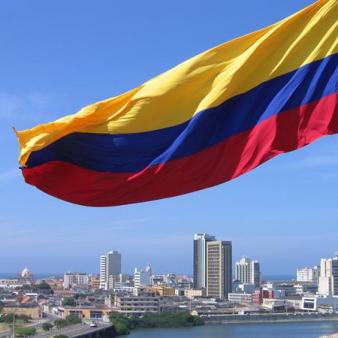
On October 21, President Obama signed into law the U.S.-Colombia free trade agreement (FTA), thereby giving American exporters greater access to one of South America’s fastest growing markets. The long, tiring debate over the FTA—which began five years ago, when the agreement was first completed—showed that popular perceptions of Colombia are stuck in a time warp. Not only has the country become a much safer and less violent place than it was in the 1980s, 1990s, and early 2000s, it has also become one of the most promising economies in the Western Hemisphere.
Last year, veteran Latin America correspondent Mac Margolis described Colombia as “a prospering dynamo,” noting that foreign direct investment (FDI) increased fivefold—and per capita GDP doubled—between 2002 and 2010. For that matter, the country received more than $7 billion worth of FDI during the first six months of 2011, an increase of 91.4 percent over the equivalent period in 2010. As the Wall Street Journal reported in mid-September, Colombia is one of six developing nations that “are being touted as the next generation of tiger economies.” Known by the acronym CIVETS, this group also includes Indonesia, Vietnam, Egypt, Turkey, and South Africa.