

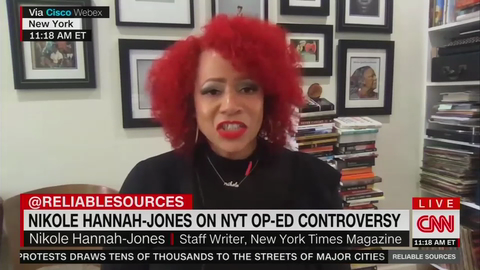
The founder of the New York Times’s 1619 Project once authored a lengthy speech attacking the entire white race and referring to Christopher Columbus as “no different” than Nazi leader Adolf Hitler.
Nikole Hannah-Jones, the lead essayist on the 1619 Project, made the comments in a 1995 letter to the editor in Notre Dame’s the Observer, arguing that “the white race is the biggest murderer, rapist, pillager, and thief of the modern world,” according to the Federalist.
Recommended Stories


Besides likening Christopher Columbus to Hitler, Hannah-Jones also said European settlers and explorers, in general, were “devils” and that the “lasting monument” of white people is the “destruction and enslavement of two races of people.”
Hannah-Jones expressed the belief that Africans were present in North America long before Europeans but befriended and traded with the indigenous people rather than conquered them.
She also criticized white people in modern times, saying they take advantage of others.
“The descendants of these savage people pump drugs and guns into the Black community, pack Black people into the squalor of segregated urban ghettos and continue to be bloodsuckers in our community,” she wrote.
Hannah-Jones ended the letter by claiming she does not hate white people.
“But after everything that those barbaric devils did, I do not hate them,” she wrote. “I understand that because of some lacking, they needed to constantly prove their superiority.”
Earlier this week, Hannah-Jones tweeted and deleted a claim that fireworks in Brooklyn were actually government forces covertly attacking “Black and Brown communities.”
Hannah-Jones was awarded a Pulitzer Prize for the 1619 Project, designed to reexamine the effects of slavery in America. Publication of the series was timed for the 400th anniversary of the arrival of the first enslaved Africans in Virginia.
Hannah-Jones conceded in March, seven months after the piece was published and while facing blowback from historians, that she got it wrong when she reported that “one of the primary reasons” the colonists revolted against England was to preserve the institution of slavery.
