

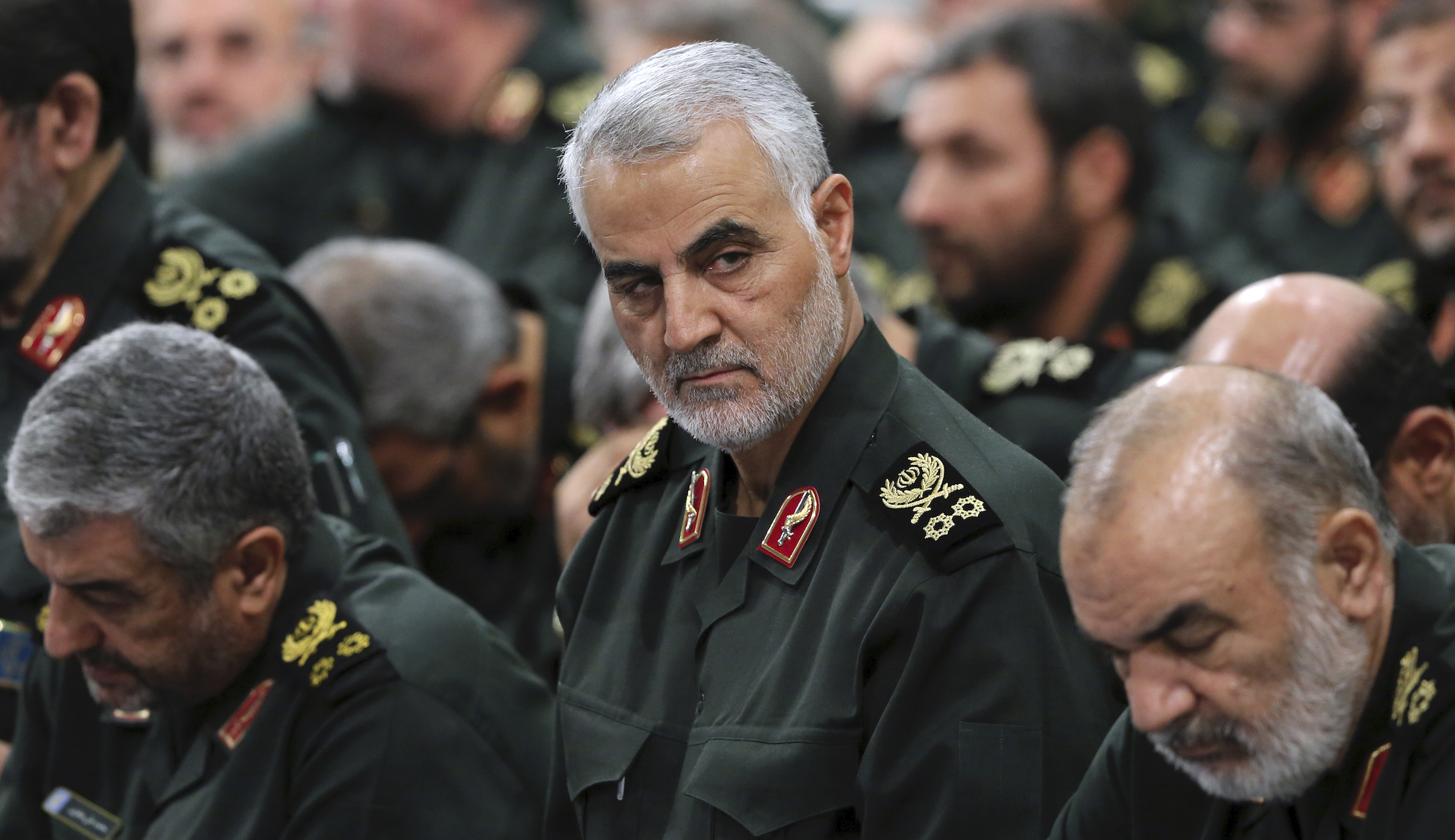
In 2007, intelligence officials for the United States had Qassem Soleimani in their sights, but leadership in the Pentagon opted not to kill the Iranian general.
Since Soleimani was killed by a drone strike on Jan. 2, President Trump has been claiming that the decision to kill the general should have been made “many years ago.” There was an opportunity to kill Soleimani in 2007 that was not taken because of fears that “contentious politics” could unfold, according to a Thursday report from Yahoo News.
Recommended Stories


An unnamed former U.S. intelligence officer claimed a Predator drone that was keeping watch over Baghdad, Iraq, saw a commotion in the neighborhood of Sadr City. The drone focused on the gathering and, through grainy footage, intelligence officials saw what looked like a group of fans swarming a celebrity.
“It was like someone was welcoming Obama to the streets of Sadr City,” the officer said. “It was electric.”
The high-flying drone couldn’t provide a clear feed for the officials, who were stationed in a tent near Baghdad International Airport, but Navy personnel assigned to the National Security Agency scanned communications in the region and learned that Soleimani was at the center of the pandemonium.
The intelligence officials surveilling Soleimani belonged to Task Force 17. The force, which consisted of U.S. Army Special Forces, was a secretive unit tasked with tracking the Iranian-backed militias that had been carrying out attacks in Iraq to minimize Iran’s influence in the region. One Army Ranger from the unit said the force’s actions were “very political” and were often bogged down by debates within the Pentagon. The force knew that the Predator drone overhead had missiles that could have ended Soleimani, but the officials came to the conclusion that the Iranian general was “untouchable.”
“We said, ‘Holy shit, it’s Soleimani pressing flesh with a bunch of people,’” the officer said. “There was a discussion, of course, of whether we should do something.”
They kept watch over Soleimani, but he later departed the gathering and disappeared from the scene after ducking inside a building.
John Maguire, a former senior CIA official, said Soleimani knew he was untouchable and acted like it. He was even spotted inside the Green Zone, a secure buffer within Baghdad that includes the U.S. Embassy, several times. Maguire called it a “bit of an embarrassment” to have Soleimani flaunt through the city while many of the officers wanted to detain him.
[Read more: Qassem Soleimani was responsible for the deaths of hundreds of American soldiers]
“We were asked for our assessment of what would be the fallout, and we said the Iranians would see this act as inflammatory,” Maguire explained. “The Bush folks decided that escalating things would not be worth it and moved on.”
The general, who led the Quds Force, a covert action wing of Iran’s Islamic Revolutionary Guard Corps, was also considered to be an intelligence official by the Bush administration. The unnamed intelligence officer said, “You don’t kill the other side’s intelligence operatives. It’s not in our DNA.”
Soleimani’s proxies killed around 30,000 Iraqis between 2005 and 2006. When the CIA consulted Army Lt. Gen. Stanley McChrystal, head of Joint Special Operations Command, and other senior military U.S. officials, they were told there was “no appetite” for killing Soleimani or his supporters because the U.S. did not want to get involved in a conflict with Iran.
“Nobody wanted to cross an official line to kill Iranians in Iraq because that would put us at war, and we had enough with Iraq and Afghanistan,” Maguire explained, later adding, “We were limited to straight intel collection. No covert action, no influence operations.”
Maguire said that the CIA’s allies in Iraq were frustrated with the decision, saying, “The Iraqi intel service wanted to kill him and couldn’t understand why we wouldn’t target him. They thought he was the most dangerous guy in Iraq.”
McChrystal confirmed the 2007 spotting of Soleimani in an op-ed last year and justified the decision not to kill the general by highlighting the potential for a “firefight” and the “contentious politics that would follow.”
Douglas London, a retired CIA senior operations officer, detailed the continued attacks American forces faced from Soleimani’s proxies toward the end of the Iraq War, saying, “They were hitting us hard with rockets and EFPs. It was clearly just to bleed us. … They wanted to ensure we wouldn’t come back.”
Following Soleimani’s death, Army Gen. Tony Thomas revealed that the brutal general was able to roam Iran and Iraq without concern, writing, “We never had the guts or the interest to do anything about him (other than ‘sanctions’ that we didn’t enforce). The reality was that he had the ability to roam and do whatever he wanted to do back then.”
His liberty to roam unhindered ended when Trump ordered the strike that killed him and his associates in an SUV on a road in Baghdad. The Trump administration maintained that there was an “imminent threat” against American lives when Soleimani was killed, but NBC News reported that Trump had approved killing the general several months before the strike took place.
