

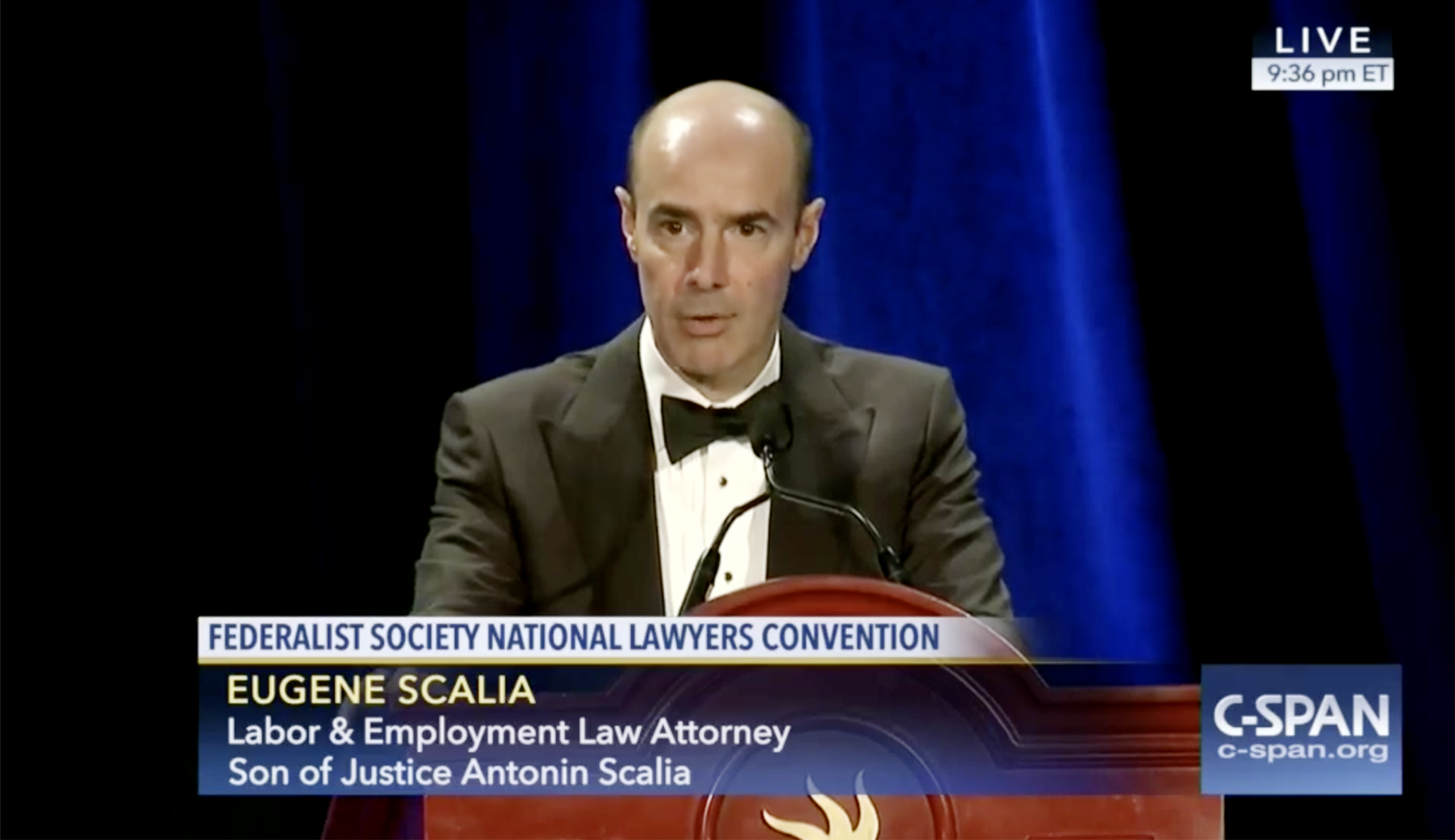
Labor secretary nominee Eugene Scalia may be obligated to recuse himself from some agency litigation, ethics experts say, because his younger brother John is a high-profile management-side lawyer involved in cases before the agency.
The situation would be an unusual one, because it doesn’t involve a financial conflict of interest, just a familial one, and it is not clear how it will be addressed by the administration.
Recommended Stories



Family ties can create tricky situations for officials regardless of how they handle them. For example, Democratic Sen. Elizabeth Warren of Massachusetts slammed then-Securities and Exchange Committee Chairwoman Mary Jo White in 2015 for recusing herself from SEC cases in which her husband was a litigator, arguing her recusals disrupted the SEC by stalling prosecutions.
President Trump last week tapped the elder brother, Eugene, 55, to replace the departing labor secretary, Alexander Acosta, who stepped down following criticism of his 2008 prosecution as a U.S. attorney of sex trafficker Jeffrey Epstein. Scalia has worked with the private sector management-side firm Gibson Dunn, where he has led its Labor and Employment Practice Group for the past 12 years.
John, the second-oldest son of the late Supreme Court Justice Antonin Scalia, is a shareholder at the firm GreenbergTraurig, where he also practices labor law. According to John’s bio on the firm’s website, “He practices regularly in federal and state courts, in private mediation and arbitration proceedings, and before the U.S. Equal Employment Opportunity Commission (EEOC), the U.S. Department of Labor (DOL), and equivalent state administrative agencies.”
In a 2008 case, for example, John Scalia defended a company, L-3 Services, when the Department of Labor, then headed by now-Transportation Secretary Elaine Chao, alleged it violated overtime rules. It eventually agreed to pay $700,000 in backpay to victims. In a 2015 case, he defended the chief operating officer of a company, Chimes DC, alleged to have violated fiduciary duties. A district court threw out the charges against his client late last year.
The Scalia brothers’ overlapping business is a potential problem, said Wilma Liebman, former chairwoman of the National Labor Relations Board, a separate federal agency that enforces labor laws.
“Surely Eugene’s involvement as secretary in any matter in which his brother John is involved would scream conflict of interest, or at least appearance of conflict — equally critical. I would think that he would have to recuse himself from any involvement in such a case,” said Liebman, now a senior research associate at Harvard Law School’s labor and worklife program.
It doesn’t matter if the elder brother isn’t directly involved in any litigation, she said. “I don’t think the department head is sufficiently removed from litigation that it does not matter. For one, litigation brought by or against the department is in the name of the secretary,” she said.
The proper course of action, said Scott Amey, chief counsel for the Project on Government Oversight, a nonprofit watchdog group, would be for Scalia “to be recused from handling or participating in any cases that would involve his brother or possibly even his brother’s firm, just make sure there isn’t even an appearance of a conflict of interest.” All matters regarding the litigation would have to be handled the next in line at the department, the deputy secretary. That would likely be Patrick Pizzella, who is the department’s acting secretary until the Senate confirms a new head of the cabinet agency.
Amey said that, in the Scalias’ case, Eugene would also need to ensure that there is no “trickle down effect” where cases brought by his brother’s firm receive preferential treatment by people in the department who think it might win favor with the department head. What complicates the situation, Amey noted, is that most ethics rules are written to prevent financial conflicts of interest. Family connections don’t necessarily involve such financial ties, but can still represent a potential conflict. There is little precedent for addressing the possible conflicts, according to Amey and others contacted by the Washington Examiner.
The elder Scalia will likely address the matter in an agreement made with the Office of Government Ethics, said an individual with knowledge of the process. All nominees for a cabinet-level position must make such an agreement, which is then reviewed and agreed upon by the cabinet agency’s chief ethics official and OGE. The agreement outlines any conflicts and how they will be addressed. It is posted publicly.
“We are mindful of ethical obligations and it is our duty to comply with them. In the event where an attorney would need to appear before a family member we would adhere to all applicable ethical guidelines,” a spokesman for Greenberg Taurig told the Washington Examiner.
The White House has not said whether Scalia has submitted anything to OGE, though Amey noted it is still early in the nomination process. The White House and Labor Department declined to comment.
