
Obama’s Pentagon cuts assailed by Republicans

Published January 5, 2012 5:00am ET


President Obama’s plan to pare down the U.S. military, unveiled Thursday, immediately became a major issue in the 2012 presidential campaign, opening one of the president’s strongest assets — his foreign policy and national security record — to Republican opponents who argue he is diluting America’s strength abroad.

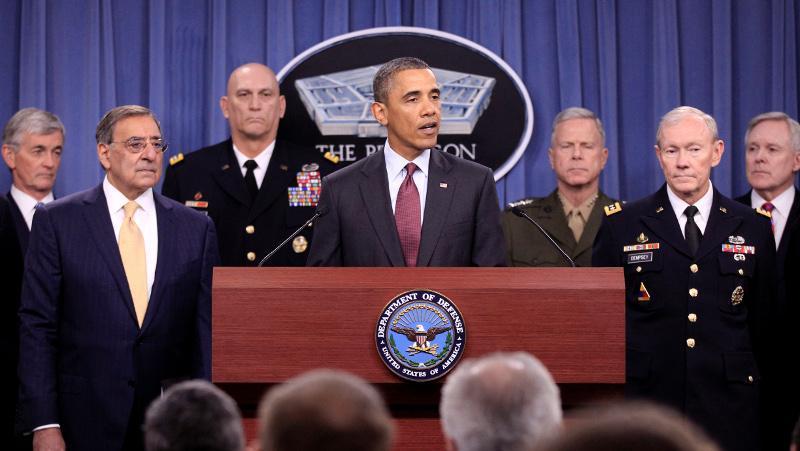
“Some will no doubt say the spending reductions are too big; others will say they’re too small,” Obama said at an unusual presidential news conference at the Pentagon, where he was surrounded by top military officials. “After a decade of war, and as we rebuild the sources of our strength — at home and abroad — it’s time to restore that balance.”

Without outlining specific cuts, Obama called for a smaller army and Marine Corps and the relocation of troops from Europe, where they’ve been based for decades, to Asia in recognition of a shift in global power.

In unveiling a plan to cut $500 billion in defense spending over the next decade, the president is attempting to showcase his commitment to slashing the budget deficit while adapting American’s national security capabilities to a swiftly changing foreign arena. He also is appealing to liberal supporters who long argued that any deficit reduction strategy must include military cuts, pointing to an explosion in defense spending in the post-Sept. 11 era.

Though Obama pointed out that defense spending would increase — albeit more gradually — in coming years, some Republicans say Obama is skimping on crucial American investments needed to stay ahead militarily.

“This is a lead-from-behind strategy for a left-behind America,” said Rep. Howard “Buck” McKeon, R-Calif., chairman of the House Armed Services Committee.

Yet White House officials said the president has established enough foreign policy clout to make such a recommendation, citing the killing of al Qaeda leader Osama bin Laden, the ending of the Iraq war and the troop drawdown in Afghanistan.

And some conservative analysts argued that Obama’s pared-back military blueprint could help him with voters.

“Politically, it makes a lot of sense,” said Christopher Preble, vice president for defense and foreign policy studies at the Cato Institute. Wars in Iraq and Afghanistan have become “quite unpopular” with a conflict-weary public, most of whom are likely to support Obama’s shifting troops from Europe to Asia, he said.

GOP presidential candidates critical of Obama, Preble said, are walking a “fine line between prudent defense of military support and overkill.”

Yet, Republican White House contenders say Obama’s plan is a job killer, pointing to Boeing’s announcement this week that it was closing a Kansas factory because of anticipated cuts in business. And conservatives say a weakened military will harm U.S. missile defense capabilities and the country’s ability to monitor a growing Iranian threat.

However, Defense Secretary Leon Panetta, joining Obama, said the president’s plan would shift the U.S. military away from traditional massive ground forces to a more flexible force that could deal with terrorist threats. That shift would be necessary even if the U.S. didn’t have to cut spending, he said.

Under Obama’s plan, nearly $500 billion would be slashed from projected Pentagon budgets over the coming decade. Hundreds of billions of dollars more could be cut in 2013 if Congress doesn’t approve deficit-cutting measures.

[email protected]