

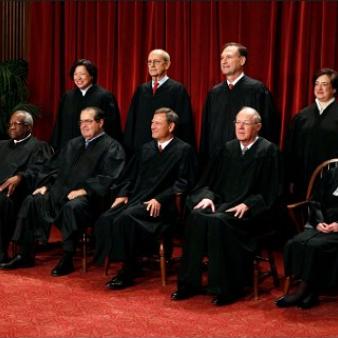
Whatever one’s views on gay marriage, it is appropriate — in a sense — that this issue, which was illegitimately thrust onto the scene by willful judges at the state level, has now been illegitimately advanced by willful judges at the federal level. Accordingly, gay marriage has been propelled forward at the expense of the separation of powers, and of applying state constitutions, and now the federal Constitution, as written. Even the policy’s advocates should view this as an unduly high price to pay.
In the coming days, the focus will perhaps principally be on whether five Supreme Court justices were correct to claim that the right to liberty, as expressed in the Fifth Amendment (and later in the Fourteenth Amendment), covers a desire to marry a member of one’s own sex and have that marriage recognized for purposes of federal law. But from a legal standpoint, the far more important issue is those five justices’ decision to follow the Court’s own precedent, established in Dred Scott v. Sandford (1857) and affirmed Roe v. Wade (1973), of ignoring the Constitution’s subsequent language — or, more exactly, of transforming that language to suit the Court’s own purposes and accentuate its own power.
Stay informed.Stay ahead.
Join Washington Examiner for unlimited access to the news, analysis, and commentary that matter most.
Already a member? Log in
