

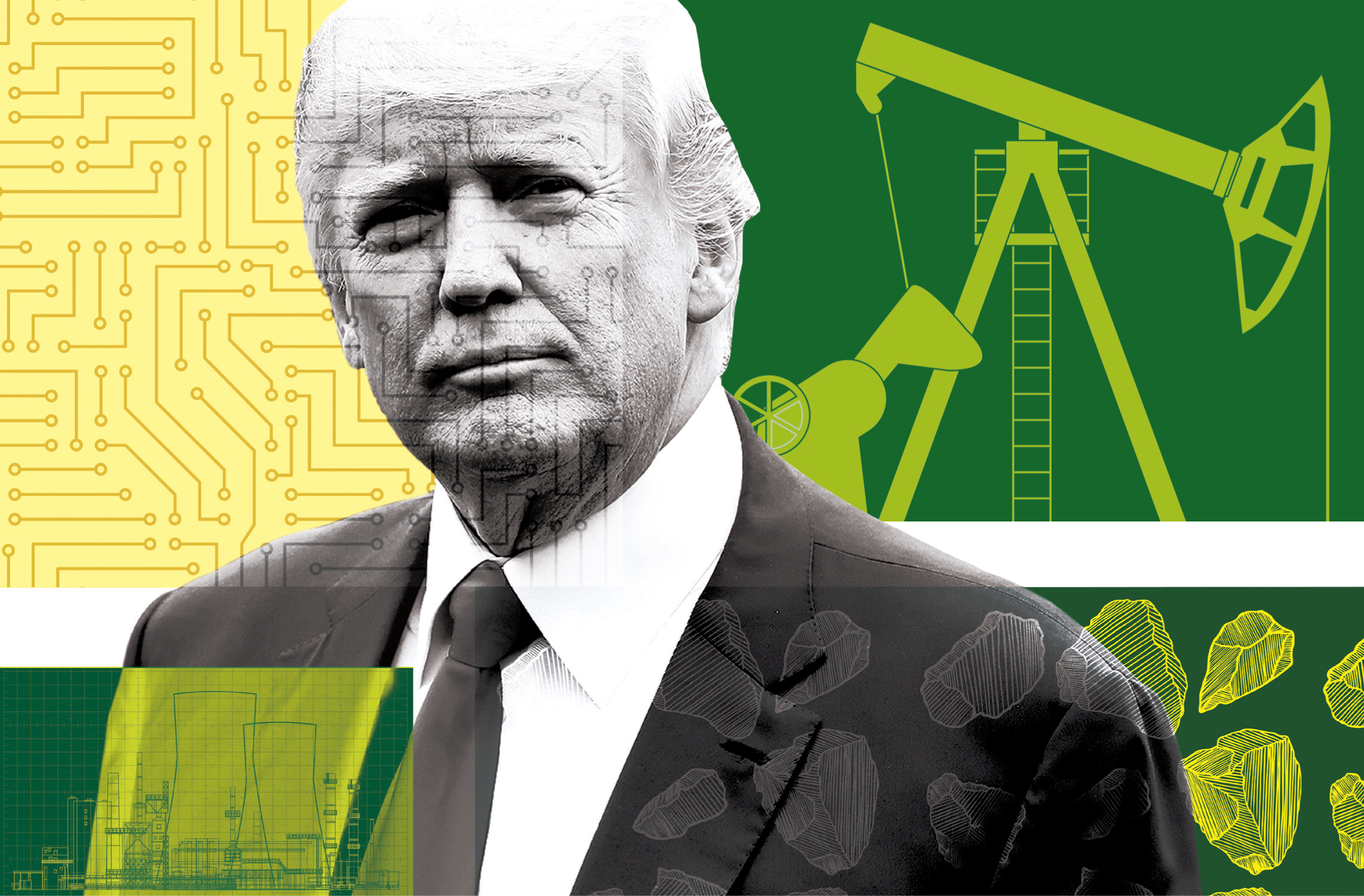
The tip of the spear when it comes to President Trump’s diplomacy is not the tongue of the diplomat, but the power of the pipeline.
The United States is now the world’s No. 1 producer of oil and natural gas, eating away at Washington’s past dependence on foreign producers and oil cartels. And that means the influence of petrostates like Iran and Russia and autocracies around the world.
Recommended Stories


Trump calls it “energy dominance,” and the freedom it provides has undergirded many of the president’s decisions, from moving the U.S. embassy to Jerusalem to re-imposing sanctions on Iran, according to administration sources.
“It allows us to impose these sanctions and not upset the world oil market very much,” said Deputy Energy Secretary Dan Brouillette. “It’s a fundamentally different posture to be in, in regard to our foreign policy. … It just gives us leverage.”
In negotiations with European, Chinese, and other world leaders, the president has made energy a central theme. Earlier this year, Trump even taunted NATO members at a summit in Brussels, calling them “captives” to Russian energy.
Above all, the comment was aimed at Germany, which is working with the Russian state-run energy firm Gazprom to build the Nord Stream 2 pipeline.
The administration opposes the construction of the pipeline and has signed a joint agreement with Germany’s neighbor Poland to “counter” energy projects that “threaten our mutual security, such as Nord Stream 2.”
“We believe [the pipeline] would undermine Europe’s overall energy security and stability by providing Russia with another tool for the political coercion of European countries, especially Ukraine,” said Vincent Campos, spokesman for the State Department’s Bureau of Energy Resources. “Russia understands that this project is dividing Europe and is using that to its advantage.”
Plus, he added in an email: “Construction of Nord Stream 2 also poses a significant national security risk to the Baltic Sea region, as Russia could use the need to protect pipeline construction as justification for expanding its military presence along parts of NATO’s eastern flank.”
Trump and the Polish government support energy deliveries that are resilient to any attempt by Russia to divert energy supplies. It’s part of a strategic decision to diversify energy supplies in Central Europe and the Baltic region by relying on liquified natural gas from the U.S. and other countries.
Russia has had a history of turning off the energy spigot to influence the domestic politics of its neighbors.
The relationship between Ukraine and Gazprom, for example, has been tenuous at best, especially over the last ten years. Gazprom began shutting off the supply of natural gas to Ukraine because of issues over repayment and price negotiations in 2008 and 2009. The cuts soon began affecting the supply of gas from Turkey all the way to Britain.
Tensions escalated in 2014 when Russia annexed part of eastern Ukraine, and the U.S. and the European Union imposed sanctions on Moscow in response. In 2018, Ukraine and Gazprom struggled to agree to a deal on gas supply. Ukraine has taken steps in recent years to wean itself off of Russian energy, but it’s still a main conduit for getting supply to the rest of Europe. Nord Stream 2 is meant to offset the problems posed by a Ukrainian choke point by creating a new path directly through Germany.
Winning the security argument
Despite the handwringing over Trump’s comments supposedly souring relations with traditional European allies, Brouillette says just the opposite is happening.
“I can tell you that the president’s comments, combined with other things that we are seeing in the intel space and other places, are leading some in Germany to believe that the Russians are being much more aggressive than I think they anticipated,” the deputy energy chief said. “And it’s raising a level of concern.”
He said private industry and members of the German parliament are now coming to the U.S. ambassador in Berlin and asking for meetings on increasing U.S. natural gas imports.
The U.S. challenge in Europe is, “candidly,” the Russians, Brouillette said. They can discount the price of natural gas to make it difficult for U.S. exports to compete, though European demand is still high.
Dan Eberhart, Trump donor and CEO of oil services firm Canary, says pipelines are very competitive when compared to shipping LNG, but the Russians are more vulnerable than some might believe.
“Russia’s efforts to use its natural resources to influence geopolitics is well known,” he said in an email. “But its success has been limited and it has far less leverage over Western Europe than is believed.”
Natural gas imports to Europe are expected to increase nearly 20 percent by 2040, Eberhart points out, citing International Energy Agency projections. This places the U.S. in a very good position “to assist in diversifying the energy supplies of our allies.”
Alternatives to Russian energy
And that reality is already grabbing the attention of Germany’s private sector.
“One company, in particular, suggested that the question is no longer if U.S. LNG is going to reach Europe and Germany, it’s just when,” said Brouillette.
The Energy Information Administration, the independent agency in charge of U.S. energy statistics, said in October that imports of LNG to the 28 countries that make up the European Union averaged 5.1 billion cubic feet per day in 2017, marking an increase for the third consecutive year.
Gas pipeline expansion has also increased. The U.S. is backing the Caspian Sea region’s Southern Gas Corridor project, which would introduce “significant volumes of non-Russian gas” into Western Europe as early as 2019-2020, said State Department spokesman Campos.
But getting industry to the table in the first place, in the case of Germany, wouldn’t be possible if Trump didn’t have the energy muscle to back it up, industry insiders say.
Indeed, says Dean Foreman, chief economist for the American Petroleum Institute, the U.S. is now “supplying virtually all new domestic and international oil demand growth, and compensating for production losses among OPEC nations.”
Keeping the pressure on
To sustain the energy boom, the U.S. needs to improve its lagging infrastructure, says Foreman. That means more domestic pipelines to move crude oil and natural gas and additional export terminals.
Canary CEO Eberhart, who meets with Cabinet officials regularly, has called on the administration to make good on its promise to help build pipelines and export terminals, thus far an unfulfilled vow.
“Trump has promised a $1 trillion infrastructure program, financed by public-private partnerships, but has yet to deliver,” Eberhart wrote in a recent op-ed. “Such a program could go a long way to unleash more U.S. energy into global markets, leaving America less vulnerable to power plays by Mideast states with poor human rights track records.”
The Energy Information Administration in recent months said that the lack of oil pipelines in the Texas Permian shale region is scaring off investors. There is plenty of oil in the Permian, but not the assets to move it to market.
The Energy Department’s analytical arm made the assessment while also announcing its decision to raise its monthly oil price projections in response to U.S. oil sanctions on Iran.
But the infrastructure troubles may also be playing in Iran’s favor, as the Islamic Republic looks for ways around sanctions with China and other consumers in Asia.
Iran’s counterstrike
New U.S. industry data shows a significant “backsliding” in U.S. petroleum exports over the summer, both in crude oil and refined products like gasoline, which dropped by 1.3 million barrels per day between June and August, API’s Foreman explained.
The reason for the drop: Iran discounting its oil in an effort to push the U.S. out of the market ahead of the sanctions that went into effect last week.
“The fact that we put these sanctions on Iran has basically kind of forced Iran’s hand to place its barrels, quietly, at a discount to other nations that might otherwise be buying U.S. crude,” Foreman said.
The American Petroleum Institute released a report showing that China and India, both huge markets for U.S. crude oil, had made good on Iran’s discounted prices, shaving $2.50 off the $75 per barrel OPEC basket price. That brought Iran’s prices closer to the U.S. West Texas Intermediate oil price. Iran is also paying all of India’s costs for insuring the fuel deliveries, the oil industry group showed in its monthly oil report.
The lost market due to Iran’s discounted prices was significant. API pointed out that China had purchased $1 billion of U.S. petroleum in June, but none in August.
Behind China and Canada, India is the next largest market for U.S. petroleum exports. But Indian Oil Minister Dharmendra Pradhan said last month that the country will import Iranian crude oil in defiance of U.S. sanctions, according to the report. Other countries that reduced U.S. oil in advance of the Nov. 4 sanctions: Brazil, Italy, the Netherlands, and Singapore.
The Nov. 5 secondary sanctions essentially ban other countries from buying crude oil from Iran without receiving a waiver from the United States. The Trump administration has said that waivers would only be granted if the country vows to cut Iranian oil exports to zero. Energy consultants and former government officials say that’s unrealistic.
Late last month, Iran sold its first 280,000 barrels on a marketing platform that sells Iranian oil to traders who in turn sell Iranian oil to other countries.
Meanwhile, the Trump administration has been primarily concerned with supply issues that could drive up the cost of crude oil amid sanctions.
In response, the White House has been working with Saudi Arabia and others to ensure oil is available to cushion the blow from sanctions.
“The economic issue is, if you see that much crude taken off the market then you’re going to see prices go up. Well, not necessarily,” said Energy Secretary Rick Perry in an interview with the Washington Examiner in advance of the Nov. 4 sanctions.
“The reason I say ‘not necessarily’ is because of increased American production,” Perry added.
U.S. production hit a new record high in September with 11 million barrels per day, according to oil industry reporting released last month. The federal government’s independent statisticians predict U.S. oil production to average 11.8 million barrels per day in 2019.
In contrast, Iran produced about 5 million barrels per day in 2017. The problem is that the U.S. consumes far more than it produces as the largest consumer of petroleum in the world. That means it needs help to keep an increasingly tight oil market in balance.
The U.S. is looking to its international partners in Iraq, Kuwait, and Saudi Arabia to allow more crude oil into the market, Perry said: “Our goal is to try to impress on everyone the importance of stability in supply,” which “is good for the world economic condition.”
For example, Perry said he has been in talks with the Saudi leadership on resolving a border dispute with Kuwait that would release about 250,000 to 350,000 barrels per day.
The dispute has to do with the shared Khafji and Wafra oilfields that the two countries manage together in the so-called “neutral zone,” a territory established by the British and the Saudis after World War I. Oil production has been off line for about three years, with Kuwait wanting issues over state sovereignty resolved before operations can resume.
The administration is also looking at how to help get stranded oil in Kurdish northern Iraq to market.
“The new prime minister of Iraq, their former oil minister … is very familiar with this area, and at this juncture is a pro-U.S. individual,” Perry said. “My point … is, there are some very real opportunities on the supply side that we don’t necessarily have to see crude prices going up, gasoline prices going up because of the increase in international supply.”
Perry also nodded at the European theater of this energy cold war.
“As we travel into eastern Europe, and as we’ve talked to our counterparts, the message that America is exporting more than just American energy, we’re supporting and exporting freedom,” he said. “That’s not lost on” the European Union.
Perry said U.S. oil production is set to rise by at least a half-million barrels per day. Natural gas will also be increasing because of a number of LNG export terminals expected to come online, along with the pipelines required to move the fuel.
“The message to the world is that the United States is going to be a reliable supplier of energy,” Perry continued.
And that energy is not just limited to LNG and crude oil, he explained. It also includes coal, nuclear, and renewable energy technologies.
The climate argument
Despite the president’s discounting of climate change as a manmade phenomenon, the energy dominance agenda does look to support low-carbon technologies.
“The countries that are out there who have a great concern about the climate issue, American LNG used in Europe is going to drive down emissions,” Perry continued.
“Europe’s reliance on gas is increasing as its coal-fired power plants are phased out and nuclear plants are placed out of service so it’s looking for resources to meet its environmental goals,” said Dan Eberhart of Canary.
Carbon capture technologies that the U.S. has developed for coal power plants will also lower emissions in countries such as China, he said.
“Obviously, zero-emission civil nuclear energy is, on its face, the cleanest form of energy produced,” Perry added. He said the U.S. ambassador to the E.U. is receiving a number of inquiries about selling U.S.-made small modular nuclear reactors into Europe.
The reactors are cheaper than conventional reactors, are much safer when it comes to emergencies, and able to provide a source of low-emission electric power.
All told, says Perry, “From an energy standpoint, we are at an incredibly different place than we were a decade ago.”
