

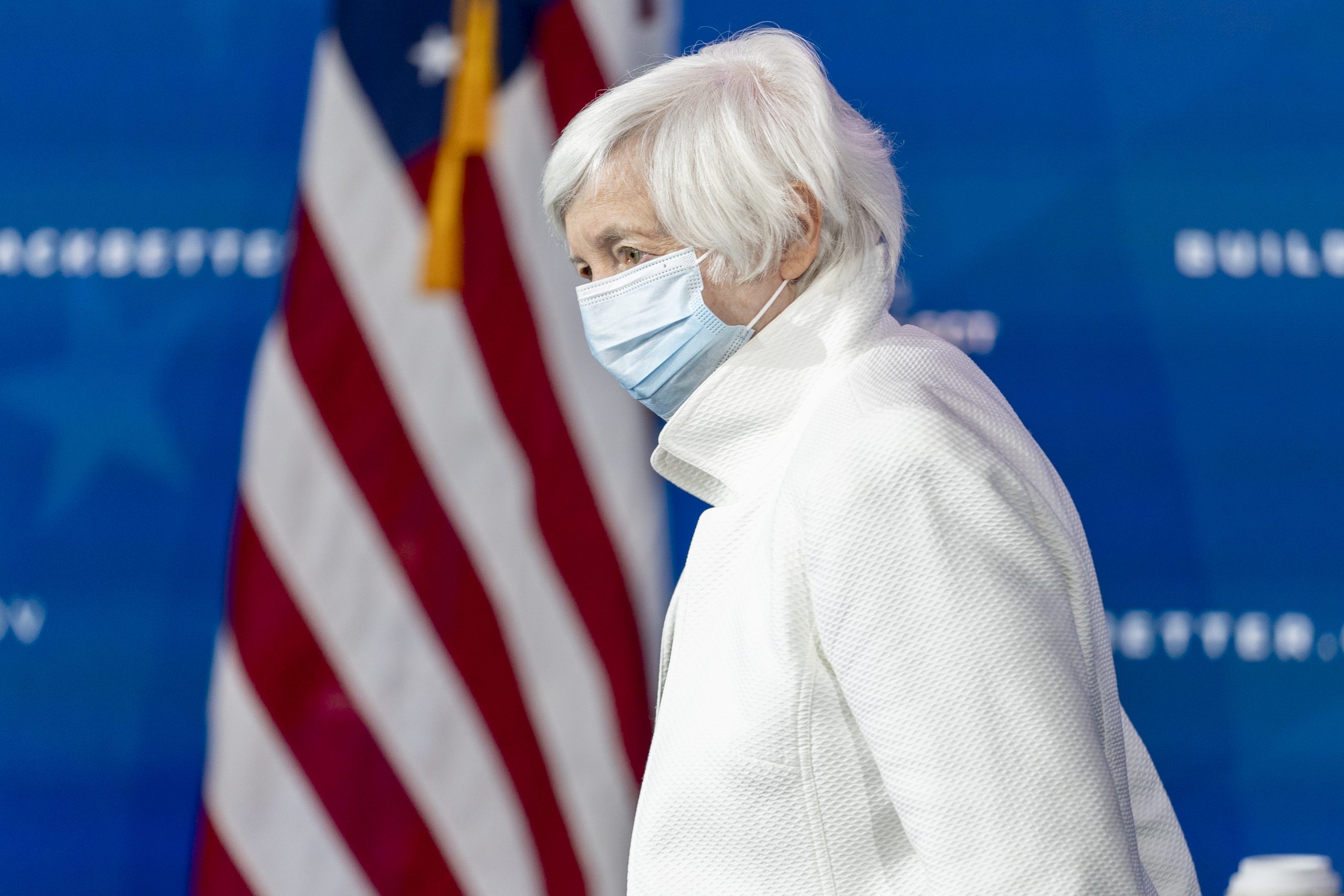
Since leaving government two years ago, President-elect Joe Biden’s pick for treasury secretary has earned more than $7.2 million in speaking fees from Wall Street and major corporations, including Citigroup, Goldman Sachs, and Google, according to financial disclosure forms.
In a 21-page disclosure form, former Federal Reserve Chairwoman Janet Yellen details more than 60 sources of income, including her benefits from the University of California, Berkeley, where she is a professor emeritus. Her speaking fees make up the bulk of her income, however.
Recommended Stories



She pulled in nearly $1 million from Citigroup alone, and her fees from Citadel, a hedge fund founded by GOP donor Ken Griffin, whom President Trump once casually accused of “trying to hide some of his money,” total more than $800,000.
Big Tech firms have also paid her significant speaking fees, with Google paying her $112,500 and Salesforce paying $67,500.
The transition team filed the forms midweek, along with those of Biden’s choice of secretary of state and national intelligence director, a transition official told the Washington Examiner. The Office of Government Ethics made public the three sets of forms online on New Year’s Eve.
In an accompanying letter dated Dec. 29, Yellen wrote that she would “seek written authorization” from the Government Ethics Office to “participate personally and substantially” in matters involving the firms. If confirmed, Yellen would be responsible for overseeing the policy and enforcement decisions that could affect companies that may have paid her.
Yellen, who was confirmed with bipartisan support as Fed chairwoman in 2014 and as vice chairwoman of the central bank in 2010, has broad support from Democrats to lead the Treasury Department and garnered a promising response from some key Republicans.
She also has the financial sector’s support.
A Wall Street investment banker and university professor told the Washington Examiner that her appointment was “key” to Biden’s plans to “build back better,” which this person said would be “heavily dependent” on fiscal policy, or the federal government’s tax and spending policies.
Yellen is “very focused on not being ideologically constrained either by the Left or by the Right,” he added, calling her a “super pragmatist.”
“Wall Street is thrilled with the Yellen appointment,” Chris Low, chief economist at investment firm FHN Financial, told MarketWatch shortly after Biden announced his pick. “‘If Joe Biden is going to be President, Yellen is pretty much the best appointment we could ask for,’ according to a friend who runs compliance at one of the biggest-five U.S. banks.”
Hillary Clinton faced criticism from the Democratic Party’s left-wing while running for president for her lucrative speaking gigs to Wall Street.
A Biden-Harris transition official defended Yellen in an email on Saturday, writing that she is “among the pre-eminent economic policymakers in the world today” with a proven record of action.
“Take a look at her record on enforcement — this is not someone who pulls punches when it comes to bad actors or bad behavior. You can expect she will bring the same high ethical standards and tough enforcement philosophy to Treasury,” this official told the Washington Examiner.
“Her views on emerging threats to the financial system and the need for a ‘new Dodd-Frank’ are well-known and something she often spoke about to these groups, both in public and private,” this official continued, adding that Yellen “didn’t hesitate” to tell some audiences that rules that may affect their business “should be tougher.”
Scrutiny of Yellen’s financial disclosures drew blowback on Twitter, with some Democrats charging that the attention was “sexist.”
Members of the Biden-Harris agency review teams have drawn rebuke for close ties to technology companies, such as Facebook, which is fending off regulatory action by the federal government. The Biden-Harris Presidential Inauguration Committee is also under fire for soliciting big-dollar contributions, including from tech and defense industry companies.
Forms filed by Biden’s choice for secretary of state, Antony Blinken, detail his work for the consulting firm he co-founded, WestExec Advisors, LLC, where he advised companies including Facebook and Uber, private equity giant Blackstone, asset management company Lazard, Boeing, McKinsey & Company, and Bank of America.
WestExec Advisors has paid Blinken more than $1.1 million since he left the government.
Avril Haines, Biden’s national intelligence director pick, was paid approximately $55,000 by WestExec Advisors from October 2017 to July 2020, according to the disclosure.
Blinken, in a Dec. 30 letter, and Haines, in a Dec. 23 letter, pledged to avoid issues that could affect their holdings and to consult with an ethics official on the measures necessary to resolve the conflict, should one arise.
Narrow conflict of interest statutes make a breach of this “basically inconceivable,” said one watchdog.
“So little is illegal under our government’s very narrow conflict of interest statutes that it is basically inconceivable to me that any of these people will do anything criminal,” the Revolving Door Project’s Jeff Hauser told the Washington Examiner.
“We should be worried by what Blinken and Haines, who were angling for big future jobs in the executive branch, think is acceptable behavior — privatizing their insider knowledge for the benefit of some of America’s worst behaved corporations,” he said.
Blinken, whose disclosure form states that he began to negotiate a plan to sell his equity in WestExec Advisors in October 2020, said he would divest from the firm upon confirmation and from three affiliated funds “not later than 90 days after.”
A Biden-Harris transition official told the Washington Examiner in an email that Blinken’s work outside of the government largely involved counseling companies on risk.
“The overwhelming majority of Blinken’s work was giving risk assessments, relying on his decades of knowledge about foreign policy and global politics,” this person said. “He is severing ties with all these clients and if confirmed, will follow all relevant government ethics rules and recommendations from government ethics attorneys, including recusals when appropriate.”
As a senior adviser to the Biden campaign, Blinken earned a $144,483 consulting fee. Between 2017 and 2019, he was paid $21,666 by CNN for his role as a global affairs analyst. His disclosure further details that his wife Evan Ryan, an executive at media company Axios before joining the Biden campaign as a senior adviser, was paid $368,722 in options on leaving the news startup.
As a consultant to Palantir, a Silicon Valley data-mining firm, Haines was paid $180,000 between July 2017 and June 2020. Palantir, which counts Peter Thiel among its founders, holds large government contracts and has drawn the ire of civil liberties advocates and liberals for its secretive intelligence-sharing databases used by the National Security Agency and U.S. Immigration and Customs Enforcement.
A transition official said in an email that Haines’s work for Palantir “was primarily focused on the company’s diversity and inclusion efforts, particularly increasing gender diversity.”
This involved mentoring “some of the company’s remarkable young women” and making suggestions on how the company “might promote diversity and inclusion,” this official said. “This is an issue she feels passionate about and one that will be a priority of hers if she is afforded the opportunity of leading our Intelligence Community.”
Haines’s salary as head of national security policy and planning for the presidential transition team totals $54,577, according to her form. She was paid $440,121 by Columbia University, where she has taken a leave of absence from her position as a senior research scholar, and $150,000 by Johns Hopkins University Applied Physics Lab, where she was a senior fellow.
“Yellen’s speechifying strikes me as far less than ideal but less worrisome than the behavior of Blinken and Haines,” Hauser said, calling the paid speech circuit “a bit of a boondoggle.”
He added, “Yellen only became a candidate for another job in government after she gave those speeches, so there is less of a sense that her audiences were paying to ingratiate themselves with a future regulator.”
