

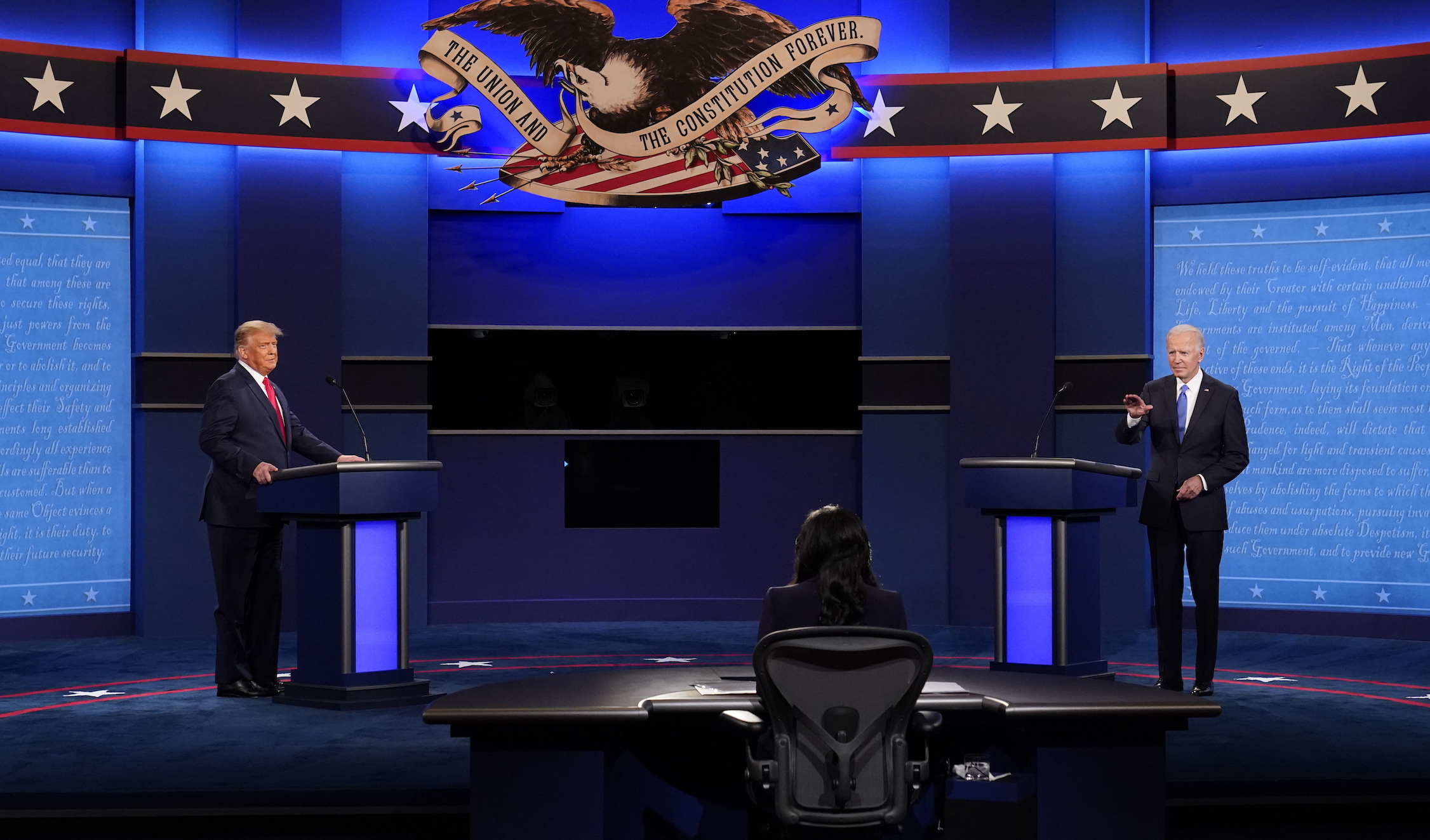
Voters getting their last side-by-side look at President Trump and Democratic presidential nominee Joe Biden before the Nov. 3 election saw a pair of antagonistic rivals engaging in harsh back-and-forths in an event that was still calmer than their initial encounter.
The candidates notably started their second and final debate in Nashville in hushed tones compared to their first clash in Cleveland last month, which devolved into a chaotic, caustic shouting match.
Recommended Stories



Though the debate was substantially more presidential than the squabbling that occurred during their last meeting, it wasn’t devoid of insults. Biden called Trump “xenophobic,” for instance, though he insisted it wasn’t because the president banned certain travel from China at the outset of the coronavirus pandemic.
Although Trump kept alluding to Biden’s campaign and personal finances, it was actually the former vice president and 36-year Delaware senator who opened the door to questions about his son Hunter’s business dealings in Ukraine and China, invoking Trump’s lawyer, Rudy Giuliani.
“I won’t, I shouldn’t — uh, I will, his buddy Rudy Giuliani, he’s being used as a Russian pawn,” Biden said. “It’s not about his family and my family. It’s about your family, and your family is hurting badly.”
Trump cut in as Biden looked into the camera, trading in his signature brand of empathetic politics.
“That’s a typical political statement. Let’s get off this China thing, and then he looks — the family around the table — just a typical politician,” Trump said.
The other predicted topic that dominated the 90-minute debate was the COVID-19 outbreak.
Trump took “full responsibility” for his pandemic response, yet blamed China for letting the virus reach the United States. He did falsely claim a vaccine was “ready” but later clarified that wasn’t a “guarantee.”
Biden countered: “220,000 deaths. If you hear nothing else I say tonight, hear this: Anyone who is responsible for that many deaths should not remain as president of the United States.”
He added, “He says we’re learning to live with it, we’re learning to die with it, like you people at home watching right now.”
The pair then chaffed on how to reopen the economy and congressional negotiations over a relief package. Biden was adamant he was “going to shut down the virus, not the country.”
Healthcare was also a wedge issue. Biden renamed his public option proposal “Bidencare” amid allegations from Trump that he wanted to introduce socialized medicine.
“What I’m going to do is pass Obamacare with a public option, it becomes Bidencare,” Biden said, if the Supreme Court dismantles the law on Nov. 10.
He continued, “He’s never come up with a plan. I guess we’re going to get the preexisting condition plan the same time we get the infrastructure plan.”
Pre-debate spin suggested Biden’s performance would be pitched at men balking at his tax plan. Meanwhile, Trump was to continue what has been a somewhat clumsy appeal to women. “Suburban women, will you please like me, please?” the president said this month at a Pennsylvania rally.
Prior to the debate, Trump’s campaign complained that debate moderator Kristen Welker had omitted foreign policy from her list of topics. They believed the exclusion disadvantaged the president because it focused attention on domestic policy — including the administration’s handling of COVID-19. Welker’s questions, though, didn’t prevent Trump from interrogating Biden on his son’s foreign business ties, nor Biden from criticizing the incumbent for his overseas bank accounts. And Welker followed up.
Expectations were different from the nominees’ contentious opening debate.
In their first debate, Biden had a low bar to meet following sustained Republican attacks over his age and mental acuity, perpetuated by Trump himself, much to his team’s chagrin. The election at that point was largely perceived as a referendum on the president after four years in office. While Biden didn’t notch a strong showing, Trump’s was worse.
Two weeks out from Election Day, Biden was seen as the front-runner going into their second and final debate, and the pressure was on not to commit a colossal mistake. Trump’s challenge was to reframe the contest as one of contrast, not simply an assessment of his progress on issues, such as the virus.
Among Biden’s weakest moments was an awkward reference to Adolf Hilter. And after a vicious opening outing marked by cutting personal insults, Trump did heal some of the fractures he created between himself and the few persuadable voters that are out there. Though his low moment came when he said, “only people with a low IQ follow the law” during the immigration section.
Thursday’s debate was the first where the commission muted the candidates’ microphones during their opening two minutes of each of the six 15-minute segments.
COVID-19 plagued debate logistics, too, after their second town hall-style meeting was canned because Trump refused to take part in a virtual format. The nominees were set to be separated by plexiglass, but the barrier was pulled down hours before the event after they both tested negative. That move was approved by the country’s top infectious disease expert, Dr. Anthony Fauci.
