
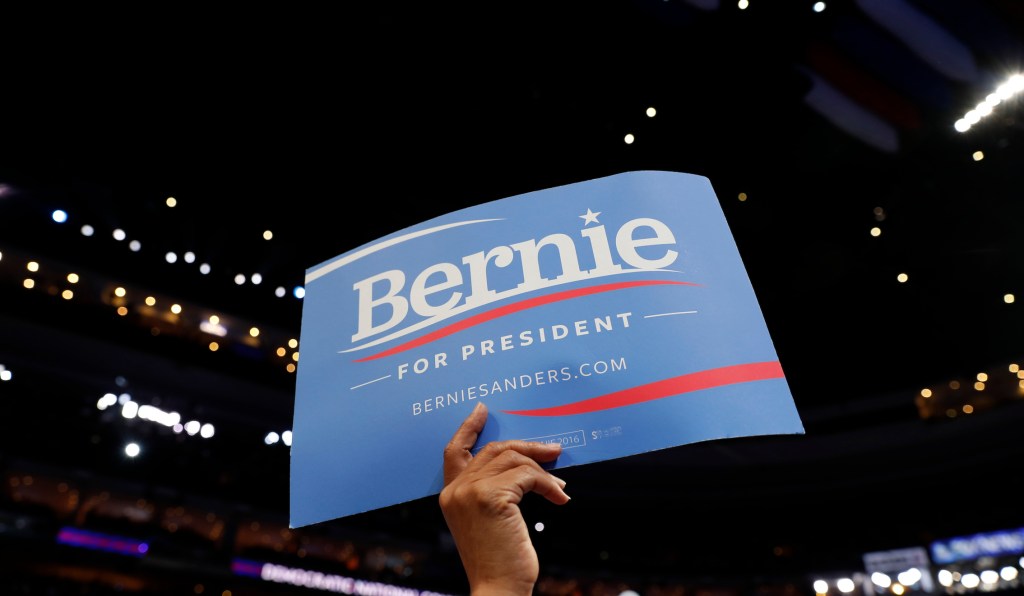
Bernie Sanders leads the polls, but Democratic Party superdelegates won’t commit

Published February 22, 2020 5:01am ET


Sen. Bernie Sanders, who is narrowly leading a pack of Democrats seeking the presidential nomination, lags in support among critical superdelegates who have mostly remained on the sidelines rather than commit to Sanders or any other candidate thanks to the uncertainty of the race.

Superdelegates will play a pivotal role in deciding the party’s presidential nominee if the top candidate fails to win a majority of a separate set of delegates up for grabs in the primaries and caucuses now underway.

The vast majority of superdelegates remain undecided.

Overall, only about 20% of the 771 superdelegates have picked a candidate, signaling a high level of ambivalence about who will ultimately win the nomination.

“Uncertainty in the candidate field tends to keep most superdelegates on the sidelines,” Joshua Putnam, who runs the delegate tracking site Frontloading HQ, told the Washington Examiner. “And this 2020 race has that.”

Former Vice President Joe Biden, whose poll numbers dropped following a poor showing in both the Iowa caucuses and the New Hampshire primary, has so far won the endorsement of 70 superdelegates, far more than any of the competitors now beating him in some of the polls.

Sanders trails Biden with 23 superdelegates, but newcomer candidate Michael Bloomberg, who is running as a centrist alternative to Sanders and has yet to compete in a caucus or a primary, also has the endorsement of 23 superdelegates. Sen. Elizabeth Warren and former South Bend, Indiana, Mayor Pete Buttigieg control 21 and 13 superdelegates, respectively. Sen. Amy Klobuchar has secured nine superdelegate endorsements.

Race analysts predict Sanders may not win enough pledged delegates to secure the nomination, and the superdelegates may end up deciding the nominee at the party’s national convention in Milwaukee in July.

Sanders leads national polls and won the New Hampshire primary and the popular vote in the Iowa caucuses. Polling shows him ahead in upcoming contests in Nevada, California, and Texas. He polls a close second to Biden in South Carolina. But the party’s rules apportioning delegates provide his competitors with the opportunity to rack up delegates even if they don’t win outright. That could starve Sanders of the 1,991 pledged delegates needed to secure the nomination before the convention.

Under the Democratic National Committee rules, if a candidate does not win a majority of the 3,979 pledged delegates from the caucus and primary contests, the 771 superdelegates will cast ballots with the pledged delegates in a second round of voting.

At that point, the nominee must win a majority of all 4,750 delegates.

“I’m just not sure that the superdelegates know where to put their money,” David Schultz, a professor of political science at Hamline University and the author of Presidential Swing States: Why Only Ten Matter, told the Washington Examiner.

Schultz recently published a column predicting the superdelegates won’t vote for Sanders if he reaches the convention without a majority of the pledged delegates.

Schultz said the superdelegates are now watching to see what happens with Bloomberg, Buttigieg, Biden, and Klobuchar, who are all more centrist than Sanders, a socialist who wants to break up big banks, eliminate fossil fuels, and scrap private health insurance for government-funded healthcare.

“The reason why they are not committed is they are not sure who the viable alternative is to Bernie Sanders,” Schultz said. “I don’t think they believe Sanders is the future of the party or is the winning candidate.”

The vast majority of superdelegates are the Democratic members of the House and the Senate as well as members of the Democratic National Committee. The superdelegate roster also comprises party royalty, including all former Democratic presidents and vice presidents, excluding Biden, former DNC chairmen and chairwomen, and some former congressional leaders. James Roosevelt, a grandson of President Franklin D. Roosevelt, is a prominent superdelegate.

The list is made up of establishment Democrats less likely to support a far-left agenda endorsed by Sanders, who was also never particularly popular among party House and Senate lawmakers.

“I think it’s unlikely that a large percentage of them are going to go over to Sanders,” Schultz predicted. “These are individuals who still view Sanders as the outsider to the party. A lot of them probably view the idea that, if the Democrats go socialist, they will go too far to the left and will lose swing state and moderate voters and will therefore lose the election.”

Putnam pointed to past Democratic presidential nomination contests that left the party’s superdelegate elites waiting on the sidelines, most notably 2008, when the party was split passionately between Hillary Clinton and Barack Obama.

“Then, it was about two fairly evenly matched candidates elites and voters had to choose from,” Putnam told the Washington Examiner. “But, in 2020, it is about the size of the field, a factional front-runner, at the moment, and a lack of consolidation among the other candidates. Elites could provide a clearer signal to primary and caucus voters but haven’t, really, to this point.”