

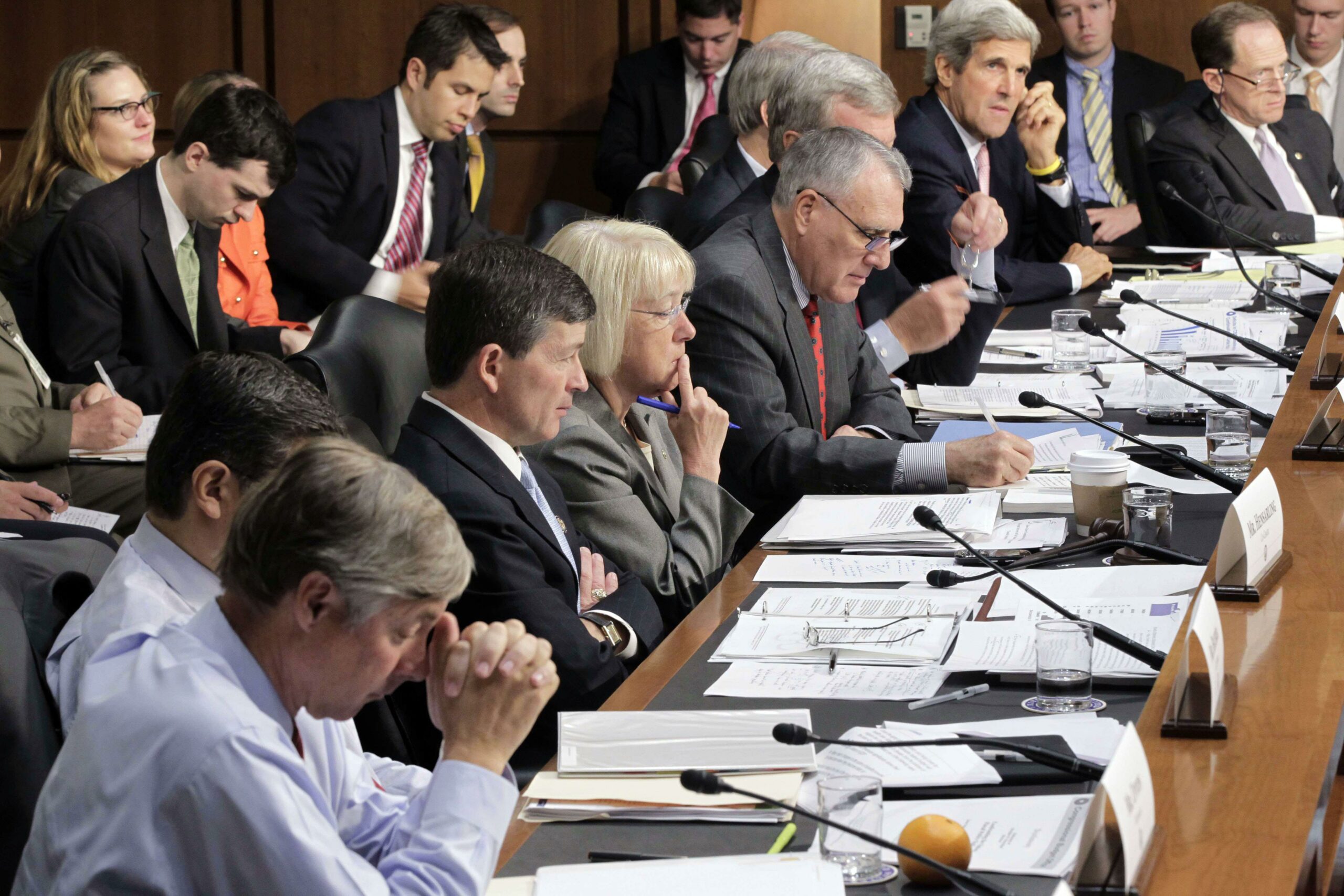
The deliberations of a congressional “super committee” charged with slashing the nation’s record debt by at least $1.2 trillion remain top secret, with no indication of whether the group will be able to complete its work by its Nov. 23 deadline and avoid massive automatic cuts in defense and domestic spending.
Even if the super committee produces a plan, it’s unlikely to make a super dent in the nation’s $15 trillion debt, say those familiar with the talks.
The 12 members of the Joint Select Committee on Deficit Reduction will make a rare public appearance this week with a hearing on government spending.
| Members of the Joint Select Committee on Deficit Reduction |
| Rep. Jeb Hensarling (R-Texas), Co-Chair |
| Sen. Patty Murray (D-Wash.), Co-Chair |
| Sen. Max Baucus (D-Mont.) |
| Rep. Xavier Becerra (D-Calif.) |
| Rep. Dave Camp (R-Mich.) |
| Rep. James Clyburn (D-S.C.) |
| Sen. John Kerry (D-Mass.) |
| Sen. Jon Kyl (R-Ariz.) |
| Sen. Rob Portman (R-Ohio) |
| Sen. Pat Toomey (R-Pa.) |
| Rep. Fred Upton (R-Mich.) |
| Rep. Chris Van Hollen (D-Md.) |
Despite being largely hidden from public view, the group has been meeting privately several times a week, for hours at a time, trying to bridge the wide political gap between the committee’s six Democrats and six Republicans about the best way to reduce the nation’s record deficit.
The stakes are high. If the panel fails to cut $1.2 trillion to $1.5 trillion over 10 years — devising a plan that can pass the House and Senate and earn President Obama’s signature — equivalent cuts will be made automatically in both social programs and the defense budget, an alternative both parties want to avoid.
“I think folks in this town on both sides of the aisle know that we can’t fail,” House Majority Leader Eric Cantor, R-Va., told Fox News. “There has to be success and an outcome here.”
But congressional Republicans and Democrats are so deeply divided, say those connected with the talks, that they’ll be lucky to secure the minimum $1.2 trillion in cuts. It’s possible the group will only slash about $800 billion and assign House and Senate committees to do the rest of the cutting.
“There have been discussions about trying to get beyond the $1.2 trillion but my sense is that is just a bridge too far,” said a person familiar with the negotiations who requested anonymity.
The panel’s six Republicans are opposed to any tax increases. Committee Democrats are averse to further large cuts in spending or significant, cost-saving changes to entitlement programs like Medicare.
What’s left to work with is a smattering of “revenue raisers” including some new government fees, tax loopholes that could be closed and the sale of broadcast spectrum. The two parties may also agree on lowering the tax rates on companies that return profits from overseas, creating a new source of revenue.
As for cuts, Democrats may be willing to accept some cuts to federal agriculture subsidies or tinkering with federal employee benefit programs.
But the super committee isn’t expected to tackle entitlement reform. It could, however, designate standing Senate and House committees to deal later with tax reform.
The panel is examining elements of past deficit reduction panels, including the Bowles-Simpson Commission appointed by President Obama and the Senate’s “Gang of Six,” which came up with a $4 trillion deficit reduction plan and met with the super committee last week.
“The advice we gave them is we think they should go big,” Senate Majority Whip Dick Durbin, D-Ill., told MSNBC. “We’ve got to phase it so that we focus on creating jobs now and getting through this recession but then make meaningful cuts in spending and raise revenue bringing everything to the table.”
