

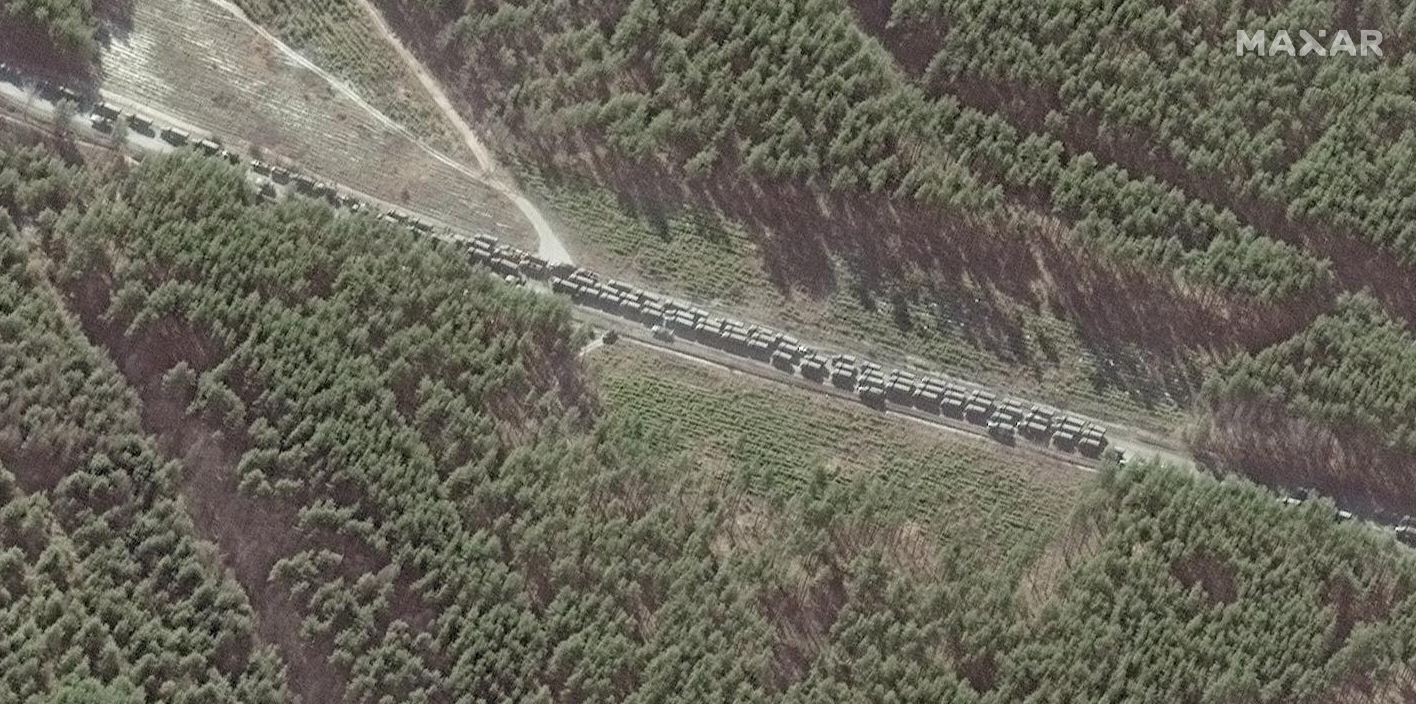
The Ukrainian military’s “direct attacks” against the Russian convoy heading toward the capital city of Kyiv have slowed it down, a U.S. senior defense official told reporters on Friday.
Russian troops have invaded Ukraine on three specific axes, with one coming from Belarus, which borders Ukraine to the north and provides a closer path to Kyiv, and they have faced resistance from Ukrainian forces. The Russian military remains roughly 15 miles outside the city, while the senior defense official told reporters on Thursday that the Pentagon hadn’t seen it make “appreciable” gains in “2-3 days,” while affirming that this analysis hadn’t changed by the same time Friday.
Stay informed.Stay ahead.
Join Washington Examiner for unlimited access to the news, analysis, and commentary that matter most.
Already a member? Log in
Ukrainian forces blew up a bridge over the Teteriv River at Ivankiv, which the defense official said “absolutely had an effect on stopping and in curtailing the movement” of the 40-mile convoy heading toward Kyiv. But it’s not the only way they’ve slowed Russian forces.
“We also believe that they have hit the convoy at other places as well in direct attacks, and so we know that has had an effect. So I think it’s been a combination,” the official continued.
US CALLS RUSSIAN ATTACK ON UKRAINIAN POWER PLANT A ‘WAR CRIME’
We have produced a #3D video fly-through of the 40-mile long convoy that is outside of #Kyiv, #Ukraine from the WorldView-3 #satelliteimagery that was collected on Monday, February 28, 2022, providing a better understanding of the situation. https://t.co/iTbaAwB1Rc
— Maxar Technologies (@Maxar) March 4, 2022
The chief of the Defense Intelligence of Ukraine, Brig. Gen. Kyrylo Budanov, told the Military Times on Wednesday that the military is “striking the enemy’s columns,” adding, “We burn many columns of the enemy.”
“My intelligence officers and agents are directing and calling the strikes,” he said, adding that the forces are using Su-24 and Su-25 fighter jets, artillery, and missile barrages against Russian forces and equipment.
Earlier this week, the defense official said the Russian troops were facing logistical problems including fuel and food, which also hampered their efforts to get to Kyiv and overthrow the government. The stunted progress could also be “as a result of their own self-determined sort of pause in operations [and] that they are possibly regrouping, rethinking, reevaluating,” the official warned.
Russian forces have had more success in the southern parts of the country. Russia invaded Crimea, a peninsula along the northern coast of the Black Sea, in 2014, which provides them with an existing infrastructure to support those troops.
CLICK HERE FOR MORE FROM THE WASHINGTON EXAMINER
“Using Crimea as the base of operations” has been “more refined than the expeditionary kind of sustainment they had to put in place in the north over the last couple of months,” the official said on Thursday, adding that the routes for troops in the south to resupply “are shorter down there.”
