

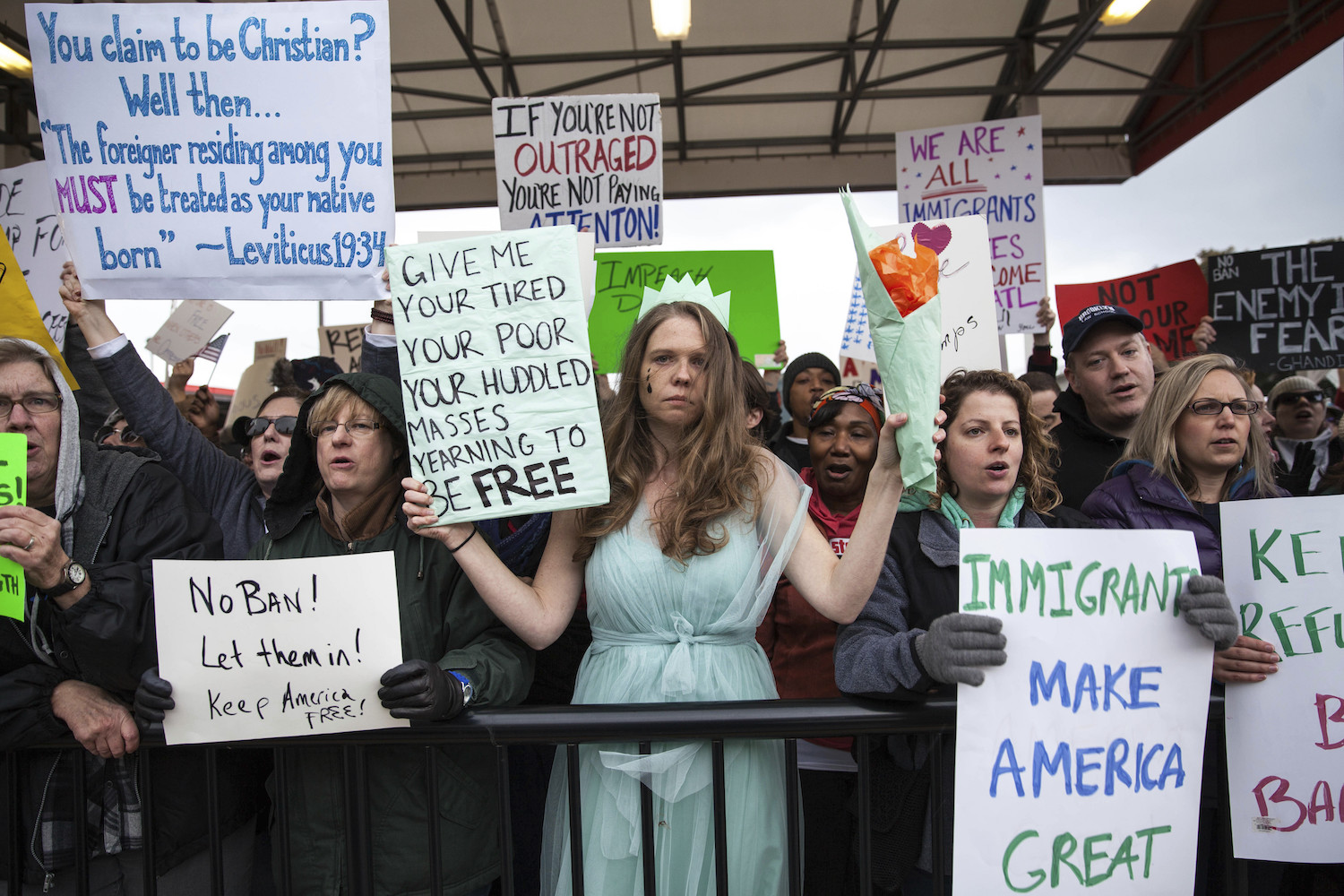
Four states have announced legal action against President Trump’s White House in response to his executive order on refugees and immigration that the president signed last week.
Recommended Stories



Democratic attorneys general from Washington, Massachusetts, New York and Virginia are separately suing the Trump administration for his call to temporarily suspend immigration from seven countries with ties to terrorism and halt all refugee programs for 120 days.
Virginia Attorney General Mark Herring and Gov. Terry McAuliffe — both Democrats — were the latest to join on Tuesday and will be joining a pending case, Aziz v. Trump et al., in the U.S. District Court of Eastern District of Virginia.
New York Attorney General Eric T. Schneiderman called the decision “unconstitutional, unlawful, and fundamentally un-American.” The Empire State has joined a lawsuit that was originally filed by the American Civil Liberties Union Foundation, the Jerome N. Frank Legal Services Organization at Yale University, the Urban Justice Center and the National Immigration Law Center.
On Tuesday, Massachusetts Attorney General Maura Healey said it would also take legal action against Trump, backing a lawsuit that was filed last weekend by two Iranian men in Boston federal court.
“It [the executive order] discriminates against people because of their religion, it discriminates against people because of their country of origin,” Healey said at a Boston press conference.
Washington’s attorney general, Bob Ferguson, is asking a judge to rescind provisions in the order.
“It’s my responsibility as attorney general to defend the rule of law, to uphold the Constitution on behalf of the people of this state. And that’s what we’re doing,” Ferguson said.
Seventeen state attorneys general have condemned Trump’s executive order and promised legal action against the administration. Those states include California, Pennsylvania, Hawaii, Oregon, the District of Columbia, Connecticut, Vermont, Illinois, New Mexico, Iowa, Maine and Maryland. All are blue states or those that Hillary Clinton won in November, with the exception of two — Iowa and Pennsylvania.
“Religious liberty has been, and always will be, a bedrock principle of our country and no president can change that truth,” the group of attorneys general said in a statement. “We are confident that the executive order will ultimately be struck down by the courts. In the meantime, we are committed to working to ensure that as few people as possible suffer from the chaotic situation that it has created.”
