

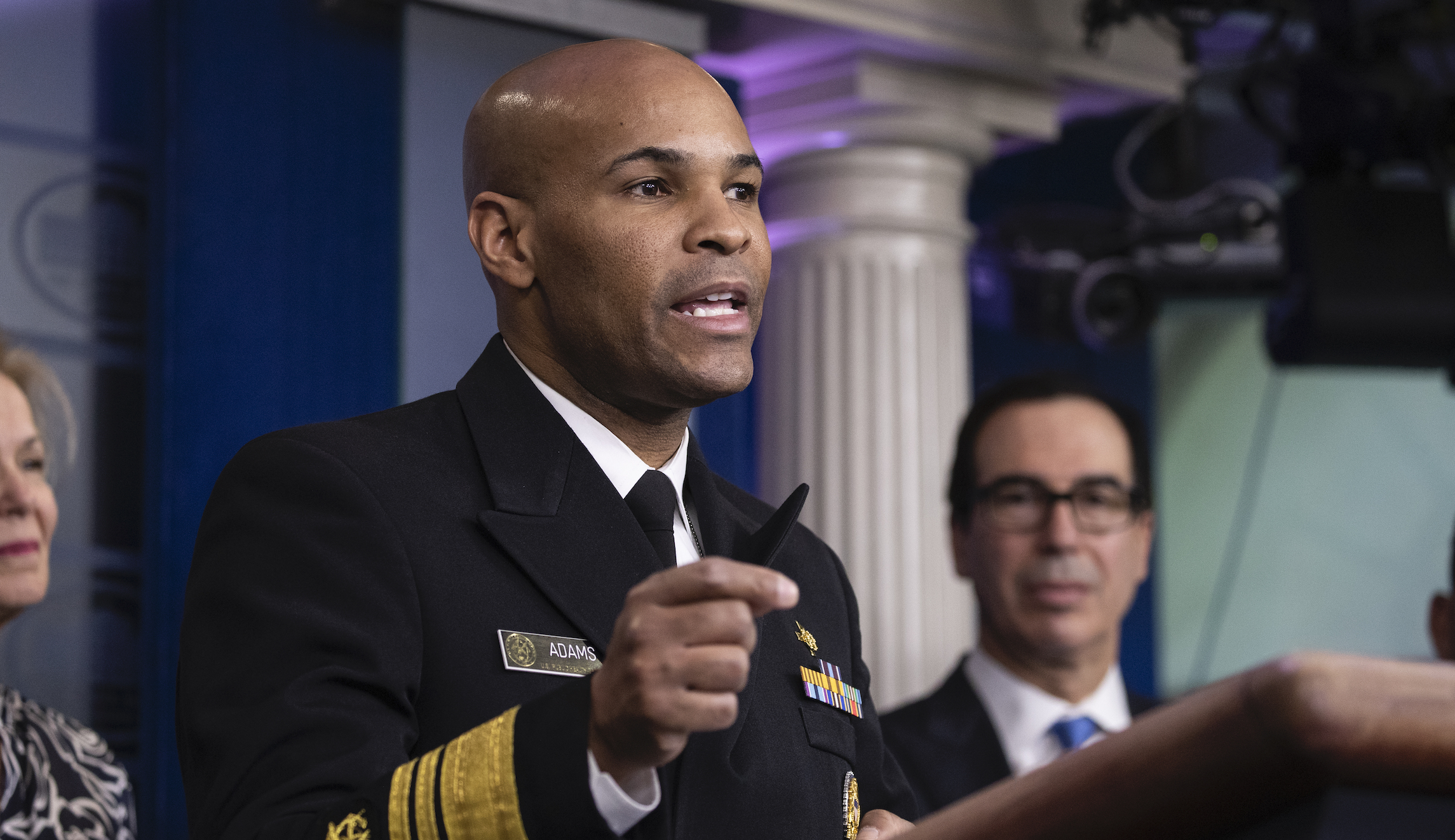
Surgeon General Jerome Adams said minority communities face increased risk from the coronavirus because of a number of physical and social ailments and denied allegations that colloquial language he recently used was offensive.
Speaking during the White House task force’s Friday briefing on the coronavirus response, Adams stressed the “alarming” number of black and Hispanic Americans struggling with the disease.
Recommended Stories


“In New York City, Hispanics represent the majority of deaths,” Adams said. “In Milwaukee County, blacks are 25% of the population but almost 50% of the cases and 75% of the deaths.”
Adams said that while there “is nothing” inherently wrong with minority groups that would predispose them to struggles with the disease, he wanted to squash the “myth” that black Americans could not get the virus.
“People of color are more likely to live in densely-packed areas and in multigenerational housing situations which create higher risks for a spread of a highly contagious disease like COVID-19,” he said.
[Read more: Surgeon general tells Americans to ‘avoid alcohol’ during coronavirus pandemic]
“African Americans and Native Americans develop high blood pressure at much younger ages,” Adams continued. “Puerto Ricans have higher rates of asthma, and black boys are three times as likely to die of asthma as their white counterparts.”
Adams then held up an inhaler he has carried for 40 years out of fear that he might have a fatal accident arising from asthma.
Later in the press conference, PBS White House correspondent Yamiche Alcindor suggested that “some people online” were offended by the informal language Adams has used when speaking to communities in color.
“You’ve said that African Americans and Latinos should avoid alcohol, drugs, and tobacco,” Alcindor said. “You also said, ‘Do it for your big momma and pap pap.’ There are already some people online that are already offended by that language and the idea that you’re saying behaviors might be leading to these high death rates.”
“I have a Puerto Rican brother-in-law. I call my granddaddy ‘granddaddy.’ I have relatives who call their grandparents ‘big momma.’ That was not meant to be offensive. That’s the language that we use, and that I use, and we need to continue to target our outreach to those communities.”
Adams highlighted statistics that show a greater likelihood of black, Hispanic, and Native American people possibly dying from the disease.
“The chronic burden of medical ills is likely to make people of color, especially, less resilient to the ravages of COVID-19, and it’s possibly, in fact, likely, that the burden of social ills is also contributing,” Adams said. “Social distancing and teleworking, we know, are critical, and you’ve heard Dr. [Deborah] Birx and Dr. [Anthony] Fauci talk about how they prevent the spread of coronavirus, yet only 1 in 5 African Americans and 1 in 6 Hispanics has a job that lets them work from home. … We tell people to wash their hands, but a study showed that 30% of the homes on Navajo Nation don’t have running water, so how are they going to that?”
Adams stressed that the White House team had spent time reaching out to minority communities to help dispel myths and to clarify government policy during the pandemic.
“Today, the vice president led a phone call that I was on with hundreds of African American leaders, including the Rev. Jesse Jackson, including Derrick Johnson of the NAACP, and including the National Medical Association and the Black Nurses Association to talk about some of the alarming trends we are observing regarding the impact of COVID-19 on communities of color.”
