

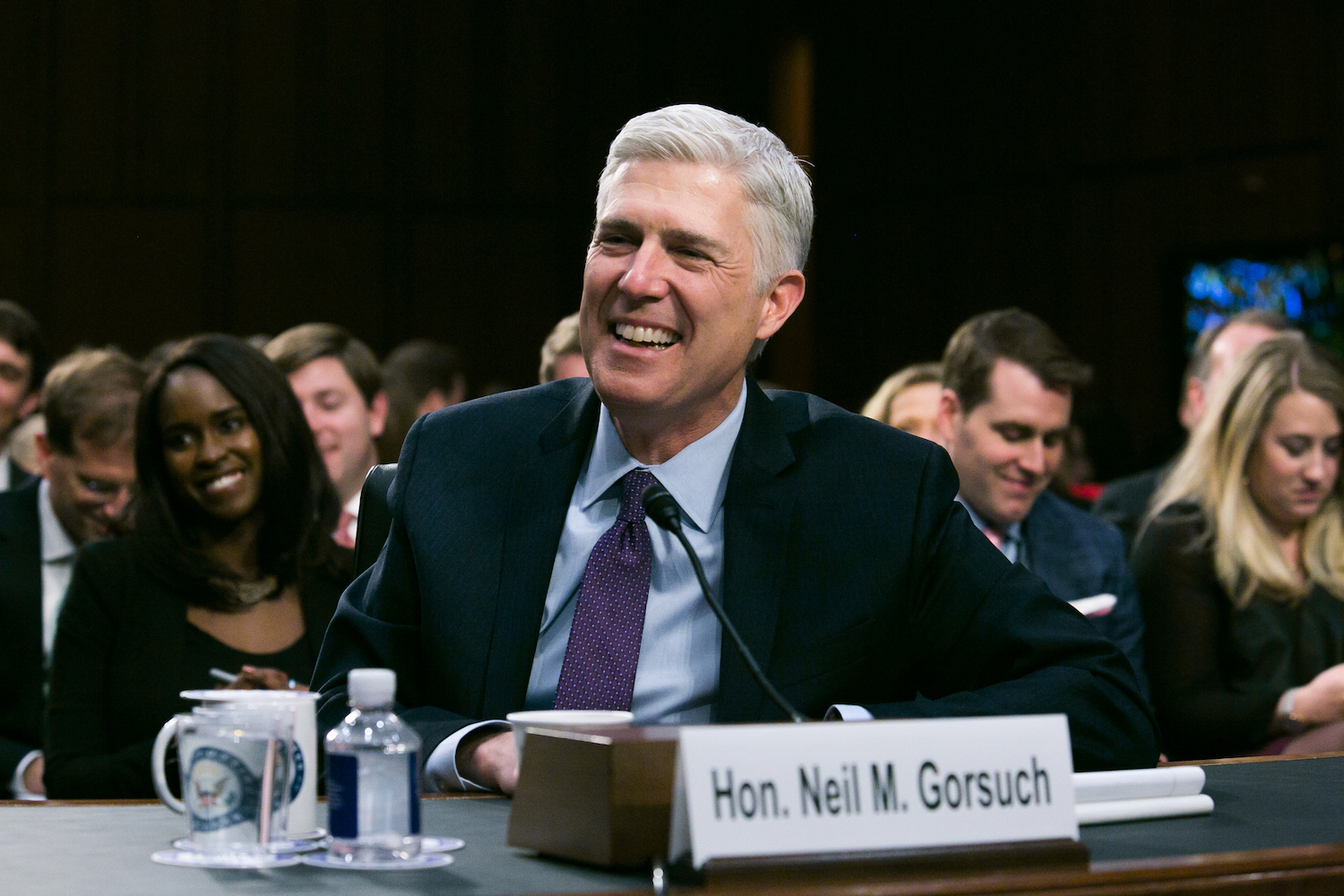
Three days of Senate Judiciary Committee hearings on Judge Neil Gorsuch’s nomination revealed much about the Supreme Court nominee’s thinking and personality not before on public display.
He fielded questions about his approach to abortion rights cases, originalist jurisprudential philosophy, his independence from President Trump and whether he had ever visited Russia. Here are some of the highlights from Gorsuch’s three days of testimony:
Recommended Stories


1. Overturning Roe v. Wade
Gorsuch repeatedly refused to answer whether he would look to overturn the Supreme Court’s 1973 Roe v. Wade decision granting abortion rights. Instead, the Supreme Court nominee noted that the high court’s decision has been repeatedly reaffirmed.
“Roe v. Wade is a precedent of the United States Supreme Court,” Gorsuch said when asked on Tuesday about whether the high court correctly adjudicated the case. “It has been reaffirmed.”
When pressed about whether he thought Roe v. Wade had “super-precedent” by California Sen. Dianne Feinstein, Gorsuch noted that the decision has been “reaffirmed many times.” On Wednesday, when asked again about the case, he said, “It’s the law of the land.”
Trump pledged to appoint judges who would overturn Roe v. Wade as a presidential candidate, but Gorsuch said Trump never asked him to commit to doing so when interviewing him. Gorsuch added that he would have “walked out the door” had Trump asked him to pledge to overturn the case.
Asked about whether to believe the White House’s assurances or Gorsuch’s answers, Senate Judiciary Committee Chairman Chuck Grassley told reporters to believe Gorsuch over the White House.
2. Originalism battles
Gorsuch repeatedly sparred with Democratic senators about his “originalist” approach to the law. Originalism, a jurisprudential philosophy popularized by the late Justice Antonin Scalia, holds that the Constitution has a static meaning. Adherents to this approach look to determine the meaning of the text of a law at the time it was written.
Feinstein, the Judiciary Committee’s top Democrat, repeatedly locked horns with Gorsuch over originalism during the hearing’s question-and-answer sessions.
“It would be a mistake to think that originalism turns on the drafters of the law,” Gorsuch told Feinstein Wednesday. “When it comes to equal protection of the laws, for example, it matters not a whit that some of the drafters of the 14th amendment were racists — and they were.”
Feinstein wasn’t satisfied and suggested that the originalist approach would take Americans “backward, and not forward.”
Democrats are looking to make Gorsuch’s originalist philosophy a hill to die on, as Vermont Sen. Patrick Leahy indicated in his opening remarks. If qualifications were all that mattered, Leahy said, “Judge Merrick Garland, who had exactly the same qualifications [as Gorsuch] but was refused by the Republicans, would be sitting on the court today. That’s why philosophy becomes important.”
3. In defense of the ‘little guy’
Democrats’ chief line of attack throughout the hearing has focused on Gorsuch as an enemy of the “little guy” and friend of the powerful.
Gorsuch, whose calm demeanor rarely flared during the hearing, spoke in defense of the “most vulnerable” on Wednesday in answer to Utah Sen. Orrin Hatch.
“I’m not worried about large corporations, honestly Sen. Hatch. They’ve got large armies of lawyers,” Gorsuch said Wednesday morning. “I’m worried about the ordinary American and sometimes the non-American.”
But that did not deter Democrats from looking to paint Gorsuch as tied to powerful and wealthy interests, including those funding a multimillion-dollar effort to boost his Supreme Court bid. Rhode Island Sen. Sheldon Whitehouse grilled Gorsuch on campaign finance and outside groups supporting his confirmation throughout the hearing. Gorsuch took Whitehouse head on near the end of the senator’s second round of questioning, after avoiding much of the Democrat’s barbs.
“I’m distressed to hear you think judges for the Supreme Court is an organ of a party,” Gorsuch told Whitehouse on Wednesday. “I know you feel that way and it distresses me. I just don’t see judging that way and I don’t see our rule of law that way. I don’t see Republican judges and I don’t see Democratic cases. I see judges.
“And senator, I think the rule of law in this country works. I think it works so well that to speak like that diminishes what we have and it is for me a failure to appreciate the beauty of our system that we resolve hundreds of thousands of cases a year almost always unanimously as judges.”
Whitehouse, who closed his questioning Tuesday with a beaming smile and drew a caustic response from Grassley, went over his allotted questioning time on Wednesday as he sought to push back.
Gorsuch repeatedly stressed his independence in answers to Democrats’ questions with answers such as “I’m a judge. I don’t have spokesmen. I speak for myself,” and “I don’t wear a crown, I wear a robe.”
4. Supreme Court throws Gorsuch a curveball
The Supreme Court ruled unanimously on Wednesday in a disabilities case that became a hot topic on day three.
Chief Justice John Roberts’ ruling in Endrew F. v. Douglas County School District overturned a 10th Circuit Court of Appeals decision that allowed a school district to refuse residential educational benefits to a student with autism. Included in the case was a legal standard related to one that Gorsuch used in a previous case, which he told the committee he chose to do because he felt that he was bound by precedent.
Minority Whip Dick Durbin brought up the Supreme Court’s opinion shortly after it came out and called the high court decision a “powerful ruling” and questioned why Gorsuch would have ever applied the standard.
“If I was wrong, I was wrong because I was bound by circuit precedent,” Gorsuch said. “And the Supreme Court is our boss.”
Gorsuch called the Supreme Court’s ruling “fine” and said he intended to apply the high court’s ruling in future cases. But Democratic Sen. Amy Klobuchar of Minnesota went a step further in tying Gorsuch to the losing party in Wednesday’s Supreme Court decision.
“What happened this morning was that the Supreme Court unanimously rejected, in an opinion by [Chief] Justice Roberts, the standard that you used to evaluate how much help kids with disabilities get in school,” Klobuchar said. “It wasn’t your case, but it was a standard that was like the standard you used and nine justices disagreed with you.”
The Judiciary Committee’s Republican members took issue with their Democratic colleagues’ description of how the case was adjudicated. Texas Sen. John Cornyn noted that the Supreme Court denied an appeal of Gorsuch’s previous ruling invoking the similar standard relating to the one in the Endrew case.
“If people are going to try to cherry pick a judge’s decisions and to characterize them as caring or not caring about children with autism or whatever the sympathetic plaintiff would be and of course they deserve our care and sympathy as a general matter, but if somebody is going to try to characterize your entire judicial career based on the decisions in these handful of cases … it strikes me as this is kind of an indictment of the whole federal judicial system,” Cornyn said.
Cornyn’s Texas colleague, Sen. Ted Cruz also spoke out and said that Gorsuch’s standard was a result of his having followed circuit court precedent.
5. The ‘frozen trucker’ case
Gorsuch’s ruling in TransAm Trucking v. Administrative Review Board, Department of Labor drew strong, repeated criticism from Democratic senators throughout the hearings.
Alphonse Maddin, a TransAm truck driver, abandoned his trailer to seek help for its failing breaks in subzero temperatures and was fired by TransAm. Gorsuch ruled that the company legally was right to do so. Minnesota Sen. Al Franken took issue with his decision.
“When using the plain meaning rule would create an absurd result, courts should depart from the plain meaning,” Franken told Gorsuch. “It is absurd to say this company is in its rights to fire him because he made the choice of possibly dying from freezing to death or causing other people to die possibly by driving an unsafe vehicle. That’s absurd.
“Now, I had a career in identifying absurdity, and I know it when I see it,” the former “Saturday Night Live” comedian said. “And it makes me — you know, it makes me question your judgment.”
Senate Minority Leader Chuck Schumer brought Maddin along to a press conference in advance of the hearings to talk about what he viewed as the harmful consequences of Gorsuch’s ruling.
Gorsuch, repeatedly responded to Democrats that his adjudication of individual laws and statutes led him to make conclusions that he may not have personally liked.
6. Sasse’s sass
Nebraska Sen. Ben Sasse routinely injected humor into the marathon Supreme Court nomination hearing.
The first-term Nebraska senator used his opportunities to question Gorsuch on the Constitution, but he also did not shy away from the opportunity to poke fun at the 10th Circuit Court of Appeals judge.
When Sasse first questioned the judge Tuesday, he asked Gorsuch about his “SCOTUS bladder.”
“My wife also sent me a text a little bit ago and said, and I’m sure she didn’t expect me to read it, but ‘How in the world is Gorsuch able to go so many hours at a time without peeing?'” Sasse asked Tuesday as the room erupted in laughter. “I won’t make you answer.”
He added, “The SCOTUS bladder is something the whole country stands in awe of.”
On Wednesday, Sasse similarly seized the chance to poke fun at Gorsuch’s expense. When the Nebraskan senator asked Gorsuch about the Declaration of Independence, the Coloradan judge began to wax poetic about John Hancock.
“”That’s why John Hancock is now synonymous with his signature,” Gorsuch said. “No one remembers who John Hancock was but they know that’s his signature because he wrote his name so bigly — big and boldly.”
You just said bigly,” Sasse said as the room laughed, “and I just won five bucks.”
“You embarrassed me in front of my nephew and he loves it,” Gorsuch replied.
“He’s the one paying me the five bucks,” Sasse answered.
“The Declaration of Independence, is that where we were?” Gorsuch asked after a pause.
“I think my work here is done, but I do want to hear your answer,” Sasse said, as Gorsuch resumed answering the question.
7. Last but not least
Long after Grassley left Tuesday’s hearing to meet his 9 p.m. bedtime, Louisiana Sen. John Kennedy got his first crack at questioning Gorsuch.
The Louisianan’s opportunity may not have attracted many eyeballs at the time, but it’s well worth watching.
Kennedy asked about what kind of a student former President Barack Obama was at Harvard Law School, where the former president’s tenure overlapped with the Supreme Court nominee. Gorsuch said he “knew him, not well.” Kennedy then jokingly asked whether the Democratic president was the sort of student who sat in the front and always raised his hand.
Later when Kennedy began to conclude his questioning, he advised the judge to grab a cocktail and sounded as though he may have wanted one himself.
“I don’t know if you’re a drinking man, but you may want to have a cocktail tonight and relax,” Kennedy said. “I’m done. Just don’t drink vodka. Stay away from vodka.”
“Senator, I’m going to hit the hay,” Gorsuch replied. “Thank you very—”
“You’ve never been to Russia have you?” Kennedy interjected. “I meant to ask that. Strike that, strike that.”
Kennedy’s question about Russia was a not-so-subtle reference to the headlines surrounding the Trump administration, especially concerning the FBI’s ongoing investigation into Trump campaign aides’ ties to Russia.
Trump’s influence on the hearing was felt throughout the three-day hearings, even as Gorsuch attempted to avoid the politics surrounding his nomination and asserted his independence as a job adamantly and repeatedly. Senate Minority Leader Chuck Schumer suggested that consideration of Gorsuch’s nomination be delayed given the FBI’s ongoing investigations. Grassley responded by calling Schumer’s request ridiculous.
The Judiciary Committee chairman told reporters after the hearings he thought Gorsuch could have gained Democratic support as a result of his performance.
“I don’t know what he would have had from Democrats before this…but I think the performance he’s put on the last two days can’t help but give fewer Democrats a reason for voting against him,” Grassley said.
