

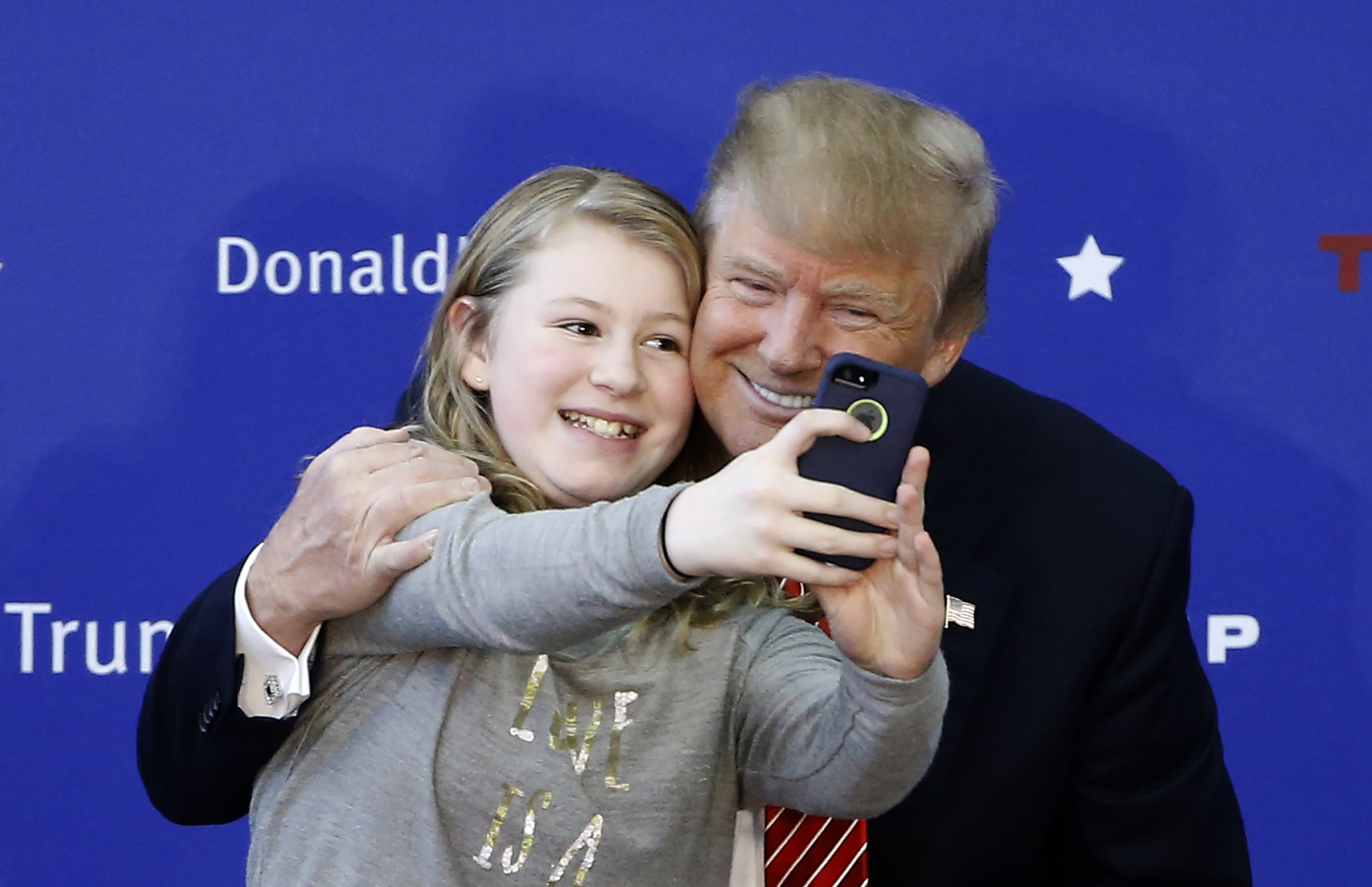
Facing an opponent who has failed to attract the same young Americans who flocked to President Obama in 2008 and 2012, Donald Trump saw an opportunity earlier this month to court disenchanted millennials with a not-so-secret weapon.
To engage youth voters, the Republican presidential nominee released an image of his eldest children — Ivanka, Donald Jr. and Eric — staring intently into the camera with the hashtag #MillennialsForTrump written beneath on a crisp red, white and blue banner. Within hours, the photograph became an unfortunate Internet meme, evoking comparisons to the 1984 cult film “Children of the Corn” and giving amateur photoshoppers a canvass to play with.
Recommended Stories


Since that episode, Trump has done little to make inroads with millennials, while Clinton has flung herself at America’s youth and deployed high-profile surrogates to lend assistance. But as polls tighten and Clinton’s outreach falls flat, Trump could renew his pitch to young voters. If he does, his campaign manager may prove to be a far better weapon than his children.
Kellyanne Conway, who took the helm of Trump’s campaign in late August, has developed intimate knowledge of America’s largest voting bloc through her years of polling millennials. She knows their likes and dislikes, which issues they find most important, and the anxiety they bear over affording college, purchasing a home or belonging to the first modern generation that is doing worse economically than their parents.
In recent history, Conway has gauged millennials’ opinions on a wide range of issues, from health care and domestic spying programs to Black Lives Matter and the size and scope of government. Said one communications professional who previously worked with the Trump campaign chief: “She has far more superior knowledge of millennials than most conservative operatives.”
“We go to Kellyanne whenever we’re looking to really dig into young people’s opinions on the hottest topics,” Young America’s Foundation President Ron Robinson told the Washington Examiner. “She’s helped us develop a deep and comprehensive understanding of the millennials we work with on a daily basis.”
As Clinton pens open letters to youth voters, commending them for their tolerance and ambition, and pounds her Republican rival on the airwaves, Conway has tethered Trump to a positive message of prosperity and job creation, and encouraged him to dive deeper into policy. Last week, for example, the billionaire teamed up with his daughter to reveal a parental leave and child care plan. The policy proposals were aimed at women, a demographic Trump has struggled to win over, but could appeal to millennials who value work-life integration and have previously expressed, in record numbers, a willingness to change jobs if existing family benefits do not meet their needs.
But it will take more than promising jobs and mandatory paid maternity leave for Trump to make inroads with young voters between now and Nov. 8. Recent surveys show the New York billionaire polling fourth among millennials in a four-way race against Clinton, Libertarian nominee Gary Johnson and Green Party candidate Jill Stein.
Even with decades of expertise in polling and a resume replete with experience shaping a conservative message that appeals to youth, Conway faces a significant uphill battle if the Trump campaign wishes to improve that standing.
For starters, Trump lacks surrogates like first lady Michelle Obama and Vermont Sen. Bernie Sanders, who uniquely appeal to millennials and are being utilized by the Clinton campaign. The only individual who has campaigned on Trump’s behalf in the general election is his running mate, Mike Pence: a champion of socially conservative positions that have been mocked, attacked and censored across America’s college campuses. At his own rallies, Trump is often introduced by former New York Mayor Rudy Giuliani, retired Lt. Gen. Michael Flynn or former House Speaker Newt Gingrich — not exactly ideal opening acts for someone who wishes to reach America’s youth.
In polling, millennials have also shown a reluctance to buy into what Trump is selling. According to a recent Quinnipiac University poll, 68 percent of voters ages 18 to 34 do not trust the GOP presidential hopeful to make the right decisions about the economy. Another 60 percent said Trump would not keep the U.S. safe from domestic terror attacks and two-thirds said they dislike both him and his policies. In fact, only 20 percent of millennials in a Pew Research Center study published earlier this year supported building a wall along the U.S.-Mexico border, arguably the most central element of the billionaire’s campaign.
Nevertheless, one source close to the Trump campaign described Conway and others as “unfazed” by the low opinion millennials have of their candidate. “Young voters don’t make up his base, [and] never have,” the source said.
For Democrats, it’s a totally different story: millennials may put more trust in Clinton to spur job growth and keep the country safe, but record numbers of them do not trust her. In the same Quinnipiac poll, 71 percent of voters ages 18 to 34 said the former secretary of state is not honest and a combined 52 percent said they dislike, strongly dislike or even hate her. Many young voters have thus become resistant to Clinton and there is fear that she is hemorrhaging their support to third-party candidates.
“Clinton is having a really hard time recreating the Obama coalition especially because of her problems with millennials,” said veteran GOP strategist Ford O’Connell. “They’re not exactly falling in love with Trump, but he’s getting a little bit of a benefit with Stein and Johnson being in the race.”
He added, “What’s happening with a lot of millennials is the conservative ones are going, ‘Screw it. I’m voting Trump,’ and the liberal ones are saying, ‘Maybe I’m going to take a chance on a third-party candidate.”
And it is far more important for Clinton, whose party has long relied on young voters’ blind loyalty, to carry millennials in numbers similar to Obama. “Losing a significant portion of that vote would tank her campaign in states like Florida, Ohio, Virginia, North Carolina and states where polling is pretty close,” said Josh Enoch, director of operations at a Washington-based Democratic communications firm.
Clinton and Trump will both have an opportunity to reach millions of millennials when they arrive on a college campus next Monday for the first of three presidential debates. Experts predict the debate could draw more than 100 million viewers, and millions more millennials are likely to follow and react to the prime-time event in real time on social media.
A winning performance by Trump could help him at the margins in swing states where he is within striking distance of Clinton and lead him to make a renewed push to gain ground with women, millennials and others. A good performance by Clinton could do the same for her in swing states, while dissuading millennials who had planned to vote third-party, or were at the very least considering it, from doing so.
“The best way either candidate can attract millennials is to have a good debate,” said O’Connell. “Sure, Trump is generally doing much better with older voters who have just had it with the current political system … but that doesn’t mean he should remove their children from the calculus.”
