

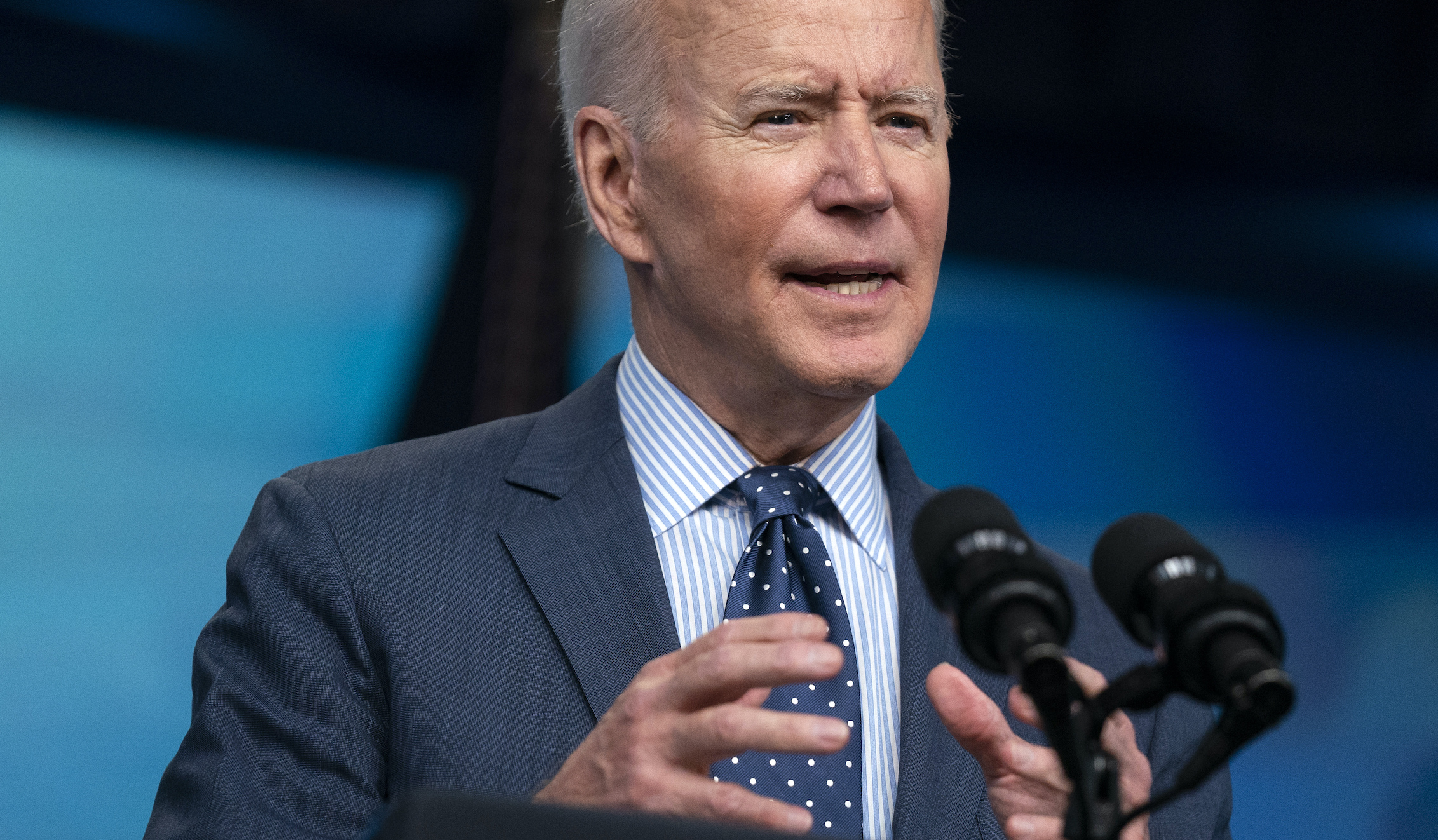
President Joe Biden’s surprising dig at two members of his own party has raised questions about his legislative strategy ahead of a summer that experts expect to be dominated by his priorities fizzling on the Senate floor.
The White House may have downplayed Biden’s veiled swipe earlier this week at Sens. Joe Manchin of West Virginia and Kyrsten Sinema of Arizona. But the dig previews the pressure the two centrists will soon face as their opposition to changing the Senate’s filibuster rules to allow legislation to pass with 51 votes stymies Biden’s plans.
Recommended Stories


‘NOT ENOUGH REALITY’: BIDEN’S FIRST BUDGET HEADED DOWN DEAD END ON CAPITOL HILL
Lawmakers do not appreciate being threatened or coerced, according to Middlebury College political science professor Bertram Johnson. Yet, Johnson described Biden’s jab at Manchin and Sinema as “far from a direct attack.”
He added that appearing independent from the White House may even boost the senators’ popularity in their home states.
“Based on the context in which he said this, I think Biden is trying to manage expectations among his supporters and prepare them for potential negotiations and compromises,” Johnson said hours before Manchin told a CNN reporter he thought Biden’s jab was “taken out of context.”
Still, a similar heavy-handed legislative strategy backfired on former President Franklin D. Roosevelt in 1938, according to historian David Pietrusza. Roosevelt had decided “to purge prominent recalcitrant Democratic members” in that year’s midterm primary elections. He targeted Sens. Walter George of Georgia, Ellison DuRant “Cotton Ed” Smith of South Carolina, and Millard Tydings of Maryland, as well as Rep. John O’Connor of New York, then-chair of the powerful House Rules Committee.
“All survived except for O’Connor, and the episode was widely seen as a black eye for FDR,” Pietrusza said.
Former President Richard Nixon had better luck in 1970. Nixon endorsed James L. Buckley, William F. Buckley Jr.’s older brother, in a three-way contest against incumbent Sen. Charles Goodell, the father of NFL Commissioner Roger Goodell.
“Goodell had been a moderately conservative Western New York congressman until being appointed to the U.S. Senate by Gov. Nelson Rockefeller following the 1968 assassination of Robert Kennedy,” Pietrusza said. “Then he veered leftward. Vice President Spiro Agnew famously derided Goodell as ‘The Christine Jorgensen of the Republican Party,’ referencing a very early sex change. Goodell finished third in the general election.”
Observers say Biden has miscalculated his influence on Congress before. Lawmakers missed his Memorial Day deadline for the body to pass the George Floyd Justice in Policing Act, and discussions regarding a possible bipartisan infrastructure deal have been extended until June 7.
“The fact that there are good-faith negotiations ongoing, and that both sides involved see them as positive, is much more progress than we’ve seen in the past,” said Daniella Gibbs Leger, Center for American Progress communications and strategy executive vice president.
The White House’s first attempt to strong-arm Manchin and Sinema did not go well. In January, Biden tasked Vice President Kamala Harris with local West Virginia and Arizona media interviews about his $1.9 trillion coronavirus spending package, in which she appeared to try pressuring both lawmakers. Then, in a gaffe that hit hard in coal-rich West Virginia, Harris mistakenly mentioned “abandoned land mines” instead of “abandoned mine lands.”
“I saw it. I couldn’t believe it. No one called me,” Manchin said. “That’s not a way of working together, what was done.”
This time around, the White House dispatched Energy Secretary Jennifer Granholm to West Virginia for a joint event with Manchin on Thursday. And Biden on Wednesday hosted Manchin’s West Virginia Republican Sen. Shelley Moore Capito in the Oval Office for infrastructure talks. A follow-up call between the pair has been scheduled for Friday.
Still, Biden undercut Manchin and Sinema during a scripted address in Tulsa, Oklahoma, this week to mark the 100th anniversary of the city’s race massacre. And his speech provides cover for his colleagues to do the same.
“I hear all the folks on TV saying, ‘Why doesn’t Biden get this done?’ Well, because Biden only has a majority of effectively four votes in the House and a tie in the Senate, with two members of the Senate who vote more with my Republican friends,” Biden said Tuesday while imploring Congress to expand voter access.
Less than 24 hours after Biden’s Tulsa appearance, White House press secretary Jen Psaki sought to undo the damage. Psaki insisted Biden was not commenting on Manchin and Sinema personally. Rather he was remarking on TV pundits, she said.
“He considers them both friends. He considers them both good working partners. And he also believes that in democracy, we don’t have to see eye to eye on every detail of every single issue in order to work together,” she told reporters Wednesday.
But political operatives and observers still fixated on the line and expressed their concerns over the White House’s legislative strategy.
In an evenly divided Senate, every Democratic vote is critical to Biden’s agenda. And Manchin and Sinema, who have actually supported most planks of Biden’s platform, have become decisive voices in the chamber as advocates for more centrist policies and inter-party collaboration.
Manchin and Sinema are uncomfortable with Democratic dependence on the budgetary fast-track procedure known as reconciliation, allowing bills to pass under simple majority votes rather than the required 60. They are also against overhauling the upper chamber’s filibuster rules, which will likely block the passage of pro-voting, anti-gun, and gay rights bills that are anticipated to be brought to the floor this summer.
CLICK HERE TO READ MORE FROM THE WASHINGTON EXAMINER
VoteVets, a liberal group promoting military veteran voters, has already announced plans to run ads related to voter access legislation in West Virginia and Arizona.
