
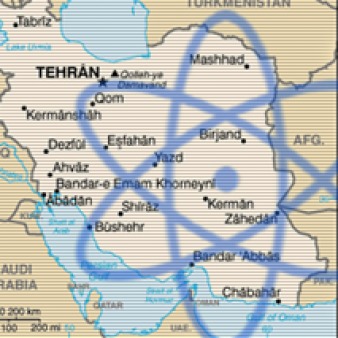
Don’t be confused by the Obama administration’s Iran policy, warns Hudson Institute senior fellow Michael Doran on the Mosaic website. It may look like random ad-hocery, but writes Doran, “Obama does have a relatively concrete vision. When he arrived in Washington in 2006, he absorbed a set of ideas that had incubated on Capitol Hill during the previous three years—ideas that had received widespread attention thanks to the final report of the Iraq Study Group, a bipartisan congressional commission whose co-chairs, former secretary of state James Baker and former Indiana congressman Lee Hamilton, interpreted their mission broadly, offering advice on all key aspects of Middle East policy.”
Doran, who served in the Bush administration when Baker-Hamilton was published in 2006, explains that the ostensibly bipartisan panel urged “Bush to take four major steps: withdraw American troops from Iraq; surge American troops in Afghanistan; reinvigorate the Arab-Israeli ‘peace process’; and, last but far from least, launch a diplomatic engagement of the Islamic Republic of Iran and its junior partner, the Assad regime in Syria. Baker and Hamilton believed that Bush stood in thrall to Israel and was therefore insufficiently alive to the benefits of cooperating with Iran and Syria. Those two regimes, supposedly, shared with Washington the twin goals of stabilizing Iraq and defeating al-Qaeda and other Sunni jihadi groups. In turn, this shared interest would provide a foundation for building a concert system of states—a club of stable powers that could work together to contain the worst pathologies of the Middle East and lead the way to a sunnier future.
Real journalism.Trusted by millions.
Unlimited access to in-depth reporting, expert analysis, and the stories that shape our country.
Already a member? Log in