
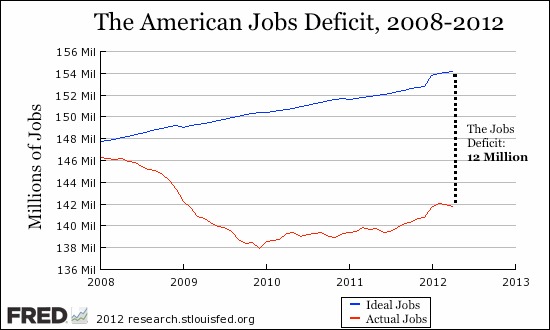
I received this smart email from a reader:
When dealing with budgets, a spending cut is routinely defined as a reduction from previously planned spending, i.e. if we planned for spending to increase by 4% and it only increases by 3% there’s been a spending cut.
Okay, if that’s how we are going to do the numbers let’s at least be consistent and do the same with employment. If the historical path of employment is that job increases are 5% per year then any growth less than 5% should be labelled a jobs deficit. Is this a fair approach? Well yes, to the extent that households make their plans based on past job growth experiences then those plans are disrupted just as are the plans of bureaucrats are when spending is cut from its projected path.
Okay, if that’s how we are going to do the numbers let’s at least be consistent and do the same with employment. If the historical path of employment is that job increases are 5% per year then any growth less than 5% should be labelled a jobs deficit. Is this a fair approach? Well yes, to the extent that households make their plans based on past job growth experiences then those plans are disrupted just as are the plans of bureaucrats are when spending is cut from its projected path.
Real journalism.Trusted by millions.
Unlimited access to in-depth reporting, expert analysis, and the stories that shape our country.
Subscribe Now
Already a member? Log in
Print subscriber? Click here to login/register your account
Digital subscriber? Click here to login/register your account.