

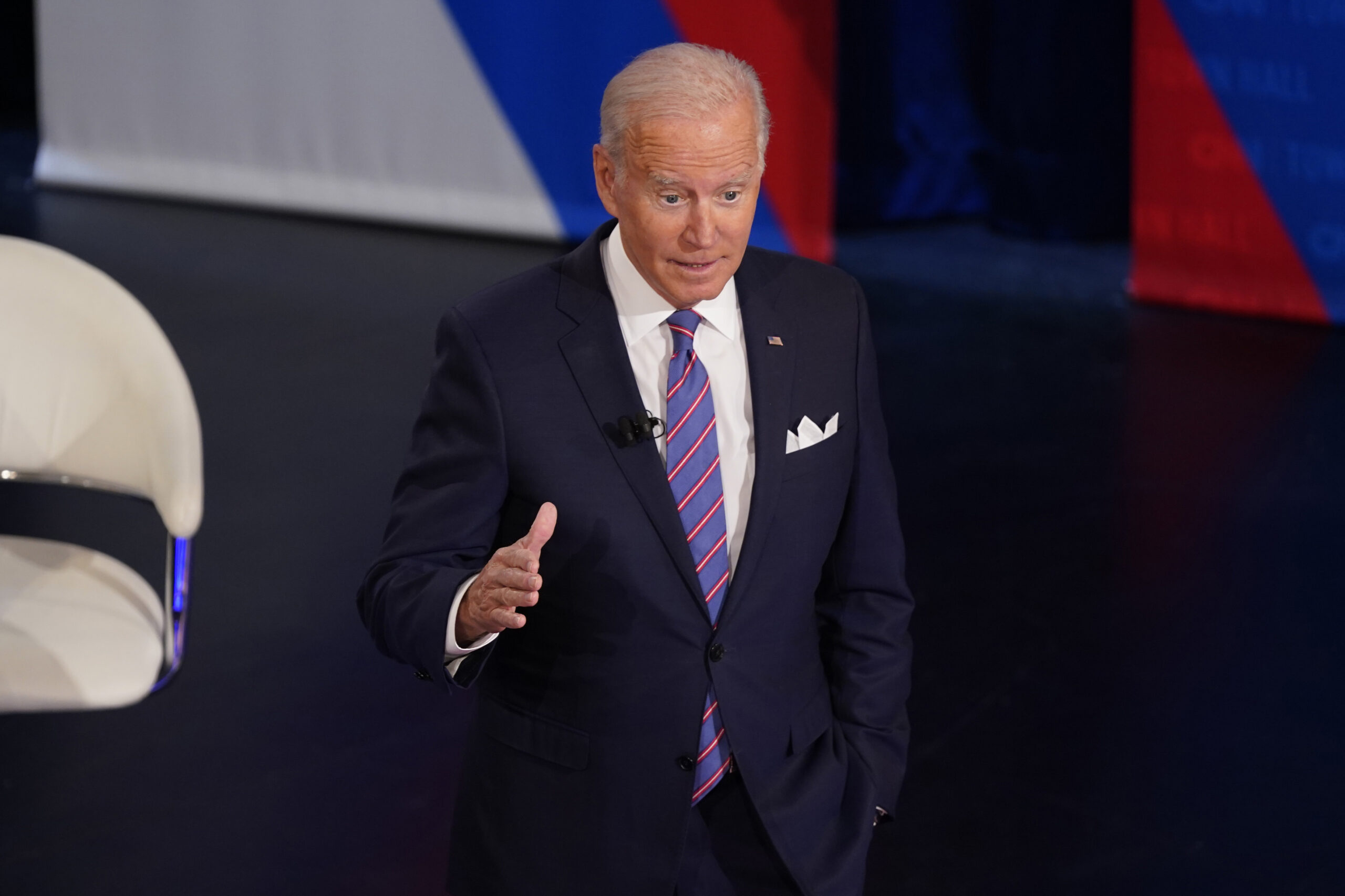
President Joe Biden’s declaration Thursday that the United States has a “commitment” to defend Taiwan against China continued his administration’s trend of sending mixed messages in the face of Beijing’s aggression.
Biden’s vow in a CNN town hall was the second time in recent months that he has said the U.S. would respond militarily if China attacked the democratic island nation. Each time, the White House has subsequently insisted America’s decadeslong policy of “strategic ambiguity” had not actually changed.
Recommended Stories


“The President was not announcing any change in our policy and there is no change in our policy,” a White House spokesperson told the Washington Examiner late Thursday. “The U.S. defense relationship with Taiwan is guided by the Taiwan Relations Act.”
CNN host Anderson Cooper asked the president about defending Taiwan in light of China’s reported recent test of a hypersonic missile capable of carrying a nuclear weapon. Biden answered in the affirmative, just as he did in an August interview, where his remarks were similarly walked back by administration officials.
“I just want to make China understand that we are not gonna step back. We are not gonna change any of our views,” Biden said.
Pressed by Cooper about whether he was saying the U.S. would come to Taiwan’s defense if China attacked them, Biden was clear.
“Yes,” he said. “Yes, we have a commitment.”
CHINA SAYS ‘NO ROOM’ FOR COMPROMISE ON TAIWAN
That stance seemed to put him at odds with U.S. policy and with the testimony of his nominee to be ambassador to China, Nicholas Burns. Earlier this week, Burns said the U.S. policy is to remain ambiguous about how it might respond to a Chinese invasion of Taiwan.
White House press secretary Jen Psaki insisted Friday that Biden’s comments to CNN did not deviate from the operative U.S. policy.
“There has been no shift,” Psaki said. “The president was not announcing any change in our policy, nor has he made any decision to change our policy. There is no change in our policy.”
When it was pointed out that Biden’s words were clear, Psaki insisted, “He was not intending to convey a change in policy nor has he made a decision on changing policy.”
Biden had also promised the U.S. would “respond” to any possible Chinese invasion of Taiwan during an interview with George Stephanopoulos of ABC News just days after the fall of Kabul in mid-August.
When Stephanopoulos said China was citing the U.S. withdrawal to tell Taiwan it couldn’t count on America, Biden directly compared the U.S. commitment to Taiwan to the mutual defense obligation the U.S. has to its NATO allies.
That comparison was quickly shot down by a Biden administration official.
“Our policy with regard to Taiwan has not changed,” a senior administration official told the Washington Examiner at the time. “The U.S. defense relationship with Taiwan is guided by the Taiwan Relations Act, as it has been for the past 40 years, and is based on an assessment of Taiwan’s defense needs and the threat posed by the PRC.”
Taiwan, known as the Republic of China, is an independent island nation off the coast of mainland China. The Chinese Communist Party has long sought to bring the territory under its control, while Taiwan is self-governed and receives U.S. defense support, despite not being formally recognized. U.S. relations with Taiwan became unofficial in 1979 after the U.S. agreed to establish diplomatic relations with the CCP-ruled Chinese mainland.
CLICK HERE TO READ MORE FROM THE WASHINGTON EXAMINER
Burns spent much of his Senate Foreign Relations Committee confirmation hearing this week defending what he said was the Biden administration’s position of strategic ambiguity.
Texas Republican Sen. Ted Cruz rejected the strategy, giving Burns a take that sounded more in line with what Biden told Cooper.
“The Chinese Communist party, I believe, interprets ambiguity as weakness and as a signal that we are not committed to Taiwan’s security,” Cruz said.
Chinese Foreign Ministry spokesman Wang Wenbin said Friday that the U.S. should “avoid sending wrong signals to the ‘Taiwan independence’ separatist forces, lest it should seriously damage China-U.S. relations and peace and stability across the Taiwan Strait.”
