

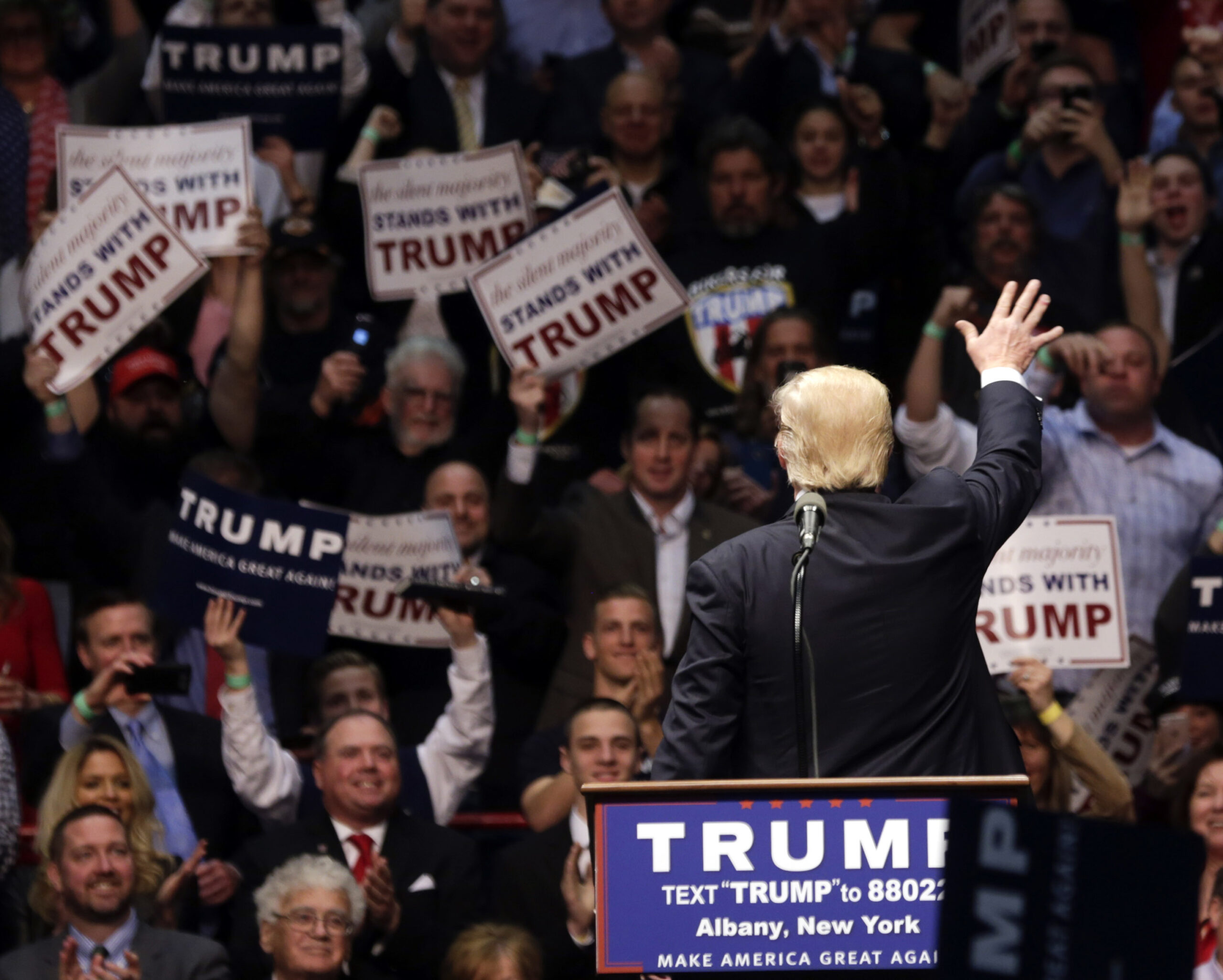
HOLLYWOOD, Fla. — Republican delegates, poised to wield real power for the first time in decades, could toss front-runner Donald Trump at a contested convention and elevate one of his underdog rivals to the presidential nomination.
But as the delegates game out scenarios for an unpredictable floor fight, they concede that there’s no way to know if they’ll embrace the power to pick the nominee granted to them under GOP rules, or fold under immense public and private pressure and throw the GOP nod to Trump, the likely top candidate in raw votes and primaries won.
Recommended Stories


The Republicans haven’t been in this position since 1976; it’s been even longer since a GOP convention featured more than one round of balloting. Delegates concede that social media harassment and an international media spotlight scrutinizing their every move — and vote — could impact decision making in Cleveland.
“If it is an open convention, no matter what happens, it’s going to be a pressure-cooker in there,” Blaise Ingoglia, the Florida Republican Party chairman, said this week in an interview with the Washington Examiner. Ingoglia is a delegate, and under his state party’s unique rules is bound to vote for Trump, the winner of Florida’s March 15 primary, on the first three rounds of balloting.
Trump insists he’ll win a 1,237 delegate-majority before the convention. The New York businessman’s senior aides spent Thursday at an upscale seaside resort near Ft. Lauderdale, where the Republican National Committee was gathered for a quarterly business meeting, to brief party officials and delegates on his plans for securing the nomination.
Florida Gov. Rick Scott, a top Trump supporter, suggested to reporters after addressing RNC members at a luncheon here that delegates should stand down and honor the will of the popular vote in the primary held in their state. “We can’t play monkey business,” he said. “We’ve got to let the voters decide; when they do, whatever choice they make, we’ve got to get behind that nominee.”
But Trump is sensitive to the inroads rival Ted Cruz has made with hundreds of delegates that have committed to vote for the Texas senator once unbound from him. So the real estate mogul is moving to pre-empt defeat in Cleveland by trying to browbeat delegates into providing him with enough votes to close whatever gap might exist between his bound delegate total and 1,237.
Trump is essentially accusing delegates of taking bribes in exchange for promising to support Cruz or Ohio Gov. John Kasich, and using a “crooked” nominating system to disenfranchise voters and steal the election from him. Delegates don’t appreciate the attacks, and they could backfire. Still, in the heat of a convention, pressure could impact their votes.
“No decisions are made in a vacuum,” said Henry Barbour, delegate and RNC committeeman from Mississippi who previously supported Sen. Marco Rubio of Florida, who has since suspended his campaign. “People will have all sorts of input if they’re a delegate, on how they vote.”
Trump leads the delegate race with 845, and is expected to pad his advantage on Tuesday, when Republicans in five states favorable to him head to the polls in party primaries. Cruz follows with at 559; he should pick up some delegates Tuesday, but his best chance for narrowing the gap with Trump will come with the states that vote in May, beginning with Indiana. Kasich trails with 148.
Trump is the only candidate of the three capable of clinching the nomination before the primary season concludes on June 7. But he still has to win more than 60 percent of all available delegates in ensuing contests, a feat that won’t be easy. In preparation for a contested convention, some delegates, as well as full delegations, are beginning to strategize.
Some delegations have decided that they will only vote as a single bloc.
Among delegates that might eventually be free agents, some are committing to stick with the winner of the state or district they were elected to represent. Others are prepared to exercise their power and vote their conscience.
These delegates often speak in terms of “doing what’s best for the party,” which is generally code for voting against Trump. In between meetings in south Florida this week, RNC members were publicly bullish on the party’s 2016 prospects. Privately, they acknowledged that Trump leading the ticket could sink the GOP in November.
“I’m going to pay attention to the popular vote in my state; I’m not bound to the popular vote in my state because of unaffiliated voters, independent voters and others that are allowed to vote in our primary,” said Kris Warner, RNC committeeman from West Virginia, which votes on May 10.
Shawn Steel, the RNC committeeman from California, which votes on June 7, predicted that most delegates, once unbound, would think similarly to Warner.
Steel, a veteran party official, said delegates if given the chance would vote for the candidate that offers Republicans their best chance to win the White House in November. On that front the polling data has been consistent. That candidate is not Trump.
“Unless Donald Trump shows us a pathway to win in November, I don’t see how he could be an exciting choice,” Steel said.
Republican insiders generally agree that if Trump doesn’t win an open convention on the first ballot, his prospects diminish considerably. Where they disagree is whether getting close to 1,237 by the time the time the primaries wrap up in June would convince unbound delegates to make up the difference and put him over the top.
Exactly what qualifies as “close enough” is another hot topic of discussion among senior Republicans. Where there does appear to be consensus is on the following the RNC rules requiring a majority of delegates to capture the nomination.
In several interviews in Hollywood, Fla., this week, even RNC members said over and over again that “1,237 means 1,237.”
In other words, Trump is not going to be treated as the presumptive nominee if he doesn’t reach that threshold. That was the opinion of those who thought Trump could win on first ballot if he gets close enough, and those who said his only path to the nomination was through winning a majority of delegates in the primaries.
“Rules are rules, and our system is based on systems like the Electoral College that have existed throughout the country’s history, that while they might be at times confusing and complex, they are the system,” said Matt Moore, chairman of the South Carolina GOP.
