

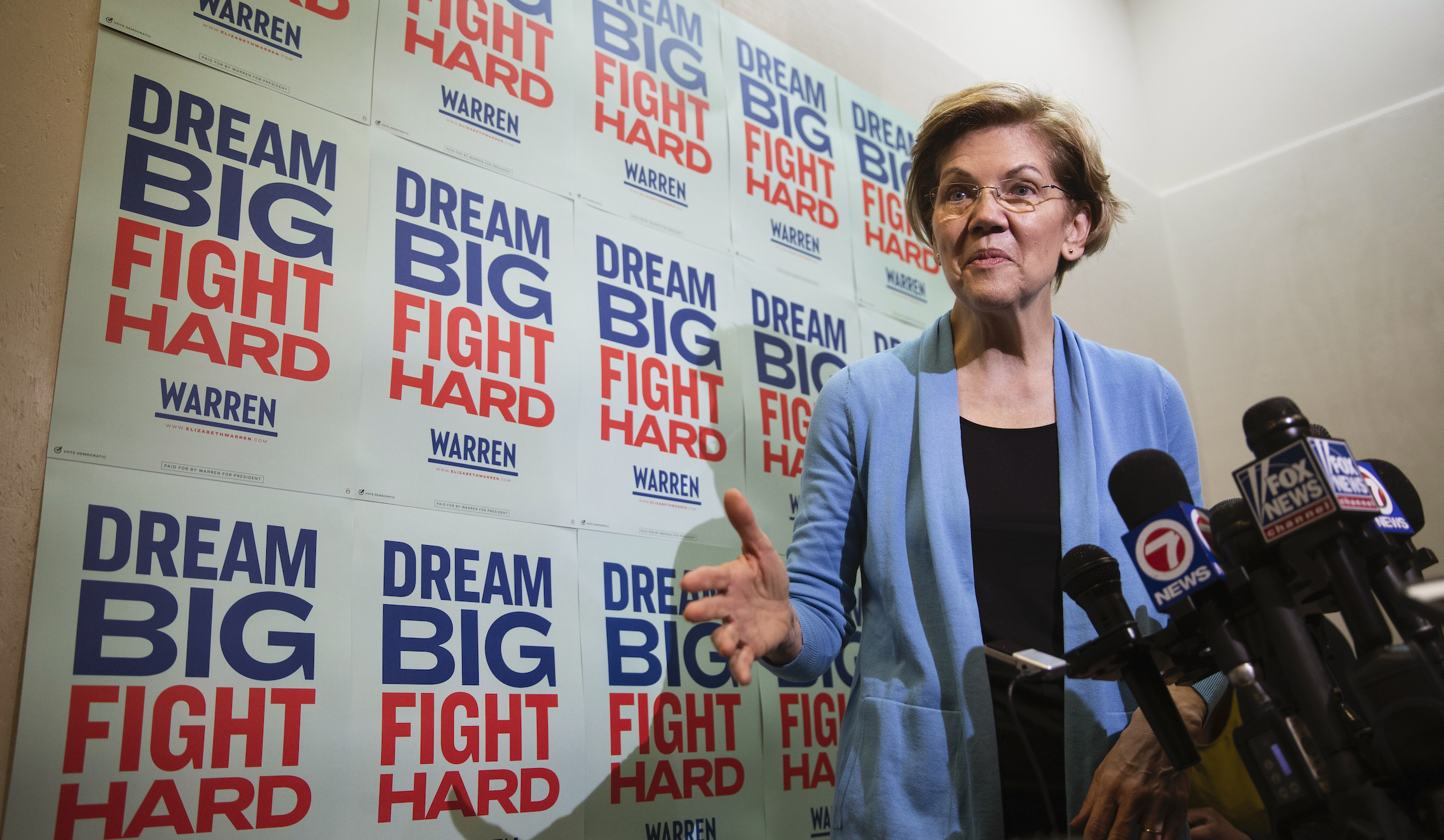
HOUSTON — Elizabeth Warren was bracing for a South Carolina beating.
Like many of her rivals for the 2020 Democratic presidential nomination not named Joe Biden, the Massachusetts senator, 70, juggled campaign stops in the first-in-the-South state with events in Super Tuesday states ahead of next week, including Texas, where she held an election night town hall.
Recommended Stories



“I’ll be the first to say that the first four contests haven’t gone exactly as I’d hoped,” Warren said in Houston Saturday night. “Super Tuesday is three days away, and we’re looking forward to gaining as many delegates to the convention as we can — from California to right here in Texas.”
Echoing a campaign memo circulated before New Hampshire that predicted she was “poised to finish in the top two in over half of Super Tuesday states,” she added, “Our campaign is built for the long haul — and we’re looking forward to these big contests.”
Even the star power of John Legend couldn’t lift Warren in South Carolina on Saturday, a result foreshadowed by a yearlong struggle to gain traction with minority Democrats and a polling average of 6% heading into the last of the first four early-voting contests, according to RealClearPolitics averages.
In the South Carolina primary she won only 7.1%. Former Vice President Joe Biden romped to victory with 48.4%.
But as she eyes Super Tuesday, her pitch that she’s the “woman who’s going to beat Donald Trump” will be tested again after finishing third in Iowa, as well as fourth in New Hampshire and Nevada, a mix of both mostly white and diverse states.
She’s polling well in California, with an average of 17% support, following only Bernie Sanders in the state that provides candidates with the opportunity to pick up some of its 416 pledged delegates. Despite investing in Texas, boosted by San Antonio native Julian Castro, she’s further behind in fourth place with 13%, falling short of the 15% threshold generally required to scoop up some of the state’s 228 available delegates. She faces a similar challenge in North Carolina and Virginia, with 11% in each of the general election battlegrounds.
Though she’s had some success dinging Michael Bloomberg on the debate stage and campaign trail, she may have left it too late to undermine Sanders’s case for the presidency.
This week, she pushed her ideological ally’s lack of legislative accomplishments and his opposition to changing the Senate’s filibuster rule which, if it remains in place, could hurt a Democratic president’s ability to pass their agenda through a likely Republican-controlled chamber. In return, Sanders, 78, scheduled rallies in Massachusetts, where four out of at least five polls released this month had him in the lead. Sanders’s event in Boston on Saturday morning reportedly drew a crowd of 13,000.
Publicly she’s projecting confidence, telling reporters in Columbia, South Carolina, around the same time that her bid is “a culmination of a lifetime of work.”
“Look, I think that we are. This is winning, I’m loving every minute,” she said when asked whether she’d feel the same way if she continues not to experience any success, refusing to call Massachusetts a “must-win” state.
She’s embraced her “fighter” image, teased by Democratic opponents such as Biden and Bloomberg as well as Trump, building on the 2010 “blood and teeth” quote about her work advocating for a consumer protection bureau that was promoted by her supporters after the Nevada debate.
Yet her willingness to accept more than $14 million worth of help from the Persist SuperPAC, the largest in the field at the moment, after criticizing campaign finance groups for much of the cycle belies some nervousness felt by the senator and her team.
Robert Thornton, 57, an undecided independent, admitted Warren’s losing streak didn’t bode well for Super Tuesday.
“No, it doesn’t look good,” the Houston engineer manager told the Washington Examiner. “But I’ve had people say, ‘Well, why is she even showing up here when she’s likely not to get very many of the voters in Texas or whatever. Well, she still needs to continue. You don’t know how Super Tuesday’s going to play out.”
