

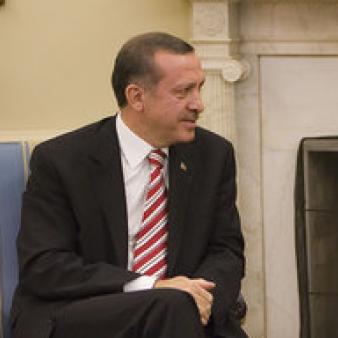
The soft-Islamist Turkish government of Prime Minister Recep Tayyip Erdogan and his Justice and Development party (known by its Turkish initials as the AKP) has expansive foreign-policy ambitions. In addition to its embrace of the Hamas regime in Gaza and accompanying criticism of Israel, Ankara has sent naval and air units into the eastern Mediterranean in a bid to intimidate Cyprus from exploiting, with U.S. economic partners, the divided island’s offshore energy assets. Turkish military maneuvers near Cyprus parallel threats of a similar seaborne campaign to shield another Gaza flotilla operation against Israel’s maritime security patrols. Turkey has acted ambiguously toward the NATO missile-defense system intended for protection from Russian or Iranian attack, after indicating cooperation with the plan developed by the Western alliance.
In more benign-appearing efforts, Turkey has switched from supporting the bloody dictatorship of Bashar Al-Assad in Syria to declaring an arms embargo against Damascus, and has sought a leading role in aid to post-Qaddafi Libya. But a key aspect of AKP’s efforts at a “neo-Ottoman” revival of national prestige is typically neglected by Western observers. That is, Erdogan has sojourned repeatedly as a triumphant patron in the former Balkan provinces of the Turkish empire, including Bosnia-Herzegovina, Kosovo, and, most recently, Macedonia. All these countries were ruled from Constantinople until the last quarter of the 19th century, in the Bosnian case, and the first decades of the 20th, in Kosovo and Macedonia.
Stay informed.Stay ahead.
Join Washington Examiner for unlimited access to the news, analysis, and commentary that matter most.
Already a member? Log in
