

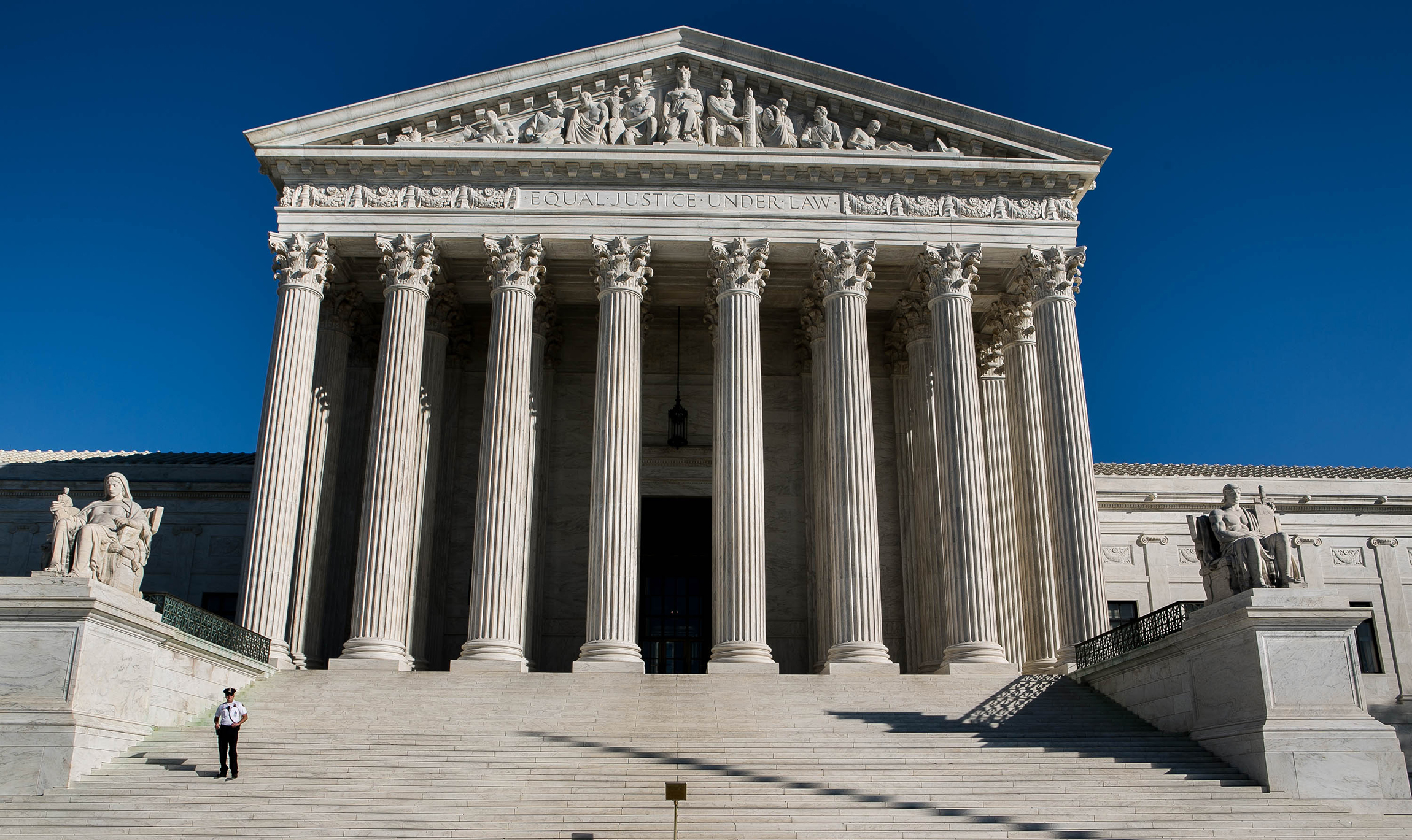
Adult diapers, the death penalty and alleged gerrymandering in two battleground states — these may sound like the components and topics of an upcoming presidential debate, but they are actually a few of the issues set to come before the Supreme Court in its new term.
As the Supreme Court kicks off oral arguments in its October term on Tuesday, here’s a look at the issues and cases we will closely follow in the weeks and months to come:
Recommended Stories


INTELLECTUAL PROPERTY
Samsung v. Apple: Samsung and Apple have feuded for years about smartphone design patents. Samsung was ordered to pay Apple $930 million after a trial in 2012, and has been trying to bring down the price tag ever since.
An appeals court reversed the damages on trademark liability, but upheld Samsung’s infringement of the iPhone patents — namely those regarding mobile phones with a rectangular shape and rounded corners and a certain graphical on-screen design.
Samsung believes the damages awarded have been excessive, while Apple thinks the law is clear and the Court needs to make no additional determination.
Oral arguments in this case begin on Tuesday, Oct. 11.
SCA v. First Quality Baby Products: SCA sued First Quality Baby Products for violating its patent on “adult incontinence products,” meaning adult diapers, in 2010.
First Quality argued SCA first accused First Quality in 2003 and then waited seven years to sue after investing “substantial capital to expand its market share for protective underwear.” A judge can dismiss a case, using the legal doctrine of laches, if the plaintiff waited too long to bring a suit.
The Court recently resolved a copyright suit by rejecting a defense involving the doctrine of laches but left open the question whether its ruling applied to patent law. The Court is poised to answer that question with its ruling in this case.
Oral arguments in this case begin on Nov. 1.
DEATH PENALTY
Moore v. Texas: The Court will determine whether the execution of an inmate after a prolonged period of incarceration — much of it spent in isolated confinement — violates the Eighth Amendment’s protection against cruel and unusual punishment.
During a failed robbery attempt of a grocery store in April 1980, Bobby James Moore shot and killed a store employee. Texas charged Moore with capital murder and he was found guilty that July. Moore was sentenced to death, but was later found to be denied his right to effective counsel during the trial and punishment phase. The state conducted a new sentencing hearing and Moore was again sentenced to death in 2001.
“Twice in the three-and-one-half decades since that imposition of the death sentence, the State signed death warrants and set his execution date: one death warrant was stayed less than 24 hours before he was to be executed, and the other only five days before the scheduled execution date,” Moore’s petition before the Court said.
This case will also allow the Court to expound upon its judgment regarding when a person lacks the mental capacity to a degree that would prevent the person from being given a death sentence. Moore’s petition noted that his mean IQ score is within the range of “mild retardation,” and that he dropped out of school in ninth grade after failing year-after-year in primary school.
No date for oral argument has yet been set in this case.
GERRYMANDERING
Bethune-Hill v. Virginia Board of Elections and McCrory v. Harris: These two cases involve lawmakers’ use of race when redrawing congressional districts.
The jurisdictional statements in these cases seek answers to several questions, including whether North Carolina redistricting constituted racial gerrymandering in violation of the Fourteenth Amendment, and whether a lower court erred in its ruling that race cannot predominate in the drawing of a given Virginia district “even where it is the most important consideration in drawing a given district unless the use of race results in “actual conflict” with traditional districting criteria.”
North Carolina and Virginia are key battleground states that could have a determinative impact on the outcome of the presidential election. New polling on Monday revealed Hillary Clinton led Donald Trump by 1 percentage point in North Carolina and Clinton bested Trump by 7 percentage points in Virginia.
Marc Elias, a Democratic superlawyer who has worked for Clinton’s campaign, is involved in both cases. He served as a counsel for the appellants in the Bethune-Hill v. Virginia Board of Elections case, and as a counsel for the appellees in the McCrory v. Harris case.
No date for oral argument has been set yet regarding either case.
RELIGIOUS LIBERTY
Trinity Lutheran Church v. Pauley: The Court will weigh whether Missouri violated the Constitution in the state’s decision to exclude a church from a state program that provides nonprofits with funding to resurface their playgrounds using recycled tires.
Trinity Lutheran operates a daycare center and applied for funds to convert its playground. The state denied the church’s request on the basis of a provision in the Missouri Constitution that prohibits public funds from directly or indirectly aiding any church, sect, or denomination of religion.
The resolution of this case has implications for other states featuring similar provisions in their state constitutions.
No date for oral argument has yet been set in this case.
TRADEMARK LAW
Lee v. Tam: After the Supreme Court shot down the Washington Redskins’ petition on Monday, the fate of the Redskins’ trademark may be determined by the outcome of this case involving an Asian-American rock band.
The band, named “The Slants,” sought a trademark for its name, and was denied by the U.S. Patent and Trademark Office, which decided the name was offensive. The band, like the Redskins, has argued that a federal law barring trademarks on racial slurs violates the First Amendment.
Victory for “The Slants” before the Court would mean a win for the Redskins, as the Washington Examiner has previously noted. But a loss for the band does not necessarily mean the Redskins’ chances of keeping its trademark would end.
No date for oral argument has yet been set in this case.
INSIDER TRADING
Salman v. United States: The Court will decide whether a conviction for insider trading requires the person who traded on the inside information to know that the source of the information benefited.
A jury convicted Bassam Yacoub Salman of insider trading for trading on information he got through his significant other’s brother, who was a Citigroup investment banker. Salman and the banker made the effort to cover their tracks and profited handsomely. The jury found Salman guilty because it said he had knowledge that his source was inappropriately disclosing inside information, and that his source earned a “reputational benefit” that could translate into future earnings by helping out a friend.
Billionaire Mark Cuban, who was cleared of insider trading charges in 2013, filed a brief supporting Salman and will be watching the case closely.
“No one should be prosecuted for conduct that Congress is either unwilling or unable to define,” Cuban’s brief argued.
Oral arguments in this case begin on Wednesday.
