

A trio of House Democrats unveiled a congressional resolution to censure President Trump for his comments about the violent white nationalist rally in Charlottesville, Va.
The resolution accuses Trump of “attempt[ing] to create a moral equivalency between white supremacist, KKK, neo-Nazi groups and those counter-protesting the ‘Unite the Right’ rally.”
Recommended Stories


The president’s comments have been criticized by Republican and Democratic lawmakers, but the resolution would elevate that rebuke into a formal censure while calling for the firing of multiple White House aides.
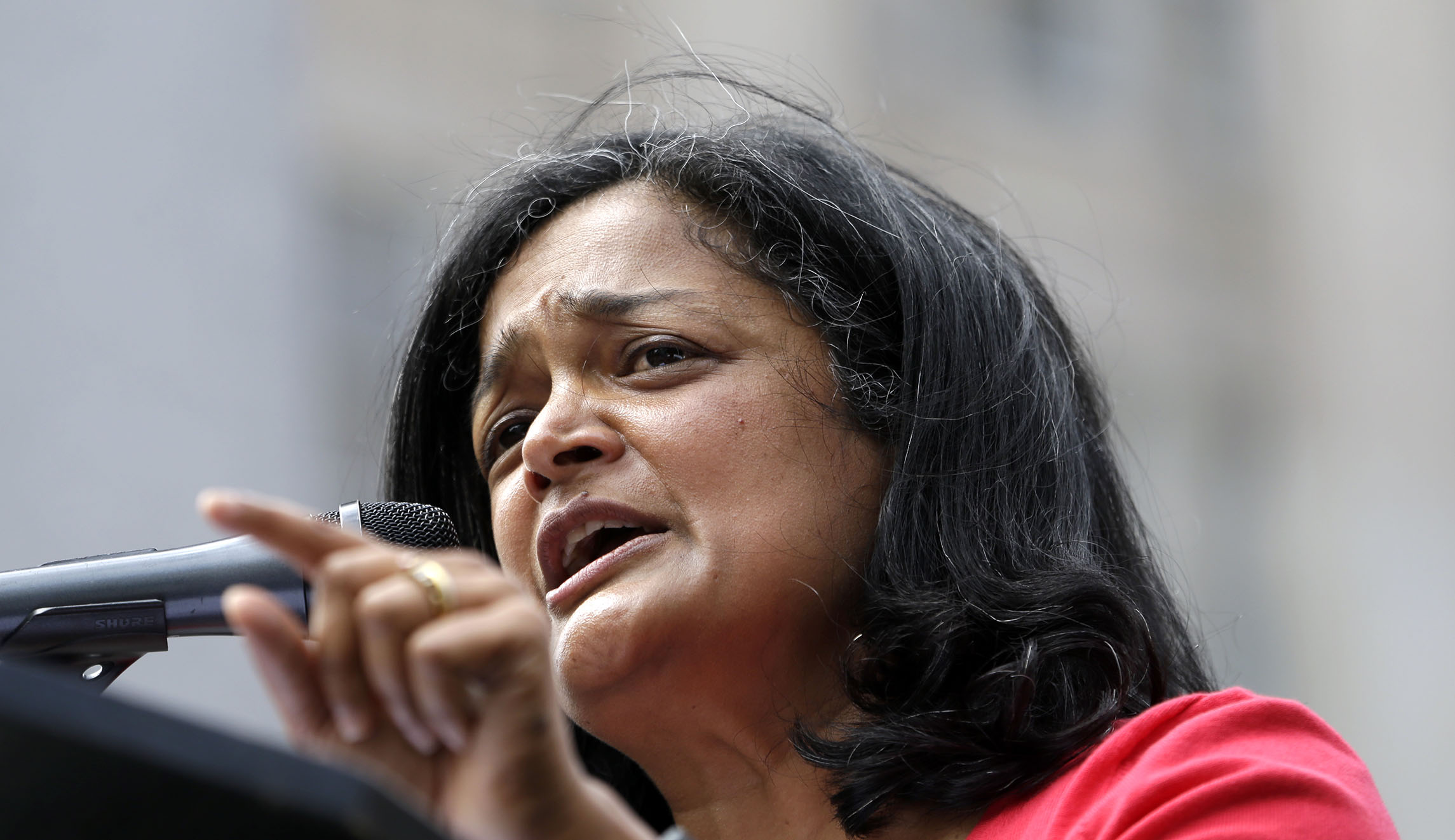
“Trump has surrounded himself with, and cultivated the influence of, senior advisors and spokespeople who have long histories of promoting white nationalist, alt-Right, racist, and anti-Semitic principles and policies within the country,” Reps. Jerry Nadler of New York, Bennie Watson Colema of New York, and Pramila Jayapal of Washington wrote in the censure resolution.
The Democrats plan to introduce the resolution during a pro forma session of the House on Friday. The effort could put Republicans in a politically uncomfortable position, caught between Trump’s most fervent supporters and their own opposition to the president’s comments.
“White supremacy is repulsive,” House Speaker Paul Ryan, R-Wis., tweeted Tuesday. “This bigotry is counter to all this country stands for. There can be no moral ambiguity.”
But a condemnation adopted by the House would be a historic rebuke. Congress rarely issued formal criticisms of presidential behavior. In 1848, James Polk was faulted for beginning the Mexican-American war without congressional approval. In 1860, James Buchanan suffered a formal House “reproof” over a corruption accusations, according to the Congressional Research Service. “In 1864, even Abraham Lincoln was condemned by the Senate for allowing a congressman to hold an Army commission,” CNN noted in 1998.
Democrats can be expected to portray any hesitation to add to that roster of censures as a failure to condemn white nationalism with sufficient force akin to Trump’s comments. “Trump has provided tacit encouragement and little to no denunciation of white supremacist groups and individuals who promote their bigoted, nationalist ideology and policies,” the resolution says.
Trump has frustrated Republican lawmakers throughout the incident. He denounced “bigotry” in general, on Saturday, but declined to comment specifically on white supremacists who expressed support for him while rallying in Charlottesville. “We condemn in the strongest possible terms this egregious display of hatred, bigotry and violence, on many sides,” Trump said. “We have to come together as Americans with love for our nation and true affection — really — and I say this so strongly — true affection for each other.”
The remarks Saturday came one day after the white supremacists’ marched Friday evening, an assembly that on Saturday drew counter-protestor associated with Antifa, a radical leftist group of activists who clashed with the original white nationalist rally-goers. The violence culminated, police say, in a white nationalist marcher driving his car into a crowd of the antifa activists, killing one and and injuring 19 others. That incident took place shortly before Trump spoke Saturday.
Some Senate Republicans, dissatisfied with Trump’s statement, condemned the driver of the car for domestic terrorism. “Mr. President — we must call evil by its name,” Sen. Cory Gardner of Colorado tweeted. “These were white supremacists and this was domestic terrorism.”
Trump maintains that it was too early in the investigation, when he spoke Saturday, to issue comment on the vehicular attack with confidence that he could be accurate. He issued a more specific condemnation of the white nationalist groups on Monday, but then stunned lawmakers and some aides on Tuesday by defending his original statement and adding that not all of the Charlottesville rally attendees were racist. “You had some very bad people in that group,” Trump said. “You also had some very fine people on both sides.”
Senate Majority Leader Mitch McConnell distanced himself from those comments when he denounced a planned white nationalist rally in his home state of Kentucky. “There are no good neo-Nazis, and those who espouse their views are not supporters of American ideals and freedoms,” he said. “We all have a responsibility to stand against hate and violence, wherever it raises its evil head.”
