

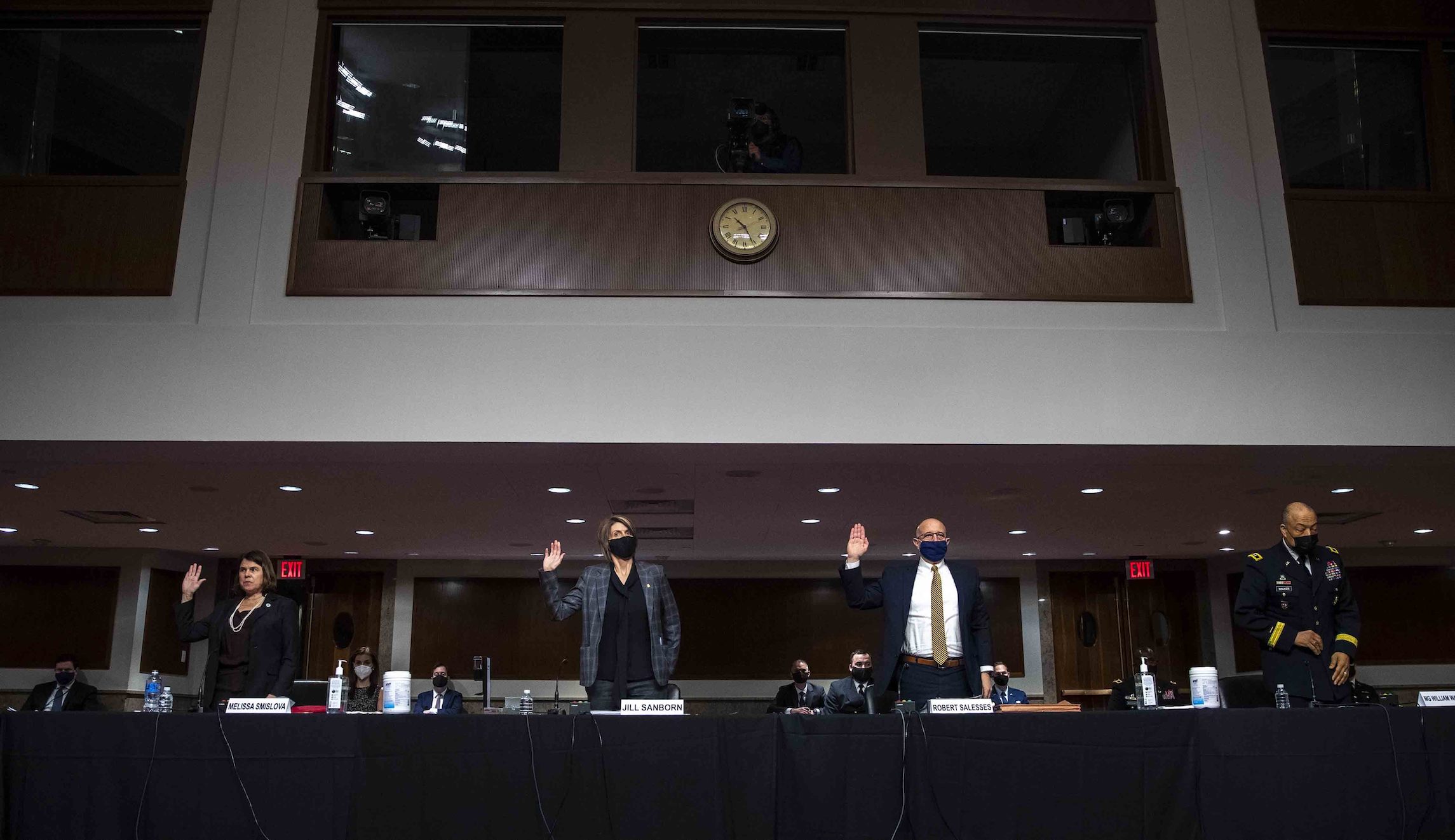
The head of District of Columbia’s National Guard force blamed strange instructions and foot-dragging from the secretary of the army for a delay of over three hours from the time he got a request to support police response to the Jan. 6 Capitol riot.
Maj. Gen. William Walker, commanding general of the D.C. National Guard, described what he said were “unusual” wait-for-approval instructions from top Pentagon brass during a joint Senate Homeland Security and Governmental Affairs Committee and the Senate Rules and Administration Committee hearing about the Jan. 6 Capitol riot on Wednesday.
Recommended Stories


The D.C. National Guard regularly provides a “quick reaction force” to Capitol and Metropolitan police during planned rallies, he said.
But a letter from the secretary of the army on Jan. 5, the day before the Capitol attack, “withheld authority for me to employ the quick reaction force,” Walker said, and “required that a ‘concept of operation’ be submitted to him before any employment” of a quick reaction force.
“I found that requirement to be unusual,” Walker said.
Without that restriction, Walker said he would have sent his troops to the Capitol “immediately” after he got a request from then-Capitol Police Chief Steven Sund for Guard support. “We could have helped extend the perimeter and pushed back the crowd.”
Instead, Walker said he was waiting for 3 hours and 19 minutes from the time of a “frantic” call from Sund requesting Guard assistance at 1:49 p.m. to the time that he got word from senior Army leaders that the request had been approved at 5:08 p.m.
Walker said that he was told the delay was due in part to the Army’s concerns about “optics,” and he was told that “it would not be their best military advice to have uniformed guardsmen on the Capitol.”
here’s William Walker, the DC National Guard commander, explaining why the instructions he got in the days before the January 6 insurrection were “unusual” pic.twitter.com/3o5jiVqMzl
— Aaron Rupar (@atrupar) March 3, 2021
Robert Salesses, the official performing duties of the assistant secretary for homeland defense and global security, disputed Walker’s characterization of the Army letter.
“In fairness to Gen. Walker, he can’t respond to a civil disturbance operation without the authority of the secretary of defense,” said Robert Salesses, the only Pentagon representative at the hearing. “Absent these memos, Gen. Walker would have had to get approval to respond through the secretary of defense.”
There was agreement, though, on issues with delays in getting Guard troops to the Capitol.
A Department of Defense timeline shows that at 3:26 p.m., the secretary of the army had a call with District of Columbia Mayor Muriel Bowser and the Metropolitan Police chief saying that their request had not been denied and that the acting secretary of defense approved the activation of the full D.C. National Guard. But that action only allowed the Guard to be called to go the armory, not head to the U.S. Capitol to support the situation, Salesses testified.
The acting secretary of defense did not provide verbal authorization for D.C. Guard troops to support Capitol Police until more than an hour later, at 4:32 p.m.
CLICK HERE TO READ MORE FROM THE WASHINGTON EXAMINER
Walker, who had his D.C. Guard troops, equipment, and a bus ready to mobilize, was not told about the approval until more than half an hour after the decision was made, at around 5:08 p.m. His troops were at the Capitol in under 20 minutes after that.
“I think that’s an issue,” Salesses said of the delayed communications.
