

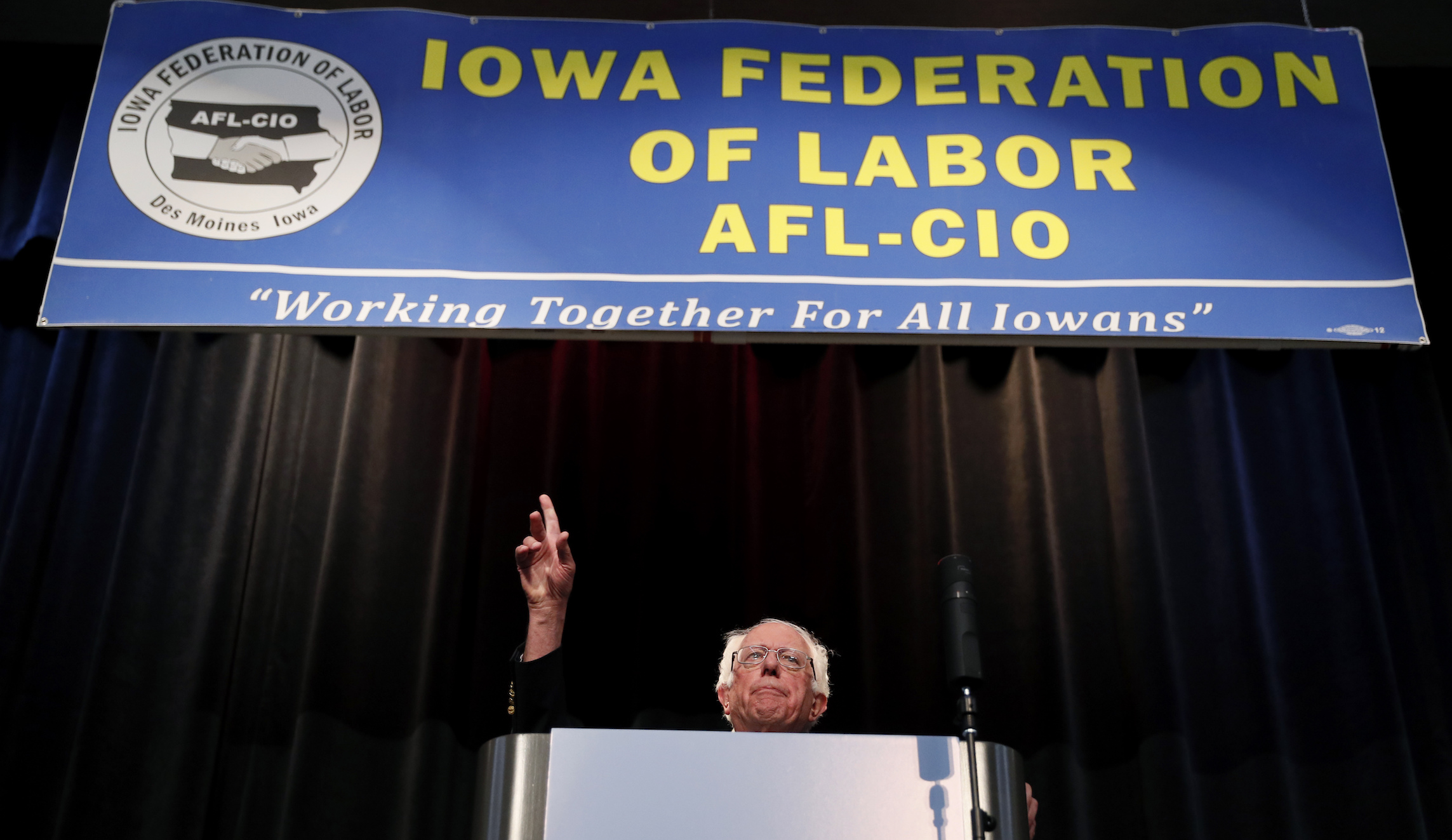
Bernie Sanders is leading the 2020 Democratic field among union endorsements, a dividend of a long career supporting pro-union ideas that outstrips even rivals such as Elizabeth Warren.
The American Postal Workers Union on Thursday became the fourth national labor organization to put its support behind Sanders. The 200,000-member union said that the Vermont senator stood apart from the other candidates.
Recommended Stories



“We’re pleased that a number of presidential candidates have positions and have taken actions supportive of postal workers and expanding union rights, but, when we judge candidates by their long-term and consistent actions, Bernie Sanders stands out as a true champion of postal workers and all workers throughout the country,” said APWU President Mark Dimondstein. Sanders tweeted that he was “honored” and vowed, “We’re going to expand and strengthen the Postal Service.”
Sanders has also been endorsed by the National Nurses United, United Electrical, Radio, and Machine Workers, and the National Union of Healthcare Workers, which co-endorsed Warren. Sanders also has the endorsements of 11 local unions. Former Vice President Joe Biden is second among 2020 Democratic candidates in national union endorsements, boasting the backing of the International Association of Bridge, Structural, and Ornamental Iron Workers, the International Association of Firefighters, and the National Association of Government Employees.
Such endorsements can matter. Labor Department reports state that the APWU has 2,000 members in Iowa, whose political caucus kicks off the Democratic primary.
Neil Sroka, spokesman for the Howard Dean-founded activist group Democracy for America, said Sanders’s appeal comes from his having “walked the walk” for many years. “That and he has a personal connection with the rank and file. He’s not some guy up high,” Sroka said.
The 2020 Democratic presidential field is arguably the most pro-union in the party’s history, but Sanders, a socialist, can boast a 98% lifetime rating on the AFL-CIO’s legislative scorecard. This matches Warren’s rating and is slightly better than Minnesota Sen. Amy Klobuchar’s 95%.
The difference is Sanders’s congressional career spans three decades, as he was first elected to Congress in 1991 before joining the Senate in 2007, and he has been staunchly pro-union throughout. Warren was elected in 2013 and Klobuchar in 2007. Joe Biden ended his career as a Delaware senator in 2008 with an 85% AFL-CIO lifetime rating.
Last year, Sanders marked an unusual first by having the first presidential campaign to unionize, a move that was soon copied by other campaigns. “We cannot just support unions with words; we must back it up with actions,” Sanders said following the announcement.
Sanders led the Democratic Party in pushing for a dramatically higher minimum wage, long before the rest adopted the cause. He introduced legislation in 2015 calling for a $15 minimum wage. It received five co-sponsors. His 2019 version received 31 co-sponsors, and a companion bill passed the House.
“Sen. Sanders’s commitment to working people extends far beyond postal workers,” the APWU endorsement said. “He has a long record of walking picket lines, fighting for living wages and healthcare as a human right, advocating for veterans’ benefits, promoting expansion of social security, and opposing every job-killing trade deal like NAFTA.”
Sanders, Warren, and Klobuchar are all original co-sponsors of the Protecting the Right to Organize Act, which has also been endorsed by former South Bend, Indiana, Mayor Pete Buttigieg. The legislation, which is set to be voted on by the House next week, would end all state right-to-work laws, prohibit numerous practices used by management to discourage union organizing, and stiffen penalties for labor rights violations. The PRO Act comprises proposals Sanders has repeatedly introduced in past Congresses.
The Vermont candidate has also introduced a “Work Place Democracy Plan” that goes even further by promising to double union membership nationwide and end the prohibition on federal workers striking. Both parties have generally rejected such a reform as incompatible with effectively and safely running the government. No other Democratic candidate has backed the idea, which would overturn a 1978 law signed by President Jimmy Carter. Sanders would instead guarantee that federal employees have “the same labor rights as workers in the private sector.” Sanders first introduced a version of the bill in 1992, which also included a repeal of right-to-work laws.
Sanders also backs reviving sectoral bargaining, which involves unionizing entire industries at once, not just individual businesses. Under sectoral bargaining, unions would be granted enormous power over industries, while businesses would be strictly limited in the workplace policies they could adopt.
Sanders introduced legislation last week intended to ensure that graduate students have the right to organize. Sanders said the bill is being introduced to undermine efforts to pass a National Labor Relations Board rule preventing graduate student unions.
