

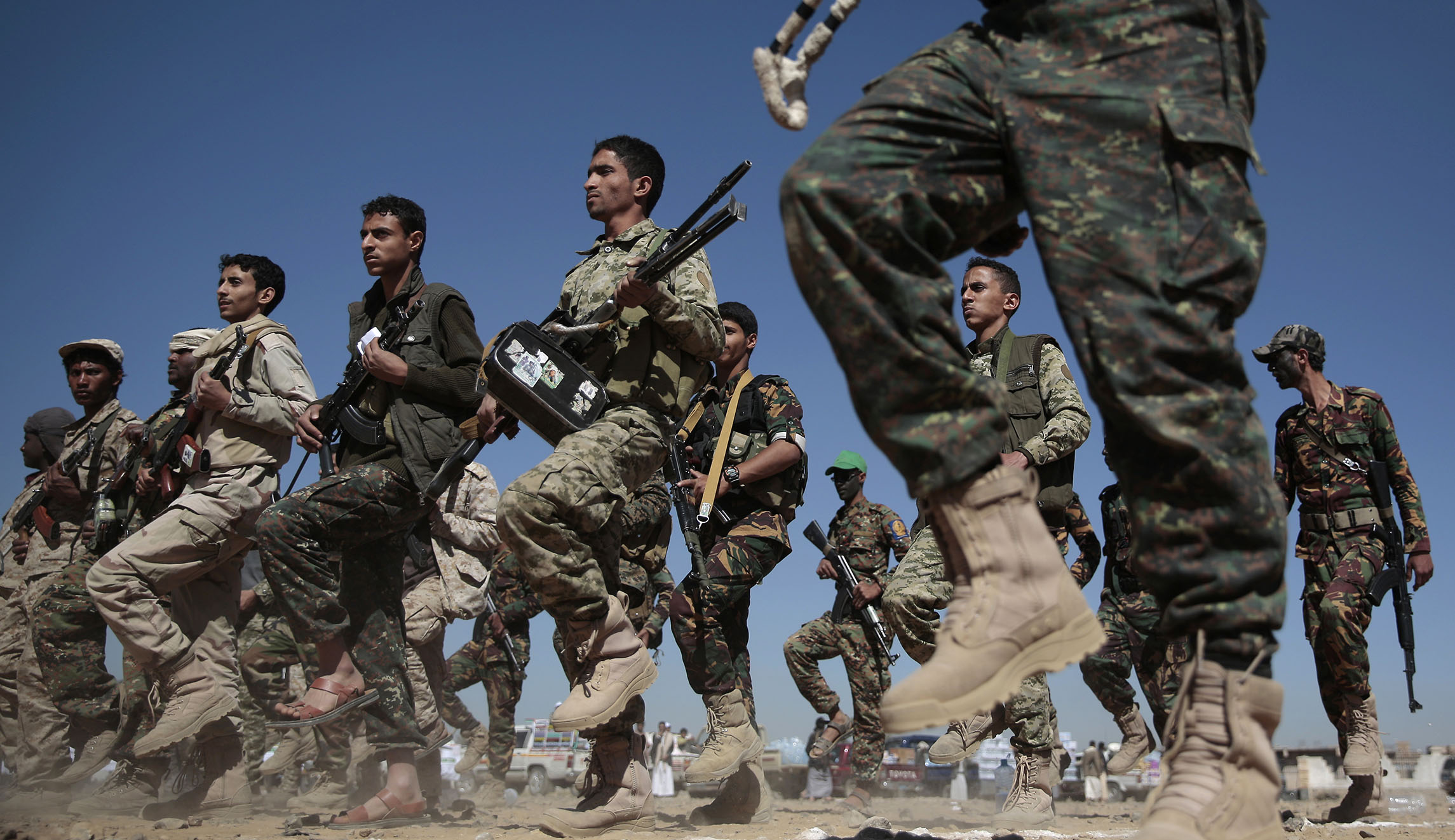
The Trump administration on Tuesday blacklisted several Iranian Revolutionary Guard Corps officials involved in arming rebels in Yemen’s civil war with ballistic missiles and other weapons, as part of an ongoing effort to punish the regime’s regional aggression.
“The United States will not tolerate Iranian support for Houthi rebels who are attacking our close partner, Saudi Arabia,” Treasury Secretary Steven Mnuchin said Tuesday. “All countries in the region should be on guard to prevent Iran from sending its personnel, weapons, and funds in support of its proxies in Yemen.”
Recommended Stories


The sanctions announcement targeted five senior IRGC officials “with links to Iran’s ballistic missile program,” a move that freezes their assets in U.S. jurisdiction and locks them out of the international economy.
Yemen is one of two countries where Iran is participating in a civil war that threatens to expand the reach of their proxy forces in the Middle East. The other, Syria, is the more substantial Iranian military operation. But the regime has provided Houthi rebels with ballistic missiles and other weapons, according to U.S. officials, some of which have been fired at a U.S. Navy guided missile destroyer as well as the Saudi Arabian capital of Riyadh.
“Their actions have enabled the Houthis to launch missiles at Saudi cities and oil infrastructure,” Mnuchin said. “They have also disrupted humanitarian aid efforts in Yemen, and threatened freedom of navigation in key regional waterways.”
The Houthis have obtained sea mines, anti-ship missiles, and other explosives that aided their ability to threaten shipping lanes in the Red Sea.
“These types of weapons did not exist in Yemen before the conflict,” U.S. Navy Admiral Kevin Donegan told the New York Times in 2017. “It’s not rocket science to conclude that the Houthis are getting not only these systems but likely training and advice and assistance in how to use them.”
The IRGC’s arming of the Houthis was a significant part of the Trump administration’s criticism of the Iran nuclear deal in the months leading up to the decision to withdraw from the pact. U.S. Ambassador to the United Nations Nikki Haley emphasized that the U.N. resolution affirming the Iran deal also included restrictions on the transfer of such weapons by the regime.
“The nuclear deal has done nothing to moderate the regime’s conduct in other areas,” she said in December while displaying Iranian weapons that she said were recovered from battlefields. “Aid from Iran’s Revolutionary Guard to dangerous militias and terror groups is increasing. Its ballistic missiles and advanced weapons are turning up in war zones across the region. It’s hard to find a conflict or a terrorist group in the Middle East that does not have Iran’s fingerprints all over it.”
