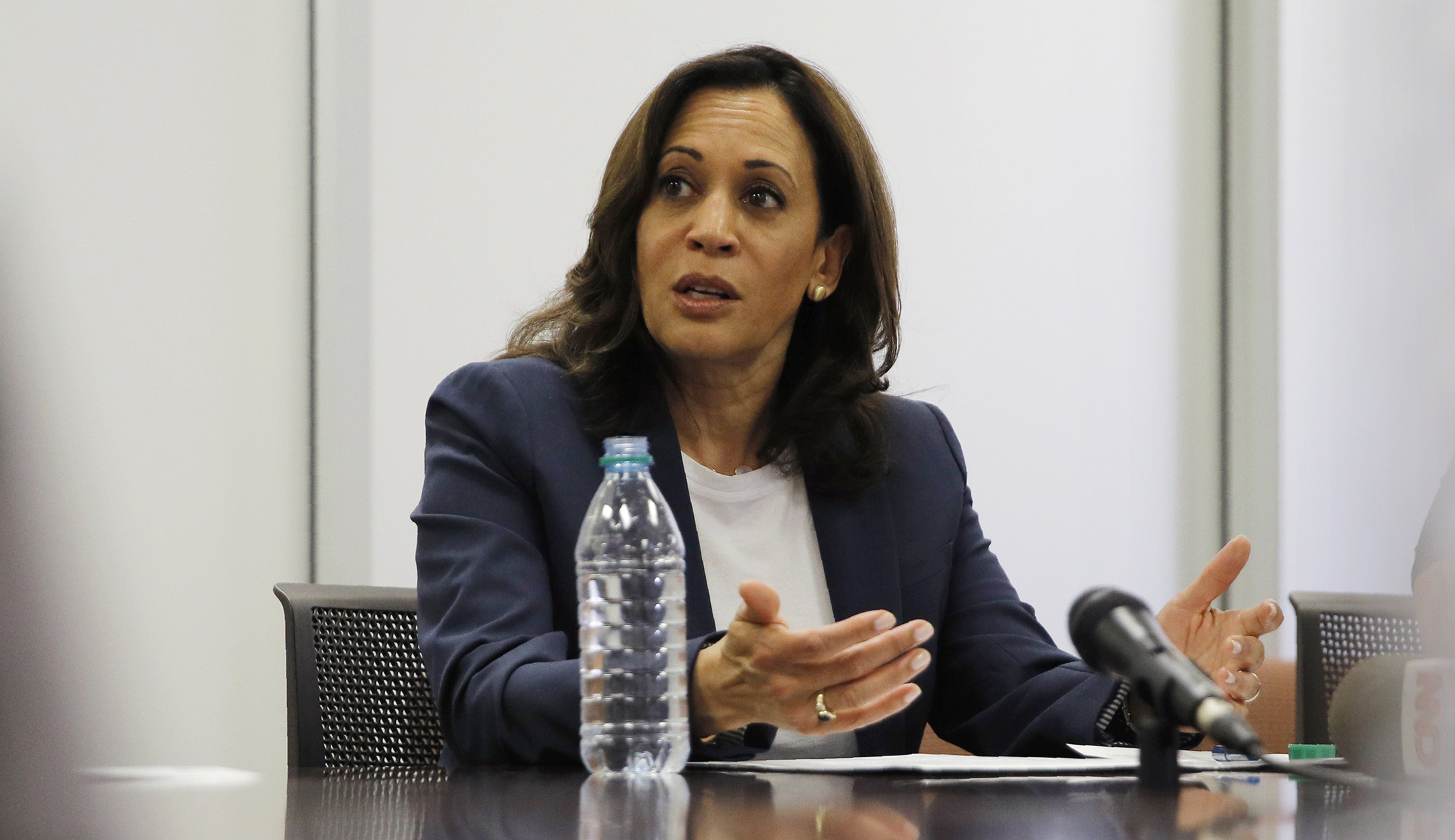
Kamala Harris used borrowed language in her debt forgiveness plan

Published July 30, 2019 2:13pm ET


Part of 2020 Democratic presidential candidate Kamala Harris’ debt forgiveness proposal appears to be have been borrowed.

The U.S. senator for California touted her innovative plan to close the “opportunity gap” experienced by black entrepreneurs on Sunday. But the language used on her website is very similar to that of a nonprofit organization, a think tank, and a government body.

“The Penn Center for Minority Serving Institutions (MSIs) reports, for example, that African American students studying engineering earned only 4.2% of bachelor’s degrees in 2012 across the United States,” the Harris website read as of Tuesday, linking to the research.

Screen Shot 2019-07-29 at 9.33.12 PM.png

The phrasing echoes the United Negro College Fund: “The Penn Center for Minority Serving Institutions reports, for example, that black students studying engineering earned only 4.2 percent of bachelor’s degrees in 2012 across the United States, while white students earned 68.1 percent.”

Screen Shot 2019-07-30 at 8.20.15 AM.png

Elsewhere, the former California state attorney general’s website states that “nearly 40% of African American adults between the ages of 25 and 55 hold student debt, compared to 30% of whites and Latinos.”

Screen Shot 2019-07-29 at 9.49.51 PM.png

The percentages are linked to Urban Institute research but not the Aspen Institute, which wrote a parallel sentence: “African Americans are particularly affected by rising levels of student debt, as almost 40 percent of African American adults between the ages of 25 and 55 hold student debt, compared to 30 percent of whites and Latinos.”

Screen Shot 2019-07-30 at 8.19.13 AM.png

In another spot, the Harris website material is similar to content published by the U.S. Small Business Administration. Her debt forgiveness site links to the Small Business Administration site, but fails to cite it.

“They are more likely to rely on personal credit cards carrying balances than traditional bank loans, and when Black entrepreneurs do get a loan, they are more likely to be offered a smaller amount and pay higher interest rates,” the senator’s website includes.

Screen Shot 2019-07-30 at 8.22.19 AM.png

In comparison, the Small Business Administration writes: “Importantly, Black and Hispanic business owners were more likely to rely on personal credit cards carrying balances, a more expensive financing option than a traditional bank loan, than other groups.”

Screen Shot 2019-07-30 at 8.19.28 AM.png

A Harris campaign spokesman, Ian Sams, said in response to comment request by the Washington Examiner, “These are cited facts.”

This is not the first time allegations of lifted material have surfaced during the 2020 Democratic primary season.

Former Vice President Joe Biden was accused of using “remarkably similar” language in his climate change policy, released last month, to that pitched by environmental groups.

“The paragraph in Joe Biden’s climate plan about carbon capture and sequestration includes language that is remarkably similar to items published previously by the Blue Green Alliance and the Carbon Capture Coalition,” Josh Nelson, a left-wing environmentalist, tweeted.

“Several citations, some from sources cited in other parts of the plan, were inadvertently left out of the final version of the 22-page document,” the Biden campaign responded at the time. “As soon as we were made aware of it, we updated to include the proper citations.”

For the Biden campaign it’s a particularly sensitive charge, since plagiarism allegations helped sink his first White House bid, in the 1988 race.

Harris has previously been grilled for her data citations, misquoting a statistic from Everytown, a gun control group. The former San Francisco district attorney, on her website, claims: “More than 1 million women in America today have been shot or shot at by an intimate partner.” Everytown, however, referring to other research, states the number is less than 1 million.

Last month, likeness between Beto O’Rourke’s voting rights proposal, in which he outlines his strategy to stop Americans having to “jump through hoops to exercise their fundamental right to vote,” and a 2014 statement from former President Barack Obama were identified.

Cory Booker wrote in a Medium post in March about how there are “more African American men under criminal supervision today than there were enslaved in 1850,” an idea reportedly first floated by Michelle Alexander in her 2010 book The New Jim Crow.

Harris’ debt relief proposal was initially panned on the weekend when she tweeted she would “establish a student loan debt forgiveness program for Pell Grant recipients who start a business that operates for three years in disadvantaged communities.” She failed to say it was part of her plan to invest in historically black colleges and universities and African American entrepreneurs, sparking derision for all of the stipulations.

“I want to thank everyone for your feedback and clarify some confusion. We have an opportunity gap in our country, and one thing we need to do is support Black entrepreneurs,” she tweeted in reply to the flap.

[Opinion: Kamala Harris’ weirdly specific student debt forgiveness fiasco]
