
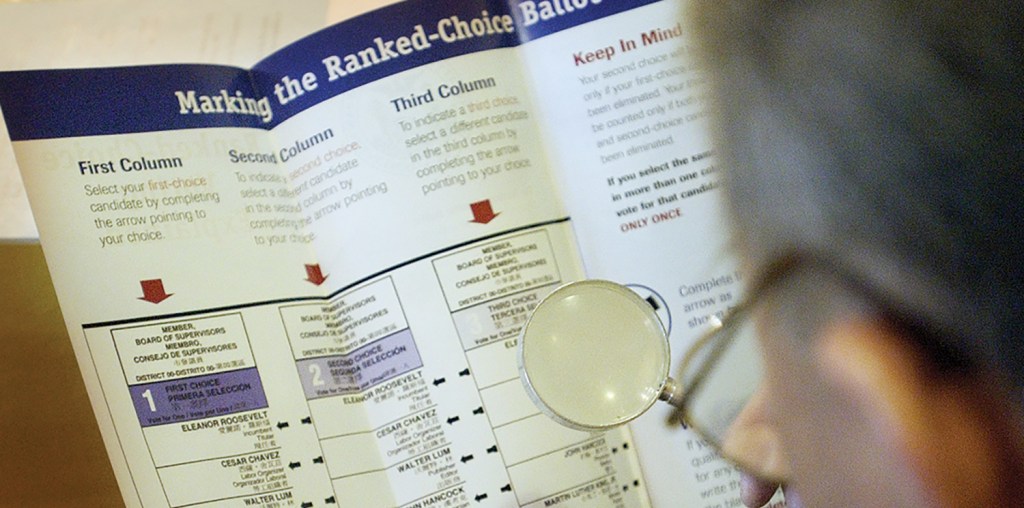
The latest fad in American politics didn’t originate with a telegenic activist or a trending hashtag on Twitter. “Ranked-choice voting,” as it’s called, is instead the stuff of academics and election reformers more interested in political process than political food-fights. But its advocates are no less passionate about the potential of their cause than followers of an alluring leader or cultural movement—in fact, they framed the recent adoption of their idea in one of the nation’s least-populous states as a seismic event that could change the country for the better.
Ranked-choice voting (RCV) replaces typical election formats in which voters select just one candidate. With RCV, voters rank their options: In a five-way race, for example, voters could rank candidates one through five, or fewer than five, if they chose. If a candidate finishes with a majority of number-one rankings, the election is over. If no one does, most RCV elections proceed to “instant runoff,” wherein the last-place finisher’s votes are reallocated to the remaining contenders. If a ballot for the fifth-place finisher chose Oprah as a second choice, the ballot becomes a first-place vote for Oprah. The process eliminates candidates and redistributes votes as necessary until there is a winner.
Real journalism.Trusted by millions.
Unlimited access to in-depth reporting, expert analysis, and the stories that shape our country.
Already a member? Log in